
Axis of Empire: A History of Iran-US Relations - Afshin Matin-Asgari
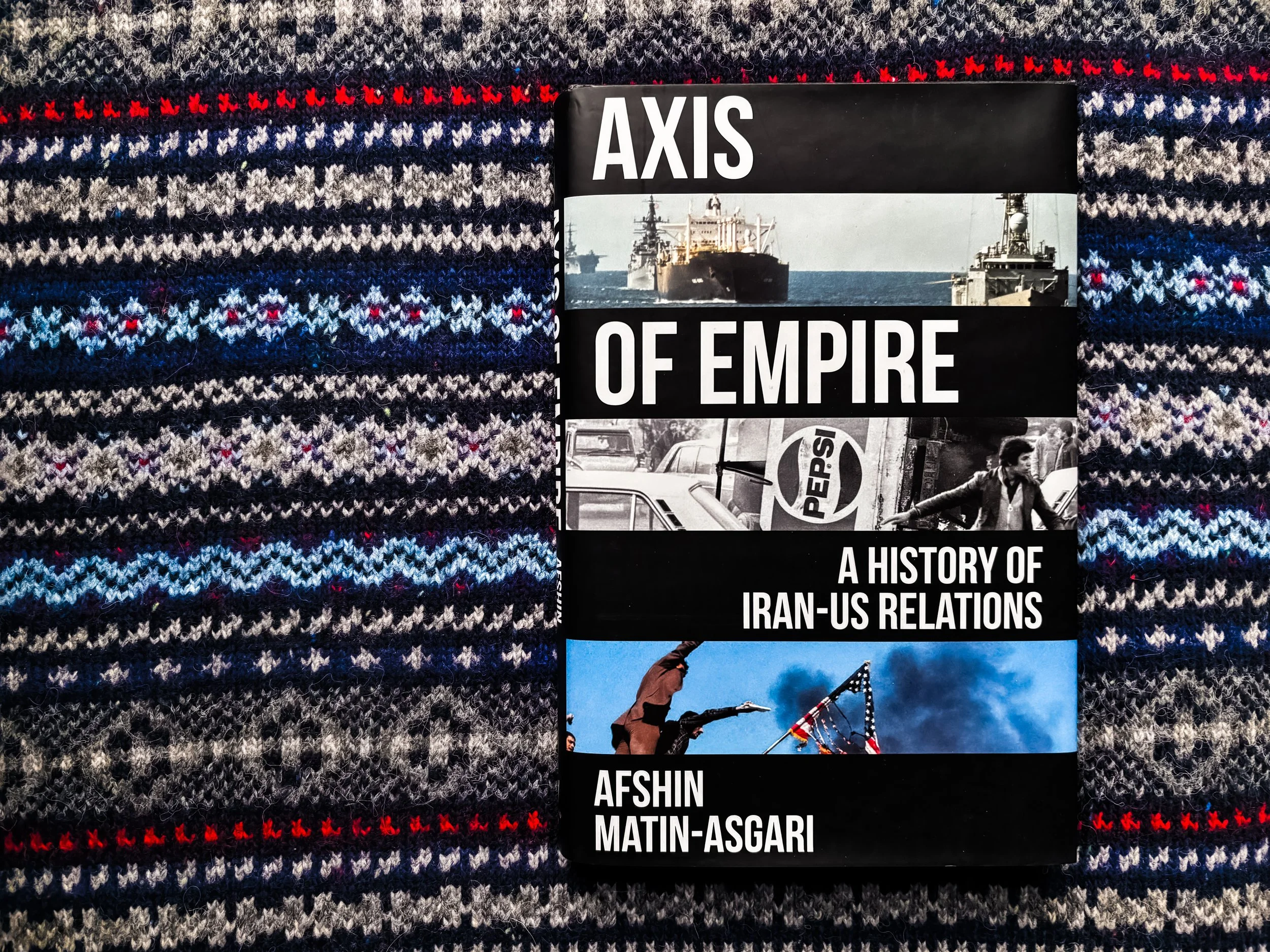
Published in 2026 by Verso, London, UK, and New York, NY
304 pages
ISBN:9781839762260
Since February of this year, the United States and Israel have waged a sustained war on Iran, beginning with a massive wave of airstrikes (nearly 900 in the first twelve hours) that killed senior leadership, including Iran’s supreme leader Ali Khamenei, and struck military and civilian infrastructure alike. Iran’s retaliatory missile and drone attacks have hit Israel, U.S. bases, and regional countries, while the conflict has already killed thousands, as estimates range from roughly 2,000 to over 3,500 dead in Iran alone, including large numbers of civilians. Even as of writing, the war continues to escalate, with U.S. strikes on critical oil infrastructure, Israeli targeted assassinations, and fragile ceasefire talks repeatedly collapsing.
Despite Iran’s geographic advantage with its mountainous terrain and its control of the Strait of Hormuz, the U.S. has recklessly engaged in a costly and unnecessary war in the region, achieving little else than driving up everyday costs for American citizens while raining death and destruction on Iranian citizens. Yet, when looking at the long scope of history between the two countries, the current catastrophic and violent war in Iran seems less like a sudden provocation than the accumulated product of a century-long imperial relationship between Iran and the West.
Over the past half-century, Iran has been a distant bogeyman in the realm of U.S. foreign policy. The reductionist image of Iran as a backwards, theocratic, villainous, and wholly irrational nation that is wholly bent on the destruction of the West has long dominated the popular imagination of Americans, especially in the aftermath of the War on Terror. Yet, few of us are aware of the long history of US interventionism and the geopolitical hubris that has led us to our current crisis and stalemate in negotiations in the region today. In his 2026 book, Axis of Empire: A History of Iran–US Relations, Iranian historian Afshin Matin-Asgari offers a sweeping and ambitious reinterpretation of the historical relationship between Iran and the United States, tracing its evolution from early cultural encounters in the nineteenth century to the entrenched antagonisms of the present.
Overview:
Beginning with the Presbyterian missionaries and educators that were sent from America to Iran in the 19th century to the present-day wars in the region, the book dismantles the idea that tensions and antagonism between the U.S. and Iran are ancient or inevitable. Instead, Matin-Asgari shows how they were made through a series of foreign policy decisions, military interventions, and shifting alliances that consistently privileged American strategic and economic interests in the region. From World War II to the present day, US interests in Iran have been focused on oil, resulting in direct American aid to Iran during the Shah’s rule while levying heavy sanctions and applying military pressure against the post-Revolutionary regime. The turning point in all of this, as expected, is the 1953 Iranian coup d'état, where a democratically elected government was overthrown with U.S. backing to secure geopolitical stability and protect Western access to oil.
From there, the book traces the consolidation of U.S. influence under Mohammad Reza Shah Pahlavi, whose regime embodied the contradictions of Cold War modernization as the nation rapidly developed while economic and social inequality and repression deepened. Matin-Asgari is particularly adept at showing how these contradictions accumulated under the increasingly brutal and unpopular Shah, producing the instability necessary for revolutionary rupture in 1979. Crucially, he resists the hackneyed hindsight that treats the Iranian Revolution as inevitably leading to the Islamic Republic. The revolution, in his telling, was crowded with possibilities, including leftist, nationalist, and Islamist variations, but only one of which ultimately prevailed under Ruhollah Khomeini. Despite anti-imperialist rhetoric, the Islamic Republic would go on to jail and commit violence against secular and Islamic leftists alike, as the increasingly reactionary government would work to consolidate power amongst the clerical elites.
After the Revolution, despite anti-American/imperialist rhetoric and bumps in the road such as the Iranian Hostage Crisis, it was widely accepted that the Islamic Republic posed little credible threat to the U.S. or Israel, and that its policies and actions were, at times, beneficial to American interests (such as the Iran-Iraq War). Israel’s increasing belligerence against Iran, however, has caused the United States to label Iran as a pariah state, and increasing sanctions against the Islamic Republic have only worked to harden the government against American interests and serve as a justification to crush dissent within its borders. These sanctions primarily hurt Iranian citizens, rather than serve as a form of pressure against the government of the Iranian Regime.
Throughout this work, Matin-Asgari rejects both liberal narratives of benign American engagement and typical culturalist explanations that reduce the conflict between the two nations as a result of an ambiguous civilizational difference. Instead, he foregrounds the roles of imperial power, political contingency, and the mutually constitutive dynamics of state antagonism that have driven the U.S. and Iran into an ever-deepening death spiral, which has led to the current war between the two countries. Each country has turned the other into a boogeyman that works to justify increased military action and spending for foreign engagements, while also cracking down on dissent at home. In the end, Matin-Asgari argues that Iran must take responsibility for its contributions to this impasse instead of reacting against its enemies, while the U.S. must realize that crushing sanctions do not yield positive results and simultaneously rein in the belligerent actions of its closest ally in the region, Israel.
Deeper Dive:
In the First Chapter, Matin-Asgari establishes the early contacts between America and Iran from the mid-19th century to the Second World War. These initial relations were primarily through Presbyterian missionaries, educators, and advisors in the region, who mostly catered to wealthy families. While Americans largely held Orientalist assumptions about the wider region, he notes that, compared to British and Russian imperial powers at the turn of the century, Americans were initially seen as relatively distant and neutral outsiders. He details how, in the failure to evangelize the population, these missionaries facilitated cultural exchanges through providing education and health care to rural areas in Iran, generating goodwill and gradually opening the door to economic and political entanglement in the region. Thus, while U.S. influence in Iran began softly, these initial contacts laid the groundwork for deeper interventions in the decades to come.
After surveying nearly a century of Iran-US relations in the first chapter, in Chapter Two, Matin-Asgari narrows the timeframe of his analysis to a single decade: from 1943 to 1953, culminating in the overthrow of Iranian Prime Minister Mohammad Mosaddegh. Even as the Soviet Union became a rising power during these decades, Matin-Asgari argues that its policy toward Iran was much more hands-off in this decade, while America became much more involved. The discovery of oil in the region meant that Iran’s geopolitical importance was growing, as Britain’s grip on control in the region began to wane in the face of the rising tide of Iranian nationalism and communism.
During World War II, Iran’s geographical location between the USSR and the Persian Gulf and its access to a vast treasure trove of oil made it a critical asset in the tide of the war, and the region was occupied by the Allied Powers. As the Iranian socialist party (Tudeh) gained momentum in the waning years of the war, the Western powers began to worry about its closeness to the Soviet Union, especially as the Tudeh party sought land reform and the nationalization of the oil industry, which had been a demand by working-class coalitions since the 1920s.
As such, during this time, the United States positioned itself as a neutral mediator between Britain, the Soviet Union, and the nascent nationalism that was growing in the region. This nationalism began to grow exponentially as the National Front (a coalition that spanned the political spectrum from right-wing conservative Islamists to leftists who had broken away from the Tudeh party), led by Mohammed Mosaddegh, led the Iranian parliament to nationalize the oil industry. When Mosaddegh rose to the role of Prime Minister, Britain and the United States began to work together to protect their interests in the region.
This culminated in the CIA-backed coup against Mosaddegh in 1953, which shattered any notion that America was merely acting as a neutral third party in the region. As Matin-Asgari writes, “From the outset, the American agenda prioritized the Iranian Army’s use against domestic insurrectionary ‘threats’…Thus, despite occasional secondary considerations, US policy toward Iran was fundamentally and systematically antidemocratic from the 1940s onward…Moreover, American assistance in Iran’s economic development was always subordinate to concerns about oil and political control” (61-62).
He also argues that Mosaddegh made a series of critical missteps, pushing back against British imperialism while remaining cozy with American interests, which blinded him to how both the Eisenhower and Truman administrations actively undermined him during their attempts to nationalize the oil industry, setting them at odds with the UK. Matin-Asgari argues that Mosaddegh vacillated and only offered half-measure responses, such as refusing to remove the US-backed Military Assistance Advisory Group (MAAG) from the ranks of the Iranian army (which would later work to overthrow him) and accepting Truman and Eisenhower's support at face value, not realizing that this was a gambit for America to squeeze into and break up the British monopoly of oil in Iran and gain a crucial economic foothold in the region. Additionally, Mosaddegh failed to build an effective nationalist movement, often alienating the communist Tudeh party.
Codenamed Operation Ajax, the plot to overthrow the democratically elected leadership of Iran began in 1953. CIA operative Kermit Roosevelt convinced a nervous Shah to take control of the military. Disinformation and propaganda campaigns were waged against Mosaddegh, and on August 13, the Shah filed a motion to dismiss Mosaddegh from his position. When the military coup began, despite being warned by the Tudeh party of the insurgent networks within the military and capturing the military officers who were sent to arrest him, Mosaddegh refused to declare Iran a republic amidst popular protests in Tehran in favor of such an action. Instead, he mistakenly took the American ambassador’s advice and assured the Shah (who had frantically fled the country) that he would not try to usurp the throne.
During this time of unrest, the CIA had hired thugs to wage pro-Shah demonstrations in response to the support that Moseddegh was receiving. Clashes broke out between the protesters, and after days of street fighting that left around 300 people dead, the capital city of Tehran was in chaos. Instead of seizing power, Mosaddegh banned anti-Shah and anti-American demonstrations in an attempt to quell the fighting. By suppressing this mass movement in support of him, Mosaddegh ensured that his defeat was all but inevitable, and on August 20th, he surrendered to the pro-Shah military government.
In the wake of Mosaddegh’s overthrow, an American/UK-backed general named Fazlollah Zahedi became the new prime minister and formed a government that greatly expanded the powers of the Shah. Mosaddegh was then convicted of treason in a rushed trial and kept under house arrest, where he remained until his death on March 5, 1967. In the aftermath, an international consortium of American and British oil companies worked together to negotiate a revenue-sharing deal with the Shah that gave them contracts to manage and refine Iranian oil. As such, the coup to overthrow Mosaddegh marked a decisive shift to direct U.S. political intervention in Iran, which prioritized direct strategic control over respecting the will of the Iranian people and democratic processes.
In Chapter Three, Matin-Asgari recounts the process of how the United States built a monarchist client state in Iran under the rule of the Shah during the 1950s and 60s. The Shah drastically increased military spending, relying on an enormous influx of funding from the United States to build the largest Navy and one of the most well-equipped Air Forces in the region. Additionally, the Shah used his expanded powers and revenue from oil deals to compose the incredibly repressive state security apparatus, known as SAVAK, which was also trained in repressive tactics and torture of political dissidents by agents from the US, UK, France, West Germany, and Israel.
Matin-Asgari points out that from Republican administrations such as Eisenhower and Nixon to Democratic presidents such as Kennedy and Carter, American foreign policy toward Iran was one of a long, continuous strategy rather than any sense of rupture. Each of these administrations sought to strengthen the strength of the Shah and his autocratic rule, especially to act as a bulwark against any perceived threat from the Soviet Union. The Shah, in Matin-Asgari’s framing, “was not a ‘puppet,’ merely dancing to Washington’s every tune, [but] he always acted within the ambit of US strategic interests” (133).
He also highlights the various anti-Shah protests that emerged during this period, especially on college campuses, as the Shah traveled throughout the United States and was received by successive American presidents. While there were social reforms, Matin-Asgari argues that the White Revolution borrowed the language and some of the policies from the left without a genuine commitment to democracy. All the while, American corporations, including IBM, Pepsi, and the military industrial complex, made vast profits from the Shah’s wealth, which was derived from oil. Matin-Asgari also points out how, while institutions such as the Peace Corps did much to foster genuine relationships and connections in Iran (though it was always viewed with a small modicum of suspicion, even though Matin-Asgari insists that it was not a vessel for the CIA), American cultural hegemony worked its way into Iran’s education system, book publishing, and pop culture mediums such as film and television. This close alliance between the United States and the Shah angered the political left and clerical right alike, fueling popular resentment among these groups.
In Chapter Four, Matin-Asgari highlights the gradual transformation of Iranian society during the mid-60s and 70s that led to the overthrow of the Shah and the institution of the Islamic Republic under Ruhollah Khomeini. As such, while it has often been cast as a “golden age” of peace and prosperity, this decade saw the Shah become increasingly dictatorial, leading to a complex, multi-faceted uprising against him. Coupled with the Carter administration’s inept and half-measured response, the fall of the Shah became a turning point in U.S.-Iran relations.
During the era of relations between the Shah and the Nixon/Kissinger administration (1968-1974), the Shah continued to spend billions of dollars on US military equipment and, aligning itself with Israel, often intervened in other countries, such as funding Kurdish rebellions in Iraq and defending the Sultanate in Oman. With Nixon’s fall, however, there was increased scrutiny on the Shah’s oppressive and authoritarian policies in Iran. Years of brutal repression of dissent and economic blunders by the Shah, which had previously been encouraged by officials in Washington, ensured that peaceful revolution was not a viable possibility, paving the way for the eventual revolutionary fervor that had amassed during this time.
This was further exacerbated by the wavering and mixed messaging that the Carter administration provided to an increasingly nervous and paranoid Shah, as the Carter administration genuinely did not know what to do in the wake of the mass protests that were rising against the Shah. The U.S. started to create connections with the Islamic opposition, led by exiled cleric Ruhollah Khomeini, and eventually, Carter advised the Shah to step down from power. Thus, amid a wave of increasing labor strikes and violence in the streets of Tehran, the Shah fled the country for Egypt. On Feb 1, 1979, Khomeini landed in Tehran, and his address “masterfully blended modern revolutionary rhetoric with vague references to Islam, hitting hard at US support of the shah and appealing to the military to join the revolution” (185). Thus, the Shah’s regime completely disintegrated as violence continued to define the transitional, provisional caretaker government, and the beginning of the Islamic Republic dawned in the following weeks.
In Chapter Five, Matin-Asgari explores the escalating tensions and conflicts over the first two decades of the Islamic Republic of Iran, including the Iran Hostage Crisis, the Iran-Iraq War, and the increasing institutions of sanctions against Iran by the U.S. First, Matin-Asgari explains the rise of Khomeini and lays out his position in the debate of whether the revolution was rooted in anti-imperialist or petite bourgeoisie currents (196). Rather than holding up anti-imperialism as the gold standard for evaluating the progressiveness of the political regime, Matin-Asgari argues that the Islamic Republic is both anti-imperialist and reactionary.
While the Revolution succeeded in removing the Shah from power, forming a stable post-revolutionary state proved immensely difficult. Splintering factions made up of 1) hardline fundamentalist Islamic clerics, 2) secular and Islamist leftists, and 3) nationalists (both secular and religious) often came into conflict with one another. While Leftists and nationalist factions would make economic demands and call for a cessation of military cooperation with the U.S., the hardline clerical establishment attempted to maintain ties to America and its armed forces in the region. As such, during the first year of its existence, the clerical establishment of the Islamic Republic coalesced to form a constitutional dictatorship, in which power was concentrated at the top through the Supreme Leader Ayatollah Khomeini, followed by unelected clerical institutions. While borrowing anti-imperialist and leftist rhetoric, the regime consolidated its reactionary vision of the Revolution by crushing workers' councils, censoring the press, purging the Left from college campuses, and stripping rights from ethnic minorities and women.
When the blundering Carter administration admitted the Shah into the U.S. for medical treatment, the hardline clerical party saw its chance to strike. In an attempt to outflank the leftist, anti-imperialist contingent of the Iranian political opposition, Khomeini’s Islamic Republican Party seized the American Embassy in Tehran and took 66 Americans hostage, thus sparking the infamous Iranian hostage crisis that would sink the Carter administration. Over the next 444 days, President Carter imposed heavy sanctions on the Iranian government, which were designed to hurt the people of Iran and pressure the government to release the hostages. Their release occurred only minutes after Carter left office and Reagan was inaugurated as President of the U.S. on January 20, 1981.
In the eyes of the American state, the Iranian government was now a pariah state, which Khomeini gladly accepted, as he pitched his regime as anti-imperialist and anti-American. As Matin-Asgari writes, “The Iranian Revolution and the hostage crisis marked a transition moment when the simmering right-wing global drift of the late 1970s morphed into the restoration of aggressive US global hegemony during the 1980s. At the same time, the Iranian Revolution inaugurated a new geopolitical era when militant Islam, or Islamic fundamentalism, would replace communism as the chief nemesis to America’s global dominance” (219). The crisis would ultimately set the stage for the decades of hostility that ensued between the two countries, as it kicked off the pattern of increasing sanctions against the country, which would only work to reify and deepen the Iranian government’s opposition to American pressure.
The crisis also worked to isolate Iran from the international community, weakening it to the point of allowing Iraq to invade, leading to a bloody eight-year war. Matin-Asgari details the Iraq-Iran war in two distinct phases: 1) Iran fighting back against Iraqi aggression during the first two years, and 2) Iran continuing to fight after it had redefined the land that Iraq took during the following six years. As Iraq began to lose the war, the U.S., Britain, Germany, and the Gulf states provided financial and military aid to Saddam Hussein in Iraq. The U.S. ended up funding both sides of the war in the hopes that the countries would eventually tear each other apart (or, as a CIA agent said, “We just wanted them to kick the shit out of each other”) (219). This included the infamous Iran-Contra scandal, in which the Reagan administration covertly trafficked arms and munitions and sold them to Iran to fund the right-wing Contras in Nicaragua, who were fighting the socialist Sandinistas (an illegal venture that would result in zero legal consequences for any Americans involved, as George H.W. Bush, who was vice president at the time, pardoned those involved in the final days of his presidency).
Meanwhile, within Iran’s borders, the war served as a means to escalate repressive tactics and clamp down on political dissent, as the increasingly authoritarian military state killed thousands of both religious and secular leftists during the decade. Meanwhile, while the 1990s were witness to a period of relative de-escalation and political reform/liberalization between Iranian President Mohammad Khatami and U.S. President Bill Clinton, the decade also included the intensification of Iran’s military build-up, especially in the wake of the increasing privatization of industry and market reforms (a process that would find parallels with the post-Soviet market liberalization). The Islamic Revolutionary Guard Corps (IRGC) became one of the main beneficiaries of Iran’s increasingly black-market-based capitalist economy (commonly referred to as “political capitalism”), which bypassed sanctions and allowed those within the political fold to enrich themselves at the expense of the Iranian people.
In Chapter Six, Matin-Asgari turns his attention to the intensification of tensions between the US and Iran after 9/11. This period is marked particularly by an increasing influence of Israel on U.S. foreign policy in the region. The antagonism that the U.S. targeted toward the Iranian regime is based on three central claims, often touted by Israeli intelligence: 1) Iran is pursuing a nuclear program, 2) Iran is spreading its military presence outside its borders by supporting militant Lebanese and Palestinian groups, and 3) Iran is actively developing a ballistic missile program, ultimately aiming to build nuclear arms to eradicate Israel and its allies in the region. Matin-Asgari recounts how the U.S. (primarily through Kissinger) supported the shah’s development of Iran’s nuclear program, as well as Iran’s offer of assistance to the U.S.’s invasion of Afghanistan in the wake of 9/11. This changed when Israel accused Iran of sponsoring international terrorism, driving a deepening wedge between the U.S. and Iran’s already fractured relationship.
Matin-Asgari makes the argument that sanctions, far from weakening the regime, have only served to strengthen power in the core of the state while hurting the Iranian people. He details the mass protests that were sparked in the wake of Mahmoud Ahmadinejad’s reelection in 2009, which was suspected to have been won due to widespread electoral fraud. These protests were met by brutal repression and crackdowns from the state, as the militia shot into crowds and placed dissident leaders under house arrest. This put Obama in a difficult situation, as he had to balance vocally supporting the dissenters while also secretly negotiating with the regime that was brutally suppressing them.
Neoconservatives and liberal war hawks in both the U.S. and Israel (including Secretary of State Hilary Clinton) called for more “crippling” sanctions on Iran, which were passed in 2010. In addition, Israel outright assassinated four nuclear scientists and the head of Iran’s ballistic missiles program, while the U.S. aided in additional cyberwarfare tactics. These sanctions further damaged Iran’s economy, but still did not push the country into outright regime change. Having just come out of the 2008 economic crisis, Obama did not want to join Israel in its ambitions to go to war with Iran, and by 2012, Obama and Netanyahu’s relationship became increasingly strained, while Congress largely sided with Netanyahu (254).
Thus, Matin-Asgari recounts how the second-term Obama administration attempted to broker better relations with Iran, as Obama replaced the hawkish Clinton with John Kerry, who advocated for a more diplomatic approach to Iranian relations. Obama’s attempt to forge better relations with Iran culminated in the Joint Committee Plan of Action (JCPOA). In exchange for Iran agreeing to keep uranium enrichment within limits for peaceful use, allowing inspections of nuclear facilities, and cutting down on the number of centrifuges, international sanctions related to their nuclear program and oil exports would be eased, while keeping in place sanctions related to ballistic missile programs, human rights violations, trade, and banking (256).
While AIPAC launched a massive campaign to kill the bill, along with a certain contingent of the Iranian diaspora, especially a vocal monarchist minority that has the backing of right-wing groups and media, both in the US and Israel. Despite these forces, the opposition could not garner enough support from Congress to override Obama’s veto power. In its passage, it showed that U.S. diplomacy toward Iran could work, as the Islamic Republic’s leaders could be accommodating to U.S. demands.
Republicans opposed to the bill, however, emphasized that the agreement was only temporary and could be removed by another president with the stroke of a pen. This is exactly what occurred as Trump took office in his first term, and he officially withdrew from the JCPOA in May 2018, believing that he could secure “a better deal” from Iran (spoiler: he could not). Matin-Asgari discusses Trump’s allyship with Netanyahu, who constantly engages in warmongering with Iran, which has led to multiple wars in the region and Israel killing leaders of Iran’s government, military leaders, and militia fighters in Lebanon.
By imposing devastating sanctions on Iran in hopes of angering the majority of the population to rise against their government, the policies of Trump and Biden have only led to more brutal crackdowns in Iran against dissent and worsened conditions for the people of Iran. Discontent within the Islamic Republic has been growing. Still, sanctions have only worked to solidify and harden the regime against external threats, as Iran uses these increasing sanctions against it as justification to protect itself against these economic and military aggressions, particularly from Israel’s bombing campaigns against Iran directly (as in the Twelve-Day War in June of 2025) and southern Lebanon.
In his Conclusion, Matin-Asgari summarizes each chapter of the book and attempts to synthesize these threads into a cohesive historical narrative. In the end, he argues that Israel alone will not be able to bring down the Islamic Republic’s regime, unless it has direct military intervention from the United States (which he, incorrectly, viewed as highly unlikely). In the end, he writes,
Regardless of what the United States and Israel might do, the Islamic Republic must accept responsibility for its own contribution to the current impasse and take the initiative to chart a new course, instead of following the worn-out strategy of merely reacting to what its enemies impose. This would be a tall order of major foreign and domestic policy changes, which, even if pursued, will not yield results unless the United States reciprocates by modifying its Iran policy of crushing sanctions and threats of war, while reining in Israel’s reckless belligerence toward Iran. (286)
Commendations:
There are several notable strengths to Matin-Asgari’s account of U.S.-Iranian relations. One of the book’s most significant contributions is its sustained attention to asymmetrical power relations between these two nations. Over the past century, the United States has been a decisive force shaping Iran’s modern trajectory, particularly in moments of crisis such as the 1953 Iranian coup d'état. Matin-Asgari convincingly situates this event within broader logics of Cold War geopolitics and capitalist stability, demonstrating how strategic concerns such as access to oil and the containment of perceived leftist threats overrode any rhetorical commitments to democratic governance.
Importantly, however, Matin-Asgari avoids falling into crude economic determinism. Imperialism in his account is a historically mediated process, often operating through competing institutions, alliances, and contingent decisions rather than as a simple expression of structural necessity. Unlike purely geopolitical accounts that too often dominate the American discourse about Iran, this book traces the evolution of the relationship between the U.S. and Iran from early missionary activity and educational exchange to full-scale imperial entanglement. This is important because it shows how soft power precedes hard power, which can often be underemphasized in more strictly orthodox Marxist accounts that are narrowly focused on economics. By framing it in this way, Matin-Asgari also deftly corrects the standard liberal narrative that so often portrays U.S. policy as merely reactive or wholly benevolent while avoiding the trap of portraying Iran as a purely passive political subject.
Another important insight that Matin-Asgari points out concerns the mutual reproduction of hostility between Iran and the United States. He persuasively argues that this series of antagonisms has served important legitimating functions for both states. For the United States, Iran’s brutal crackdowns on dissent within its own borders and military assistance to resistance groups in Lebanon end up justifying U.S. intervention and sanctions, as Congress constantly portrays Iran as a permanent, existential threat to the Western world. For the Islamic Republic, these crippling sanctions end up hurting average Iranian citizens the most while working to consolidate internal political authority and legitimacy through anti-imperial rhetoric.
As such, the hostility between Iran and the United States has become, in a sense, self-sustaining. The antagonism between the two countries is real (and is often stoked through Israel’s belligerent actions in the region), but it is also politically useful for those in power, as these hostilities work as a feedback loop in which both states find reasons to keep the conflict alive to legitimize their own power. On both sides, having an all-powerful external enemy serves to cover over and stabilize the internal contradictions of each state. This intractable position helps to explain the current impasse that exists in the negotiations over the end of the war.
Additionally, I also found Matin-Asgair’s insistence on contingency and political struggle to be compelling, particularly in his treatment of the Iranian Revolution. By reconstructing the multiplicity of political actors involved, which run across the political spectrum from Islamists, Marxists, and nationalists, Matin-Asgari challenges many of the common teleological accounts of the Revolution that portray the rise of Ruhollah Khomeini as inevitable. By recognizing the complex social and political webs that made up the final years of the Shah’s rule before his overthrow, Matin-Asgari restores historical agency to these competing social forces and underscores the radical openness of revolutionary outcomes. The Islamic Republic is not the natural culmination of Iranian history, but was simply one contingent resolution among many possible alternatives.
Finally, as a religious studies scholar, I appreciated how Matin-Asgari situated Shia Islam in Iran within a specific historical and political context. He rejects common essentialist depictions of Islam as inherently anti-Western or irrational, and instead treats it as a flexible political language. During the Revolution, religious discourse in Iran was capable of articulating anti-imperial and populist grievances in a language that resonated across social strata and mobilized mass participation, ultimately helping to consolidate a new ruling order. However, it has also been used as a justification to crack down on popular dissent and stabilize an oppressive, authoritarian government structure, as secular and Islamic leftists have often been the target of mass arrests and violent countermeasures by the state. Religion is not merely a private belief, but often serves as a mediating structure that can aid or hamper other streams of social and political struggles. In this way, Matin-Asgari rightly highlights the competing ideological currents that existed during the Revolution and continue to the present day, which reframes the Revolution as a process of contestation rather than a singularly reactionary “Islamic” event.
Critique:
On the other hand, for all its strengths, Axis of Empire sometimes pulls its punches. Most significantly, its engagement with class analysis remains underdeveloped. While Matin-Asgari points out the various social groups that comprise Iranian society and resistance, there is little systematic theorization of class structure, class formation, or the dynamics of capitalism under Mohammad Reza Shah Pahlavi. The Shah’s development model is described, but not analyzed as a form of dependent capitalism with its own internal tensions and limits that led to its collapse. Similarly, the complex interplay between the bourgeoisie, the clergy, the urban proletariat, and rural populations is briefly acknowledged, but Matin-Asgari does provide a rigorous analysis of these dynamics. As such, we are not fully given the tools to understand how these different classes interacted to produce revolutionary change.
A related shortcoming concerns the book’s limited engagement with global capitalism as a structured totality. Although oil and geopolitics figure prominently in Matin-Asgari’s account, his narrative account stops short of situating Iran within a broader world-system characterized by uneven development and transnational capital flows. His analysis remains largely bilateral, privileging state actors over systemic economic processes. A more explicit integration of political economy would have strengthened the account of imperialism and its enduring effects.
Furthermore, while Matin-Asgari’s framework of mutually reinforcing hostility is illuminating in describing the current state of U.S.-Iranian relations, it risks flattening the profound asymmetry between a global hegemonic power (the U.S.) and a heavily-sanctioned regional power (Iran). If anything, the ongoing war underscores precisely this dynamic. The current conflict is not just a bilateral confrontation between two equal powers, but a node in a wider order of military power, energy markets, and geopolitical strategy. The Strait of Hormuz has become a flashpoint for global oil flows, as Iran has taken control of the Strait to force the U.S. to come to the table and accept concessions closer to the JCPOA than anyone in the Trump administration would dare to admit. Meanwhile, the IDF has expanded the war into Lebanon and beyond, which continues to serve as a deterrent for brokering an end to the war. The scale and speed of destruction make clear that this current impasse is not simply about the relations between two states, but rather the violent reproduction of a global neoliberal order that is struggling to maintain its stability and legitimacy.
Finally, as a religious studies scholar, I found the book’s treatment of Islam, while refreshingly non-essentialist, comparatively thin concerning theology and institutional analysis. Key Shai concepts, such as clerical authority and the doctrine of guardianship associated with Ruhollah Khomeini, are not explored in sufficient depth to illuminate their transformative role in Iran’s modern state formation. Nor does the book adequately examine the material infrastructures of religious power, including seminary networks, endowments, and clerical ties to mercantile classes. Consequently, Islamism at times appears primarily as a strategic language of mobilization rather than as a coherent ideological project with its own internal logic.
The relative absence of the average, day-to-day experience of Iranian citizens in Matin-Asgari’s account further narrows his analysis. By focusing predominantly on elites and major political events, his narrative leaves aside the everyday practices and experiences through which Islamic religious meaning is produced and contested by more secular citizens in Iranian society. This omission limits the extent to which religion can be understood as an embodied and socially embedded phenomenon in Iran, rather than solely as an instrument of political articulation used for either emancipatory or reactionary purposes in Iranian political and social discourse.
Conclusion:
Overall, Axis of Empire is an accessible and well-documented contribution to the history of U.S.-Iranian relations, tracing its contours over the past century and a half. While his limited examination of class dynamics and the finer contours of Islamic religious expression in Iranian society leaves the narrative a bit underdeveloped theoretically, Matin-Asgari has still produced a thought-provoking introductory text for the average reader. He largely succeeds in opening new avenues for critical inquiry, and this work undoubtedly serves as a foundational text for scholars and newcomers alike seeking to understand the complicated and deeply entangled history of Iran and the United States.
As the war has waged on for four months with no end in sight, Trump’s vision of a quick victory (reminiscent of his kidnapping of Venezuelan president Nicolás Maduro just a month before the start of the strikes and assassination of Iranian leadership) has clearly evaporated. The war against Iran has been a total strategic blunder and defeat for the U.S. and Israel, as Iran has leveraged its geography and control of the Strait of Hormuz to shock the global economy, skyrocketing the price of oil and other commodities. At best, a negotiated agreement would likely be a similar or even worse deal than the JCPOA.
Once again, the U.S. has further damaged its hegemonic position as a global power as it has been dragged into failed military conflicts in Iraq, Libya, Afghanistan, Lebanon, and now Iran. Even from a non-radical liberal standpoint, it is abundantly clear that American (and as an extension of American imperial interests, Israeli) hubris has reached a breaking point, as their belligerence in the region has disrupted the global economy, weakened international alliances in Europe and the Gulf States, and further opened the door for China and Russian interests to be furthered in the region.
Yet, as a progressive American, I would be remiss to say that this was unforeseeable. As Matin-Asgari illustrates, American intervention in the region has consistently bred backlash, as the forces of empire generate the very resistance it then seeks to crush. Yet, in all of the discourse regarding the outcome of which states win and lose, we must remember that the ultimate goal of any negotiated agreement must focus on minimizing the devastating effects of war on civilian populations, no matter where they reside. As such, for readers looking to move beyond the typical clichés that dominate mainstream discussions of Iran, Matin-Asgari’s book is an essential starting point.