
The Cameroon War: A History of French Neocolonialism in Africa - Thomas Deltombe, Manuel Domergue, and Jacob Tatsitsa
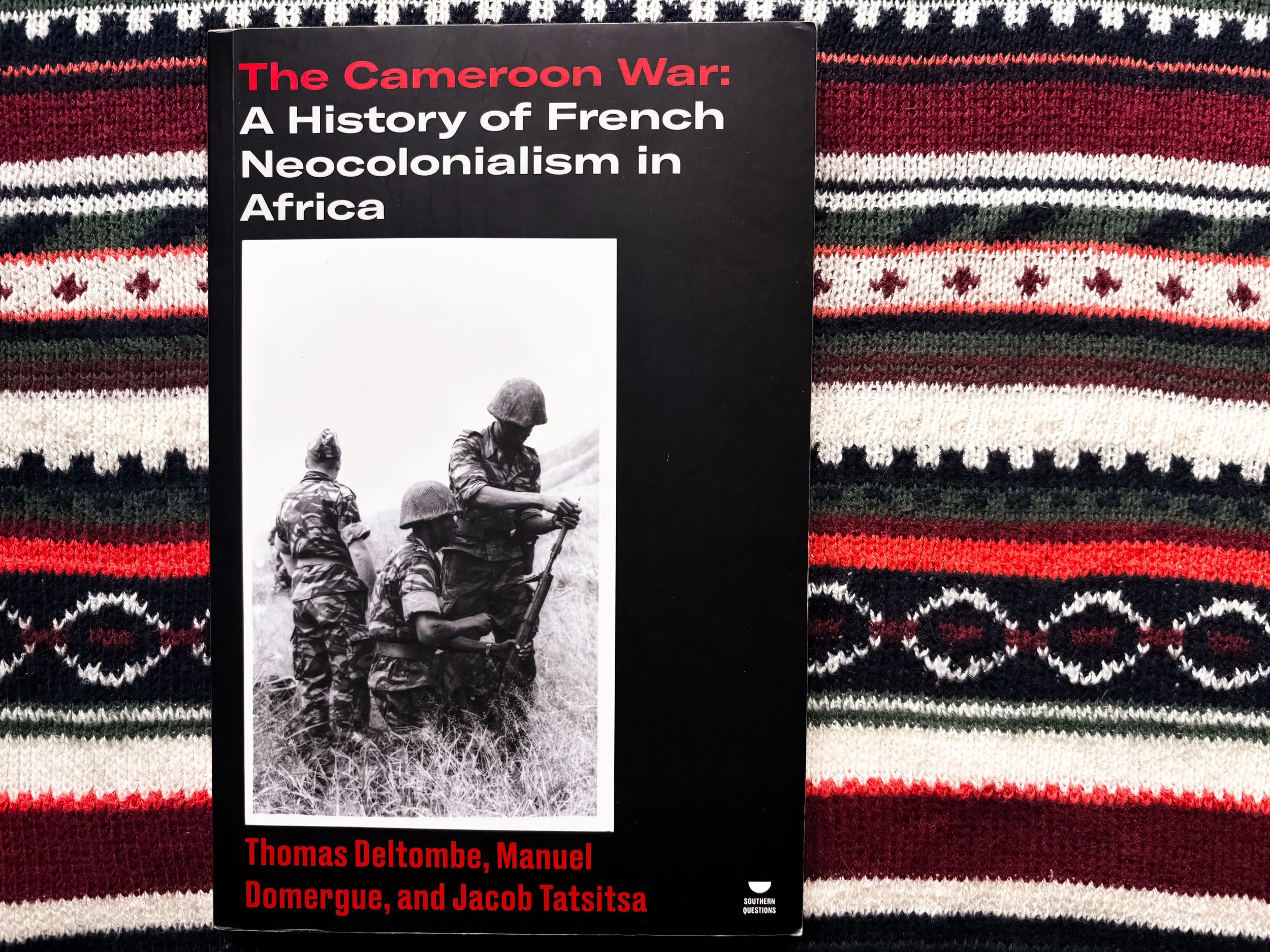
Translated by David Broder
Originally published in French in 2016 as La Guerre de Cameroun. L’invention de la Françafrique 1948-1971
English translation published in 2025 by Verso, London, UK, and New York, NY
192 pages
ISBN: 9781788733762
LCCN: 2025004414
LCC: DT573.5.F8 D4513 2025
The historiography of African decolonization has long been haunted by myths made by the West. In particular, the stubborn myth of a peaceful transition acts to alleviate the anxieties of Western actors, serving as a palliative against the guilt that so often looms over their legacies of colonial carnage. This narrative suggests that while North Africa and Southeast Asia were sites of imperial carnage, sub-Saharan Africa (and the French territories in particular) negotiated a largely bloodless exit from the imperial fold. As such, the history of the French Empire in sub-Saharan Africa is often presented as a largely sunny affair of carefully negotiated exits and peaceful transitions of power, especially in French society and classrooms.
However, at best, this framing is a textbook case of historical amnesia. More than a mere act of forgetting, it could be argued that this sanitized account of African decolonization is a purposeful, carefully constructed lie that has been used to cover up the commission of war crimes, especially in sub-Saharan Africa. This should come as no surprise. As we’ve seen in the case of the CIA-led assassination of Patrice Lumumba or the slander and opposition mounted against figures such as Andrée Blouin and Walter Rodney, Western intervention in Africa has been a defining feature of African decolonization in the 20th century, as Western powers feared Soviet influence in this resource-rich region of the planet.
In this 2025 English translation, titled The Cameroon War: A History of French Neocolonialism in Africa, journalists Thomas Deltombe and Manuel Domergue, and Cameroonian historian Jacob Tatsitsa focus on the bloody birth of the modern Cameroonian state. Far from a peaceful transition to independence, the authors reveal that the struggle against colonial forces included a brutal, decade-long counterinsurgency that served as the primary laboratory for Françafrique, the system of post-imperial control that continues to define French-African relations as it leeches off of the continent today.
Overview:
Through six chronologically-structured chapters, the authors uncover what they call a “hidden war" that transpired between 1955 and 1964 (and extending in its most repressive forms until 1971). By synthesizing archival materials from France and Britain with oral histories and meticulously documented field research, the authors expose a conflict that claimed tens of thousands, perhaps hundreds of thousands, of lives, yet was intentionally obscured by the French state and its local collaborators to preserve the illusion of a benevolent imperial exit from the region. As such, their investigation into archival sources reveals that the Cameroon War was a total war waged by the French Fourth and Fifth Republics to maintain a strategic foothold in Central Africa during the height of the Cold War and the Algerian conflict.
As such, the authors carefully analyze the structural origins of the conflict, the sophisticated military doctrines of counter-insurgency applied by French forces, the political engineering of a client state, and the enduring neocolonial architecture that continues to ensure that Cameroonian sovereignty remains largely nominal. They argue that the Cameroon War never truly ended, but rather it simply transitioned from a hot war to a structural one, as the authoritarian structures established during this period set the stage for the decades-long presidencies of Ahmadou Ahidjo and his successor, Paul Biya (who has been in power since 1982).
Deeper Dive:
The roots of the Cameroon War lie in the unique international status of the territory following the collapse of the German Empire. Originally the German protectorate of Kamerun, the territory was partitioned after World War I into French and British mandates under the League of Nations, a status later converted into a United Nations Trusteeship in 1945. This status theoretically obligated the colonial powers to prepare the indigenous population for self-determination. However, the French administration utilized this mandate as a veil for intensive economic extraction and the systematic implementation of the indigénat, or Native Codes, which were a set of arbitrarily determined laws that relegated the native populations of French colonies to second-class citizenship.
Under the French mandate, Cameroon became a colonial laboratory where large-scale infrastructure projects and commercial monopolies were established through the exploitation of human bodies. The indigénat legal code allowed for forced labor, racial segregation, and administrative imprisonment without trial, creating a state of perpetual subjugation for the native population. This period of shallow development was designed to serve the needs of the metropole rather than build the internal capacity of a future independent state, ensuring that the eventual transition to autonomy would leave the territory structurally dependent on French institutions.
The French strategy focused on the creation of a loyalist elite known as évolués, who were Cameroonians who had assimilated French culture, language, and legal norms. These individuals were favored by the colonial administration and utilized as administrative candidates in elections to thwart more radical nationalist voices. A pivotal example occurred in 1945 when the administration supported Chief Andre Fouda against the popular anti-colonial leader Douala Manga Bell, a tactic that established the precedent for the clientelist politics of the post-independence era.
The catalyst for open conflict was the formation of the Union of the Peoples of Cameroon (UPC) on April 10, 1948, in the Bassa district of Douala. Founded primarily by trade unionists, the UPC represented a genuine mass movement for radical independence and the reunification of the French and British mandates. Under the leadership of Ruben Um Nyobè, the party initially pursued a legalistic and democratic strategy, appealing directly to the United Nations Trusteeship Council to enforce the terms of the mandate and end French colonial abuses.
The French administration, viewing the UPC’s demand for total independence as a threat to its imperial interests, sought to delegitimize the movement by painting it as a communist front. While some leaders like Félix-Roland Moumié and Ernest Ouandié were influenced by Marxist-Leninist ideals, Um Nyobè maintained that the movement should remain ideologically neutral to unite all Cameroonians regardless of their political leanings. Despite this moderate stance, the administration systematically hindered the UPC’s participation in the political process, as seen in the 1951 legislative elections, where Um Nyobè’s candidacy was obstructed until the final moments to prevent his victory.
By 1954, the appointment of Roland Pré as High Commissioner signaled a shift toward total confrontation. Pré was tasked with "liquidating" the UPC, utilizing judicial harassment and the surveillance of activists to dismantle the party’s urban networks. This repression culminated in May 1955 when, following a series of strikes and riots, the French government officially banned the UPC on July 13, 1955, under the pretext of maintaining public order. This prohibition forced the nationalist leadership into exile and the rank-and-file into hiding, transforming a democratic struggle into a guerrilla war.
The military response of the French state to the UPC insurgency was governed by a sophisticated and brutal doctrine known as "Revolutionary Warfare" (Guerre Révolutionnaire). This doctrine, developed by French officers who had experienced defeat in Indochina and were simultaneously fighting in Algeria, posited that modern conflict was a total war for the hearts and minds of the population. As the authors write, “Rather than being genocidal in intent, in a strict sense, for the French, the war was primarily aimed at subduing and disciplining unruly populations through a ‘reconquest’ of their territory—but also of their minds” (119).
In the Cameroonian context, this translated into a strategy that combined extreme physical violence with intense psychological control. The French army, supported by local colonial militias, established pacification zones where the distinction between combatant and civilian was effectively erased, as anything that moved in these zones was shot on sight. To isolate the guerrillas from their support base, the administration implemented a policy of regroupment, forcibly moving hundreds of thousands of peasants from their ancestral lands into strategic villages. These camps were designed for total surveillance, where social bonds were methodically broken to prevent any assistance to the UPC militants.
The authors also detail how the French military utilized napalm and heavy explosives to raze villages that were suspected of harboring "hostile elements". In administrative reports, the victims of these bombings were euphemistically described as "neutralized outlaws" or "terrorists," a semantic strategy used to sanitize war crimes for the metropole. This shadow war was conducted without witnesses or limits, as war zones were strictly closed to journalists, and the few who were granted access were often complicit in the French intelligence services' clandestine activities.
The war was concentrated in two primary geographical and ethnic regions: the Bassa forests of the coast and center, and the Bamiléké highlands in the West. These regions were the strongholds of the UPC and consequently became the primary targets of what Deltombe and his co-authors describe as an ethno-political purge. They detail how entire villages were razed, and hundreds of civilians were massacred in single-night "pacification" operations. French forces routinely and systemically dumped the bodies of the slaughtered into wells and ravines to hide the scale of the extermination.
In the Bassa region, Ruben Um Nyobè led a disciplined guerrilla movement that relied on deep local roots and a complex network of forest hideouts. The French military’s focus on this region culminated in the assassination of two UPC leaders. In 1958, the charismatic "Mpodol" Ruben Um Nyobè was hunted and killed in the forest in 195, while Félix-Roland Moumié was poisoned with thallium by the French secret service (SDECE) in Geneva in 1960. These events dealt a catastrophic blow to the political leadership of the insurgency.
However, it was in the Bamiléké region that the violence reached its most extreme levels. The Bamiléké people were collectively suspected of supporting the UPC, leading to a deliberate program of destruction that included the systematic burning of territories from planes and the deportation of entire populations to resettlement camps.
The scale of the killings in the Bamiléké region has led some researchers to describe the event as a genocide, though French institutions have never recognized it as such. Colonial censuses from the period record sudden and unexplained drops in population in these areas, and oral testimonies describe bodies routinely dumped into wells, pits, and ravines to hide the scale of the extermination campaigns. The psychosis generated by this period, often characterized by the memory of public rapes, electrocution in prisons, and the sight of hamlets burning, continues to shape the political behavior of these regions today, manifesting as a deep-seated distrust of the centralized state in Yaoundé.
As the international pressure for decolonization grew, the French government orchestrated a transition that would preserve its influence while granting nominal autonomy to Cameroon. This process, termed "stolen independence" by the authors, involved the installation of Ahmadou Ahidjo as Prime Minister in 1958 and subsequently as the first President of the Republic of Cameroon in 1960. Ahidjo, a northern leader who had not participated in the radical nationalist struggle, was seen as a compliant intermediary who would allow French economic and strategic interests to persist.
The independence granted on January 1, 1960, was, as the authors argue, "independence stripped of all substance." The Cameroonian constitution was modeled directly on the French Fifth Republic, granting Ahidjo quasi-dictatorial powers that would eventually consolidate into a one-party state. Furthermore, a series of bilateral agreements of cooperation were signed, ensuring that French advisors remained embedded in every position of sovereignty, including the military, the treasury, the police, the intelligence apparatus, and other civil service sectors.
These agreements, many of which remain secret to this day, granted France exclusive rights to exploit Cameroon’s mineral and petroleum resources for several decades, creating a leech-like relationship where the nation was looted for the benefit of the old colonial power. The transition from colonial rule to a neocolonial system allowed France to withdraw its formal administration while maintaining its grip on the country’s wealth through a "client dictatorship" in Yaoundé. This transition ensured that Cameroonian sovereignty remained nominal, as they write, “The new Cameroonian state had been born in a warlike atmosphere; and it was now transformed into a counter-subversive machine, under the pseudo-democratic trappings of a façade of sovereignty” (121).
As such, one of the primary arguments of the work is to identify the conflict as the origin of the unique system of neocolonial governance known as Françafrique. This system enables a tiny number of French officials, in collusion with a handful of African leaders, to control former colonies remotely and at low cost. The authors argue that the violence of the Cameroon War was necessary to clear the field of radical nationalists who would have resisted this system, thereby creating a vacuum that was filled by compliant elites.
Most importantly to their argument, Françafrique is characterized by a hidden architecture of power where the official Cameroonian army often serves as a screen for French military actions. After 1960, the war against the UPC did not suddenly end, but merely transitioned into a civil war phase where President Ahidjo requested continued French military assistance to eradicate the remaining insurgents. This allowed the French to continue their "pacification" operations under the guise of supporting a sovereign ally, ensuring the conflict remained hidden from international scrutiny.
This neocolonial system, established in 1960, has proven remarkably durable. When Ahmadou Ahidjo resigned in 1982, he was replaced by Paul Biya, who has maintained the same autocratic structures and subservience to French interests for over four decades. The continuities between the two regimes are profound and remain with us even today. From the military suppression of cost-of-living protests in 2008 to the 2014 military pact with France against Boko Haram, the Cameroonian state remains an essential pillar of French strategic foreign policy in Central Africa.
Commendations:
There are several notable strengths to the authors’ account. First and foremost, the amount of research that went into this book is staggering. The authors demonstrate extraordinary rigor by synthesizing previously classified French and British archives with oral histories and field research. Essentially, this book serves as a distilled version of their much longer, nearly 800-page 2011 work, Kamerun! Une guerre cachée aux origines de la Françafrique 1948–1971. The immense amount of archival material and oral reports from that work make their way into this much slimmer volume, albeit in a condensed format.
As such, for those who find themselves hesitant to invest in such an arduous task of reading 800 pages on the Cameroonian War, this work is a much more accessible introduction to the topic. This attempt to reach a wider, more generalist and non-specialist audience is especially important since it exposes the public to the voices of the subaltern Bassa and Bamiléké populations who were targeted by the French state's "Revolutionary Warfare" doctrine. Accordingly, the book is particularly strong in its systematic destruction of the narrative that sub-Saharan Africa transitioned smoothly to independence. By documenting the litany of atrocities that claimed tens of thousands of lives in the region, the authors force a reckoning with the bloody reality of the French imperial exit.
Furthermore, Deltombe, Domergue, and Tatsitsa’s account is vital for understanding the contemporary crises that rattle contemporary Cameroon. The authors gesture toward the argument that the ongoing Anglophone Crisis, which has roiled the country since 2016, is a direct legacy of this colonial engineering. The 1961 reunification of the British and French mandates was conducted under a model of centralization and assimilation that prioritized French culture and law, effectively marginalizing the Anglophone minority. This externally imported problem is a direct result of the neocolonial structures established after the war, where a French-speaking majority imposed its system on the English-speaking population, eventually leading to an armed struggle for secession.
Accordingly, the current regime’s response to Anglophone demands, which is largely characterized by internet shutdowns, general strikes, and military repression, eerily mirrors the "law and order" tactics used against the UPC in the 1950s. The centralized, repressive state structures established to crush the UPC are the same ones now being deployed against Anglophone minorities demanding self-determination. As such, the authors suggest that the failure to address the colonial roots of the Cameroonian state has trapped the nation in a cycle of instability, where the political, social, and economic consequences of this hidden war continue to manifest in new forms of civil strife.
Finally, one of the most salient contributions of this work is to provide a scathing critique of how the modern French state has worked to cover up these horrific events and erase them from the public memory. For decades, the French state and its Cameroonian intermediaries wiped every remaining trace of the conflict from official records and school curricula. This state-sponsored amnesia was so successful that many modern Cameroonians are unaware of the scale of the violence that preceded their independence.
France has only recently begun to address this “dirty war." While President Emmanuel Macron appointed a commission in 2023 to analyze France’s role in Cameroon, Deltombe, Domergue, and Tatsitsa characterize these efforts as cynical diplomatic and communicational exercises rather than truly scholarly. These commissions often serve a therapeutic and pacifying role, aimed at quelling protest and striking new deals rather than providing a lucid examination of the past or offering genuine reparations. For many Cameroonians, reparations remain absent from official discourse, and the archives remain only partially accessible to independent researchers.
Critique:
On the other hand, the book is not without its shortcomings. First of all, since this book is a condensed version of an 800-page volume, there are some details that get lost in translation, especially when it comes to its structure and pacing. While it is roughly chronological, the book occasionally skips back and forth in time, which can be disorienting at times. In particular, I found that the book moves incredibly rapidly through the post-1971 era, which was a bit disappointing. While it correctly identifies the continuities between the Ahidjo and Biya regimes, the treatment of the contemporary Anglophone Crisis and the neoliberal shifts of the 1980s and 90s is relatively brief compared to the exhaustive detail provided for the 1948–1971 period.
Additionally, when it comes to the historical record, these authors write primarily as journalists who are seeking to uncover the horrific actions of the French state and its allies, rather than a carefully reconstructed history. While it is undoubtedly well-researched and sourced, these slimmer volumes can lose some of the finer nuances of the events that led up to the conflict. For example, rather than examining the complexities and contingencies of French and British policy and correspondence, the authors occasionally lean toward a narrative of a singular, monolithic French strategy in the region. This slightly overstates the monolithic coherence of French neocolonial policy and ignores the internal contradictions, bureaucratic infighting, and the degree to which local events were sometimes driven by contingency rather than a well-thought-out, grand-scale master plan from Paris. This by no means is to excuse the French state for its actions, but rather as an encouragement for fellow historians to engage with the authors’ much longer volume before passing judgment on their assessment of the war.
Finally, while the book excels at analyzing the binary between the French and the client-state it propped up in the wake of decolonization, I felt that the authors could have provided a deeper analysis of the internal social and class contradictions within the Cameroonian population. Too often, it seems that limited political agency is given to those loyalist Cameroonians who chose collaboration over rebellion, and the book can too easily present them solely as "puppets" of the French regime rather than as rational (if opportunistic) actors in their own right. The larger context as to why some Cameroonians chose to openly rebel against their colonial oppressors (via the UPC), why others chose to choose tactical reforms, and while still others chose to closely collaborate with the French to hedge their bets and attain power within the neocolonial regime is largely elided, and the authors choose instead to focus on various networks of individuals.
For the most part, the bulk of these criticisms is also undoubtedly due to the book’s brevity. I certainly cannot fault the book for its intended purpose, which is to shine light on a dark event in Cameroonian and French history. The target audience for this volume is a more generalist audience, rather than hard-nosed historians and academics, and in this regard, the book largely succeeds. However, if one wants an in-depth examination of the complexities of the conflict, they will likely be better served using this work as an introduction before moving to more systematic works that explore these dimensions.
Conclusion:
Overall, The Cameroon War is a bracing and well-researched historical investigation that brings to light one of the most hidden and brutal conflicts of the decolonization era. While its brevity and narrow focus limit its ability to fully explore the intricate depths of the conflict and its impact on Cameroonian society today, the authors’ exhaustive research and documentation of these events serve as a vital corrective to the historical amnesia surrounding the end of the French Empire. By documenting the extreme violence of the Cameroon War, the authors demonstrate that French neocolonialism was a deliberately engineered system of capitalist extraction founded on mass violence, military suppression, and political manipulation, which still has ripple effects that make themselves known today.
The future of Cameroon and its relationship with France remains contested. While the Macron administration’s recent recognition of their repression during Cameroon’s path to independence is a step toward acknowledgment, such milquetoast statements do not fully reckon with the depth and scope of the brutal violence committed. The Cameroon War successfully frames the current instability in Cameroon, including the ongoing Anglophone Crisis, as a direct legacy of the colonial pact and the violent engineering of the postcolonial state from its very founding. The lack of reparations (or even something as bare minimum as an apology) suggests that the neocolonial architecture remains largely intact. For a genuine Cameroonian dream of self-determination to be realized, the nation must not only rewrite its history but also fundamentally redefine its identity away from the extractivist ties that have bound it to the metropole of Paris for over sixty years. Shining a light on this Hidden War is thus not just a matter of rectifying the past but also signifies a central struggle for the future of African sovereignty and dignity for the peoples of Cameroon.