
Citizens of the Whole World: Anti-Zionism and the Cultures of the American Jewish Left - Benjamin Balthaser
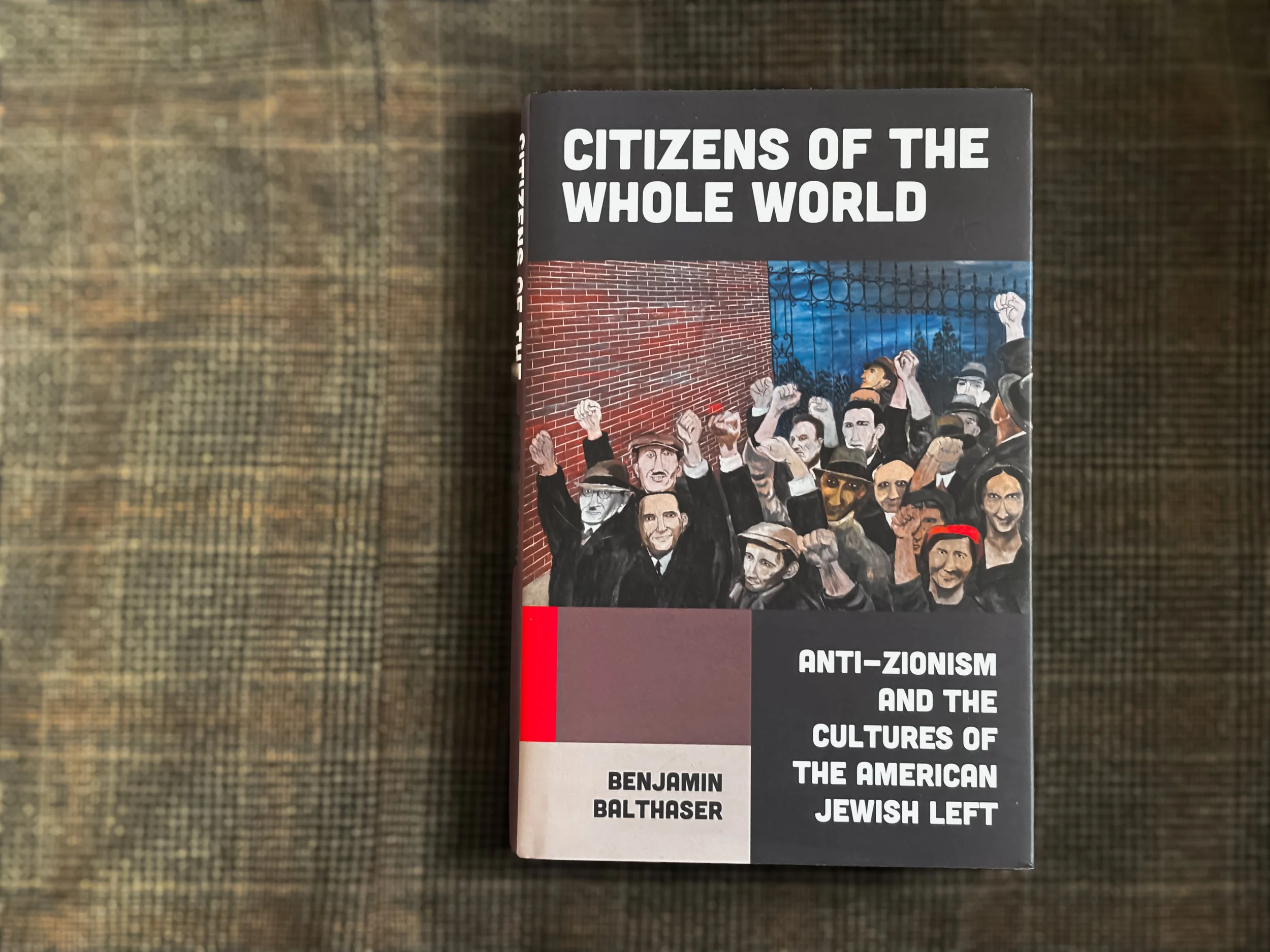
Published in 2025 by Verso, London, UK and New York, NY
320 pages
ISBN: 9781804291375
On a chilly early April evening in Cambridge, Massachusetts, I hurriedly passed by the Harvard Lampoon, crossed through the blaring beeps that littered a busy Mt. Auburn St, and made my way into the Harvard Hillel building. Working as an intern for the Pluralism Project, I was tasked with attending various interfaith events around the greater Boston area and writing up reports to post on our website. Harvard’s chapter of the Progressive Jewish Alliance (PJA) was holding a Seder to celebrate Passover, and I was invited to attend as a guest and write up a report on the event for our organization. Walking into the building for the first time, I had no idea the controversy that I was about to step into.
Inspired by the anti-Zionist Jewish student group IfNotNow, this Liberation Seder was organized to highlight the Palestinian victims of occupation as a way to advocate for the liberation of all peoples. After some initial tension between participants and some words from Palestinian students, the atmosphere quickly settled into one of solidarity and mutual understanding. Instead of framing the event as “anti-Israel” or "pro-Palestinarian," the participants were guided by one central question: “Are you for endless occupation or for freedom and dignity for all?”
As I joined in on the traditional dinner gathering, I noticed that, in addition to the traditional elements of the seder (such as the asking of the Four Questions, the resuscitation of the Exodus narrative, and the hiding of the afikomen), the Haggadah used during the service was compiled from a variety of sources, including stories of Palestinian refugees and activists, considerations for the LGBTQA+ community, and words of support for the Black Lives Matter movement. Talking to some of the event organizers, I learned that since Hillel International sets specific regulations for events within its spaces regarding speech that concerns the state of Israel, the organizers had to be especially mindful and cautious as they planned and advertised the event. They also said that while it took an incredible amount of effort to get it approved, they ultimately wanted to host the event at Harvard Hillel so that they could reach a wider audience, including Jewish students who might be pro-Zionist, as well as provide a voice to other groups who have been historically marginalized or not given a voice within the organization.
Overall, the event was well-attended and proceeded smoothly. After the dinner, students and faculty burnt the midnight oil in deep discussion, and after a long delay, participants began to slowly trickle out of the room and into the cold Cambridge night. Finally, after quite some time, the remaining students gathered together in a circle in the middle of the room as they shared the final words, songs, and prayers to mark the end of the seder. As a Christian at this event, it was eye-opening to witness how this Passover celebration, which celebrates the Jewish community’s struggle for liberation, was reinterpreted and expanded to include the recognition of how freedom has been stripped from the Palestinian population. The Seder openly acknowledged the Israeli occupation of Palestine in the West Bank and Gaza, which made the event a lightning rod of controversy in the wider liberal Zionist community in Boston.
Fast forward five years in the wake of Hamas’s Al-Aqsa Deluge of October 7th and Israel’s genocidal response against the civilians of Gaza, the encampment protests at Columbia and other universities across the country likewise became a contested domain in which the assumptions of liberal Zionism were challenged. Liberal Zionists denounced those to their Left, often conflating anti-Zionism with anti-Semitism and alleging that anti-Zionist Jews are a small minority of the community.
It’s common today to hear that Jewish anti-Zionism is a largely generational revolt and a product of the campus left, social media radicalization, or a moral reaction to the catastrophe in Gaza. Conservatives and liberals alike in America cling to the hackneyed claim that these anti-Zionist Jewish activists are “self-hating Jews” who do not represent the views of the larger community. From a Zionist point of view, the Jewish people have been shaped by persecution and exile, but found safety in postwar America and solidarity in the establishment of the state of Israel. In this narrative, Zionism becomes the natural political expression of Jewish survival and a unifying project that brought Jews “home.”
Meanwhile, in the wake of the atrocities committed by Israel against the Palestinian people, an increasing number of young Jews are questioning this narrative and instead calling for an end to the Israeli apartheid regime. As such, debates over Zionism, anti-Zionist campus protests, and the constitution of Jewish identity are reshaping both public discourse and the academic study of modern Jewish politics.
In his 2025 book, Citizens of the Whole World: Anti-Zionism and the Cultures of the American Jewish Left, Benjamin Balthaser argues that today’s Jewish anti-Zionists aren’t inventing something new. Rather, they are rediscovering a buried tradition that stretches back nearly a century to a time when Jewish radicals in the United States saw Zionism as a betrayal of Jewish identity. Drawing on interviews, literary analysis, and political history, Balthasar traces the continuities of expressions of Jewish belonging that centered on diasporic internationalism, anti-imperial solidarity, and socialist critique, rather than nationalist or Zionist aspirations. By doing so, he aims to recover the largely forgotten genealogy of Jewish radicalism in the United States.
Overview:
Balthaser’s central argument is that contemporary American Jewish anti-Zionism is not a new phenomenon born of millennial disillusionment or campus protest but rather is the reemergence of an older diasporic political tradition that understood Jewish freedom as inseparable from the liberation of others. For much of the twentieth century, he reminds us, Jewish radicals in the United States saw Zionism as a retreat from the universalist ethics of socialism and anti-imperialism into the narrowness of ethnic nationalism. Rather than treating today’s Jewish anti-Zionist movements as a sudden break with the past, Balthaser argues they’re part of a deep tradition that runs from the labor organizers and Yiddish poets of the 1930s, through the Jewish New Left of the 1960s, to today’s activists in Jewish Voice for Peace and IfNotNow. For generations, he shows, many Jews saw their fate not as tied to a single state but to the global struggles of the oppressed. Balthaser contends that the postwar ascendance of Zionism within American Jewish life is a historical aberration or rupture that obscured earlier diasporic and universalist commitments.
Through five chronologically arranged chapters, Balthaser follows this tradition from the 1930s to the present day, as it illustrates a vision of Jewish identity rooted in diasporic, transnational solidarity rather than territorial sovereignty. For much of the twentieth century, the Jewish left was one of the beating hearts of the American labor and socialist movements. From the Yiddish-speaking radicals of the Lower East Side to Jewish communists fighting Jim Crow and fascism, Jewish politics once meant militancy, not ethno-national loyalty. As such, Balthaser examines the anti-imperialist literary culture of Depression-era Jewish radicals, highlighting writers such as Mike Gold and Howard Fast, who viewed Zionism as a bourgeois nationalist project inconsistent with proletarian internationalism. Real Jewish survival, they believed, depended on smashing capitalism and fascism, not building a settler colonial state.
Balthaser then traces how that vision was buried under the rubble of Cold War liberalism and the consolidation of Zionist hegemony in postwar America. On one hand, McCarthyism accelerated the purging of the radical Jewish left, while the memory of the Holocaust and the founding of Israel rewrote Jewish identity around victimhood and statehood. As Jews gained entry into white middle-class America by the 1960s, the radical inheritance of the Jewish labor movement was displaced by suburban philanthropy and pro-Israel lobbyism. Balthaser explores how this assimilation into “whiteness” complicated Jewish identification with the oppressed, and how Zionism became a substitute for the radical Jewish internationalism that once defined the community’s politics. As such, Balthaser devotes special attention to the 1960s and 1970s, when Jewish radicals joined movements for Black liberation, women’s rights, and anti-imperialism, reconnecting their diasporic Jewish identity to global liberation movements and using their identity as a catalyst for building solidarity with other oppressed groups.
Balthasar then shifts his focus to the 1970s–80s reconfiguration of Jewish identity politics and the recent resurgence of Jewish anti-Zionism in movements such as Jewish Voice for Peace (JVP) and IfNotNow. Whether marching with Black Panthers, organizing against Vietnam, or protesting Israeli militarism, these Jews reclaimed diaspora not as a form of temporary exile to be remedied by nationalist ambitions, but as a radical political standpoint to stand in solidarity with the marginalized and dispossessed. They insisted that the Jewish history of diaspora, persecution, and survival carries a revolutionary message, namely, that no people are free while others live under occupation and empire. For these radicals, being Jewish meant being opposed to the forces of empire and oppression, no matter where they may arise.
Deeper Dive:
In the Introduction, Balthaser outlines his main argument, which is that there has been a continuous tradition of Jewish left-anti-Zionist thought in the U.S., and that the dominance of Zionism within American Jewish life (especially after 1967) should be treated as the historical exception rather than the norm. He is careful to note that his work is not an attempt to offer a comprehensive history of the American Jewish left or Jewish anti-Zionism. Rather, he argues that “Jewish anti-Zionism emerges, much like Zionism, not soley within the Jewish community as an autochthonous formation, but rather in dialogic relation to the non-Jewish world” (44). He situates his own work in the ongoing discourses around Jewish identity, nationalism, and diasporism, while also explaining how his methodology combines elements of historical reconstruction, literary analysis, and interviews with Jewish anti-Zionist activists.
In Chapter One, Balthaser explores the period roughly from the 1930s through the early Cold War, focusing on how Jewish radicals responded to fascism, anti-semitism, imperialism, and the rise of nationalist Zionism. During the Great Depression, Jewish communists and socialists were major figures in the American left, making up a majority of the American Communist Party (CPUSA). In this era, anti-Zionism was mainstream while Zionism was viewed as a fringe ideology. He points out that writers like Mike Gold and Howard Fast saw Zionism as a bourgeois nationalist project that distracted from the fight against fascism and capitalism. During the Cold War, those voices were silenced by Red Scare propaganda, McCarthyism, and the growing power of pro-Israel institutions within American Jewish life. Zionism, once controversial among radicals, slowly became synonymous with Jewish identity itself.
Taking Mike Gold’s semi-autobiographical novel Jews without Money as a key reference point, Balthaser examines how Jewish racial subjectivity (i.e., Jews as a “racialized” or “othered” group in U.S. society) influenced their critique of Zionism and imperialism. He also brings in other literary figures and anti-imperialist intellectuals who challenged the Zionist narrative during this era, showing how anti-Zionism was embedded in a broader anti-colonial and socialist framework for many Jewish leftists. Many literary and political circles, such as those formed around the Partisan Review and the CPUSA, understood Zionism as a form of colonial nationalism that was inherently incompatible with proletarian solidarity. As such, Balthaser explores the connections between this popular form of anti-Zionism and the struggles faced by African Americans, as many activists from both groups found themselves in common cause and worked to build solidarity.
In Chapter Two, Balthaser analyzes how post-World War II developments, such as the memory of the Holocaust, the Red Scare, and anti-communist purges, affected Jewish left politics and anti-Zionist tendencies. He argues that Jewish radicals, especially those in or influenced by the New Left, had to negotiate the implications of the Holocaust, the exclusion of Jews from whiteness, and the pressures of McCarthyism, all of which shaped their relationship to Zionism. Balthaser aims to illustrate how the increasing mainstream assimilation of Jews in America changed the terrain of Jewish identity, and how anti-Zionist positions became more fraught.
He also engages with debates around the role of the Holocaust in shaping modern Jewish identity, recognizing how the memory of the Holocaust has been utilized to further nationalist and colonial settler narratives and justify the need for an ethno-nationalist state. By contrast, Balthaser shows how anti-Zionist Jews in the 1960s and 70s used the memory of the Holocaust to draw parallels to the death, destruction, and slaughter of the Vietnamese during the ongoing Vietnam War. Through this comparison, Balthaser argues, “this rewrites the history of the Holocaust from the paradigmatic genocide to rather its exception, occurring at the heart of Europe rather than in its colonial or settler peripheries” (105). These examples illustrate how Jewish radicals used the moral language of anti-fascism and Holocaust remembrance to critique U.S. imperialism and Israeli militarism during the 1960s and 70s.
In Chapter Three, Balthaser delves deeper into the racial and class dynamics within the Jewish left from the 1960s onwards. He argues that as Jews increasingly entered the white middle class and moved into the suburbs in the U.S., several tensions began to emerge. Even as anti-semitism persisted, Jews were increasingly accepted as “white” in postwar America, often being positioned as a “model minority” who could assimilate into American culture. There was much ambivalence within the Jewish community about their newfound position, and Balthaser traces how Jewish leftists during this time confronted their own newly elevated positionality in post-war America.
Balthaser critiques the liberal “model minority” framework of Jewish identity that emerged in mid-century America, contrasting it with the self-identification of “bad Jews” who rejected respectability politics and ethno-nationalism. In Isaac Deutscher’s essay, “The Non-Jewish Jew”, the Polish journalist writes,
Religion? I am an atheist. Jewish nationalism? I am an internationalist. In neither sense am I therefore a Jew. I am, however, a Jew by force of my unconditional solidarity with the persecuted and exterminated. I am a Jew because I feel the pulse of Jewish history; because I should like to do all I can to assure the real, not spurious, security and self-respect of the Jews.
Balthser shows how Jewish anti-Zionists related to this text to resist assimilation and align themselves with anti-racist and anti-colonial movements, critiquing their own inclusion into whiteness, empire, and U.S. capitalism.
In Chapter Four, Balthaser shifts his attention to the 1970s era and examines how Jewish identity politics and left-radicalism intersected. “Kesher” (Hebrew for “connection”) signals a linkage with broader leftist movements such as the anti-war, feminist, racial justice, and Third World solidarity movements. Balthaser explores how Jewish anti-Zionists sought to remake Jewish identity around diasporic and internationalist frameworks, rather than Zionist nationalism. He also traces institutional and cultural shifts, in which organizations, thinkers, and activists carried this tradition in this period, writing, “Disasporism is neither exclusively identitarian nor a flattened, universal subject; it is the nexus between their ‘kesher with the left’ and their own search for a Jewish community and Jewish interests” (185).
Accordingly, Balthaser focuses primarily on the writings and actions of two main Jewish organizations, Chutzpah and the Brooklyn Bridge Collective, as they sought to carve out a space that simultaneously contained a specifically Jewish identity while also being open to other marginalized struggles. He details the contradictory nature between their Zionist (or non-Zionist) stances, while also trying to align themselves with other progressive movements. By doing so, he shows the struggle that many within these movements had in balancing their particularist identities with the universal call for emancipation.
He contrasts the growing turn toward ethno-nationalist Zionism as a central tenet of Jewish identity during this era with a Leftist conception of Jewish identity as diasporic and fractured, identifying with the marginalized and powerless. By way of literary analysis, Balthaser ends the chapter with a comparison between the works of Philip Roth (namely, his 1969 novel Portnoy’s Complaint) and Melanie Kaye/Kantrowitz, both of whom illustrate this dialectic tension. He writes, “For Roth, to be a citizen of the world is to leave one’s collective Jewishness in a nostalgized Newark past or a perverse, reified Zionist future; for Chutzpah and Melanie Kaye/Kantrowitz, to be Jewish is to be a citizen of the world” (218).
In the final chapter, Balthaser focuses on how the Jewish anti-Zionist tradition re-emerged in recent decades (from the 1980s to the present) and how it contends with liberal Jewish institutions and the dominant Zionist consensus. He investigates how memories of Jewish socialist/anti-imperialist pasts interact with contemporary anti-Zionist activism, and how Jewish liberalism both accommodates and resists these strands. Balthaser contrasts the moral politics of Jewish liberalism, which is focused on pluralism, Holocaust memory, and advocacy for the state of Israel, with the revived socialist and diasporic ethics of the new Jewish left. He contends that there is a growing rupture with Zionism even within liberal Jewish currents, beginning with the rise of the Likud Party in the Knesset in 1977 to the current genocide occurring in Gaza, though this rupture remains ambivalent and tenuous to this day.
Balthaser argues that the current wave of anti-Zionist organizing by groups such as Jewish Voice for Peace (JVP) and IfNotNow draws on the buried traditions explored in earlier chapters. As such, Balthaser calls on the reader to reconsider the possibilities for Jewish diasporic internationalism and activism beyond Zionism. He writes,
If one could pinpoint three overlapping yet distinct anti-Zionist positions in our current conjecture, one might say they are, loosely, classical liberalism, Marxism, and left religious Judaism. It has been my contention that these positions are often inseparable, and are conjoined by many shared assumptions about Jewish life and social justice, but also shared between families and institutions in ways that are, if not entirely new, at least creatively reconfigured…I would like to propose with this chapter that the memory of the American Jewish left is an integral part of keeping a broader anti-Zionist Jewish left alive, if the purpose is to live with a people, within many peoples, yet without a country to call home (271).
Commendations:
Several dimensions of Balthaser’s work are particularly strong. First and foremost, one of the book’s most significant contributions is its excavation of a tradition of anti-Zionist Jewish activists, writers, and organizations that have been too often sidelined and marginalized in both Jewish studies and broader historiography. Balthaser demonstrates that what appears to many as a new feature of Jewish anti-Zionist activism in the U.S. actually has deeper roots in the 1930s-70s radical decades. In doing so, Balthaser challenges the assumption that Zionism has always been central to American Jewish identity, giving space instead to diasporic, internationalist, anti-imperial possibilities. Therefore, as a work of historical recovery, Citizens of the Whole World succeeds impressively.
Balthaser’s most significant methodological innovation lies in his fusion of Jewish historical analysis with critical race and decolonial theory. He situates Jewish radical culture within broader structures of racial capitalism and imperial power, arguing that American Jewish leftists grappled with their ambiguous racial position as they were simultaneously marginalized and increasingly assimilated into whiteness during the post-war era. This framing enables him to read Jewish anti-Zionism not simply as a political dissent but as a racial and ethical practice of solidarity.
The book’s intersectional attention to race, class, and gender adds further depth, showing how Jewish radicals navigated their positionality vis-à-vis Black liberation movements, Third World struggles, and feminist politics. For scholars in Jewish studies and religious studies alike, Balthaser’s insistence on the diasporic and universalist dimensions of Jewish ethics offers a compelling counterpoint to the nation-state paradigm that has dominated modern Jewish thought.
Additionally, Balthaser does not restrict himself only to organizational history but brings in literary texts (primarily works by Jewish writers), historiographical debates, and interviews with former activists. He moves effortlessly from literary analysis to the gritty politics of labor movements and anti-war coalitions, often reading postwar novels and poems through the lens of assimilation, exile, and diaspora. This multidimensional approach adds a rich texture and depth to Balthaser’s narrative, enabling the dynamic and shifting cultures of the American Jewish Left to emerge beyond just formal politics. As such, Balthaser’s has produced a rigorously researched and intellectually ambitious monograph which offers both an intervention in Jewish historiography and a provocation to contemporary political discourses.
Equally commendable is the book’s normative ambition. Balthaser writes both as a historian and as an active participant in a living intellectual tradition, arguing for a Jewish politics that is resolutely anti-colonial, solidaristic, and committed to a world after Zionism. He writes from within today’s revival of Jewish anti-Zionism, but rather than treating these groups as a rupture with the past, he situates them in a century-long struggle over what Jewish liberation actually means. He offers a compelling vision of Jewishness that is defined not by settlement or statehood in Israel, but by global solidarity, a diasporic posture, multi-racial alliances, and anti-imperial politics. Balthasar reminds us that, for many in the American Jewish left, the memory of Jewish oppression in Europe and the diaspora informed a commitment to universalist solidarity rather than exclusively Jewish nationalism. As a religious scholar, I found this to be a provocative and refreshing alternative to Zionist or state‐centered Jewish identity frameworks.
What truly distinguishes Balthaser’s analysis from the typical liberal handwringing over “Jewish values” is his commitment to a materialist approach, situating Jewish politics squarely within the shifting terrain of race and class in the United States. As Jews climbed the postwar ladder of whiteness, their institutions traded proletarian internationalism for Cold War respectability. Zionism became not only an ideology but a class project to align Jewish upward mobility with the American empire. Against this, Balthaser recovers the Jewish left’s older language of diaspora by highlighting the steadfast refusal to let safety depend on someone else’s dispossession. His titular “citizens of the whole world” were internationalists because they had no illusions about the nation-state and its violence. They saw the Jewish question and the colonial question as two faces of the same capitalist world system.
Given contemporary developments, particularly how many Jewish Americans are rethinking the Israel/Palestine question, the book’s intervention is timely. Balthaser explicitly links past currents to modern groups such as Jewish Voice for Peace (JVP) and IfNotNow. He offers a genealogy for those who now march for Palestinian freedom under banners reading “Not in our name,” reminding us that Jewish anti-Zionism is not an import from the far left but a homegrown American tradition. By centering the history of these subaltern alliances and critiquing colonial-national formations, Balthaser’s analysis provides both a valuable contribution to academic debate and an inspiration for renewed diasporic politics that can address contemporary issues.
Critique:
On the other hand, Balthaser’s account does contain a few shortcomings. First of all, the book’s analytical power occasionally comes at the expense of fully textured nuance. While the project of recovering continuity is important, his argument sometimes leans too hard on continuity, suggesting that there is an unbroken line from the Yiddish communists of the Popular Front to today’s anti-Zionist organizers. The real story is much messier. There is a risk of underplaying the real ruptures, ambivalences, and internal contradictions within the Jewish left, as well as how Zionism’s institutional dominance shaped Jewish life in the U.S. The Jewish left was always fractured between Bundists and communists, Ashkenazim and Mizrahim, and secularists and religious dissenters, many of whom possessed their own flavors of anti-nationalist thought. Balthaser’s emphasis on continuity sometimes smooths over these significant ruptures and contradictions within the Jewish left.
On a related note, the book’s treatment of Jewish diversity is also somewhat limited. Its narrative remains largely focused on the Ashkenazi, secular, and American experiences of 20th-century Judaism. As such, Mizrahi, Sephardi, and religious anti-Zionist voices appear only tangentially in Balthaser’s account. As a religious studies scholar, I found myself wishing for more engagement with Jewish theological responses (orthodox, reform, conservative) to anti‐Zionism, such as the role of rabbinic anti-nationalism in these discourses and their responses to such dissent.
Similarly, while Balthaser places Jewish anti-Zionism in conversation with Black and Third World movements, he gives less sustained attention to non-Jewish anti-Zionist and Palestinian intellectual traditions that might have sharpened its decolonial critique. Though Balthaser critiques Jewish assimilation into whiteness, his own cast of radical characters remains overwhelmingly male and white-passing, reflecting the racial and gender limits of the movements he describes. I often found myself wishing for a deeper dialogue with other Palestinian and non-Jewish anti-colonial writers, whose perspectives could’ve sharpened the critique of how Jewish radicalism both resisted and reproduced forms of privilege, whiteness, and empire during the post-war era.
Finally, while Balthaser critiques liberal Zionism’s hegemony in contemporary history, he does not always reckon with the internal pluralism of Zionist thought throughout the 20th century and how these streams interacted with the anti-Zionist Jewish left. While Balthasar often correctly treats Zionism as a settler colonial project, Zionist politics and Jewish institutional life in the U.S. have had many currents over the past century, including liberal Zionism, socialist Zionism, cultural Zionism, left Poale Zionism, and more. A more fine‐grained analysis of how different Zionist streams engaged (or didn’t) with the Jewish left would have been interesting to see and add nuance to the historical analysis. For example, toward the end, I found myself wanting Balthaser to more deeply interrogate how structural power (of Zionist institutions, state funding, philanthropy) shaped the marginalisation of anti‐Zionist Jewish voices.
Conclusion:
Overall, Citizens of the Whole World is a well-researched and valuable contribution to the current discourse around Jewish political history, recovering the long and largely buried history of Jewish radicals in the United States who opposed Zionism and embraced a politics of diaspora, solidarity, and socialism. While it is occasionally repetitive and confined in scope to the American Jewish Left, Balthaser’s work still offers a detailed and well-documented account that can broaden one’s understanding of what the “Jewish left” has meant in the U.S. and how anti-Zionism fits into that story. In a time when Jewish identity is often publicly measured by one’s relationship to Israel, Balthaser’s study feels incredibly timely and necessary to consider.
By recovering a tradition of diasporic, anti-nationalist Jewish radicalism, Balthaser invites readers to imagine Jewish identity as a practice of international, diasporic solidarity rather than a commitment to defend an ethno-nationalist state. For scholars of Jewish history, religious studies, and decolonial theory, it opens new avenues of inquiry and invites rethinking of Jewish identity beyond Zionist paradigms.
Balthaser’s work arrives at a moment when the American Jewish left is again front and center and embattled in controversy. In the mainstream press, Jewish anti-Zionism is still cast as a generational heresy or merely a product of moral confusion. U.S. support for Israel remains unshakably bipartisan, and accusations of anti-Semitism are weaponized to silence Palestinian solidarity.
As protests against Israel’s war in Gaza fill the streets and Jewish anti-Zionists face accusations of betrayal for their anti-Zionist stance, Citizens of the Whole World offers much-needed historical grounding. The history Balthaser recovers shows that dissent has deep roots. For decades, Jewish radicals in the United States understood that freedom for their own community could never be divorced from freedom for others. They built labor unions, fought fascism, marched for civil rights, and opposed imperialist wars out of a political understanding that justice must be universal. For anyone seeking to understand not just how we got here, but where Jewish politics could go next, Citizens of the Whole World is essential reading. It’s a reminder that diaspora, far from a wound to be healed, can be a source of power and a way to imagine freedom and dignity beyond national borders.