
Revolutionary Yiddishland: A History of Jewish Radicalism - Alain Brossat and Sylvia Klingberg
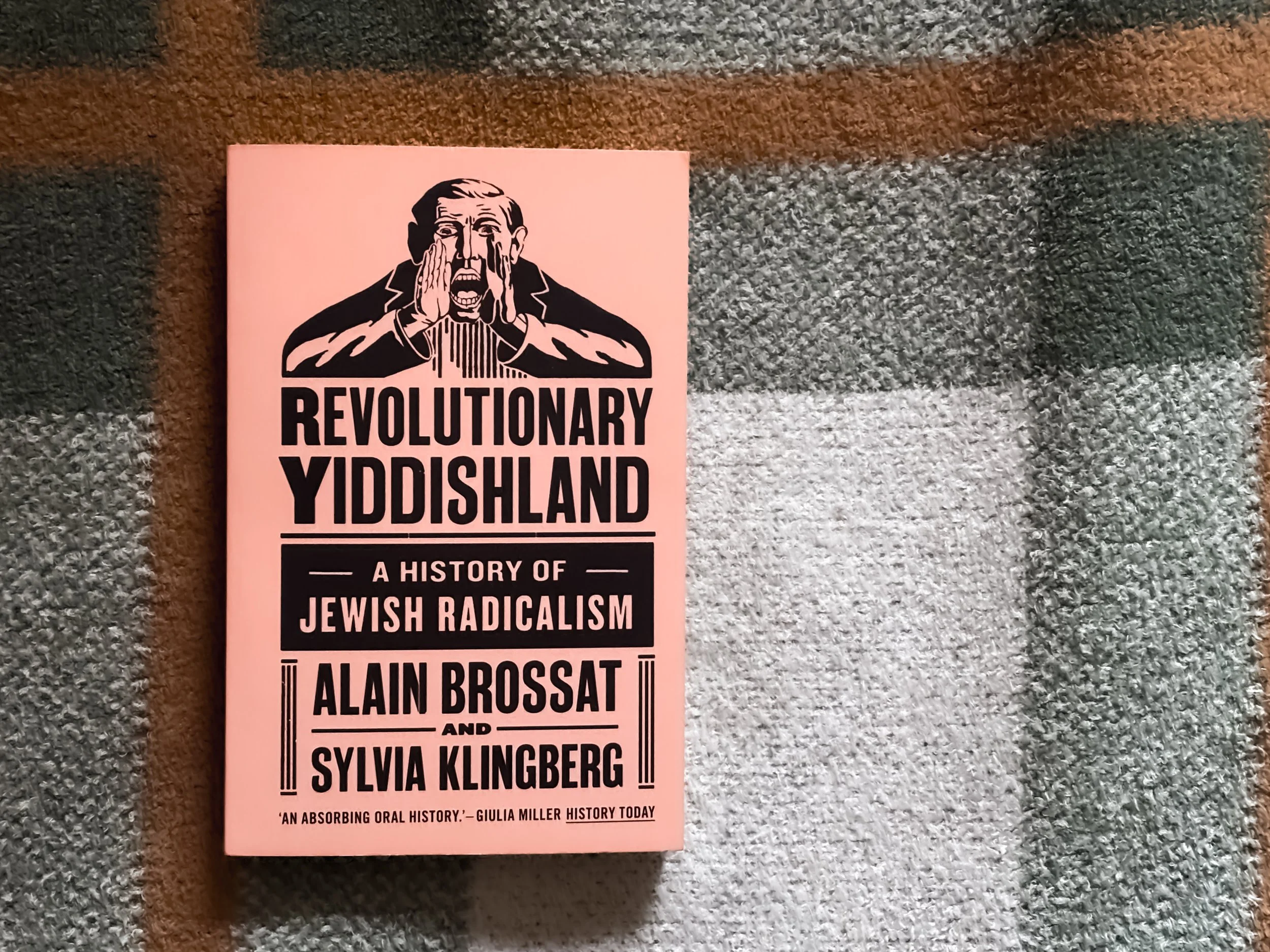
Translated by David Fernbach
English paperback edition published in 2017 by Verso, London, UK, and New York, NY
Originally published in French in 1983 as Le Yiddishland révolutionnaire by Belland
320 pages
ISBN: 9781784786076
At the dawn of the 20th century, nearly half of the world’s Jewish population lived in Russia. Confined to a region known as the Pale of Settlement (comprising modern-day Belarus, Lithuania, Poland, and Ukraine), these Jews were often the subject of violent pogroms and economic hardship in Tsarist Russia. In the lead-up to mass industrialization, most were also proletarians, frequently living and working in brutal, harsh conditions. In response to these waves of violence and persecution, many of these Jews became deeply involved in revolutionary groups such as the Bund (aka Jewish socialists), Bolsheviks, and various left-wing Zionist movements.
Throughout the following decades, these revolutionary Jews would take up arms against fascism in Spain and Germany, as well as fight for economic equality and struggle for social change. Far from passive victims who were “led like lambs to the slaughter,” these Jews valiantly fought against the forces of empire and oppression, refusing to be snuffed out silently. Yet, in much of Zionist historiography, these radical figures who dedicated their lives to the struggle for socialism have been largely erased because of their inconvenience to official narratives.
First published in 1983 and translated into English in 2016, Revolutionary Yiddishland: A History of Jewish Radicalism aims to rescue the lived experiences of these Jewish radicals, whose voices have often been silenced and erased by official narratives. By conducting interviews with a collection of former Jewish radicals, sociologists Alain Brossat and Sylvia Klingberg paint a collective portrait of the socialist, internationalist Jewish Left that once flourished across Eastern Europe before the forces of fascism and authoritarianism destroyed it. Rather than framing the Jewish experience during the twentieth century as one of either passive victimhood or assimilation, Brossat and Klingburg aim to reframe Jewish history in this era as one of resistance, collective struggle, and continual disappointments.
Overview:
Through a series of interviews with former activists interspersed with commentary and historical context, Brossat and Klingberg provide an oral-history narrative that explores the vibrant tradition of Jewish radicalism in Eastern and Central Europe (“Yiddishland”) from the late 19th century through the mid-20th century. The authors define Yiddishland not as a fixed geographic area but as a vast cultural and linguistic sphere stretching roughly from the Baltic Sea to western Russia, with millions of Yiddish-speaking Jews living in shtetls and cities before the Holocaust. Within this milieu, radical politics found fertile ground amidst poverty, rapid industrialization, discrimination under the Tsarist regime, and shifts in Jewish identity and community life. This diasporic, Yiddish-speaking space served as a crucible for socialist internationalism, anti-fascism, and revolutionary aspiration before its near-total destruction during the Holocaust and its subsequent marginalization in both Zionist and Soviet historiographies. By focusing on Jewish involvement in socialist, communist, and other left-wing movements, they highlight how Jews were not only victims of oppression but also active participants in struggles for social change.
Brossat and Klingberg draw heavily on interviews with former militants, many recorded in Israel in the 1970s and 1980s, when the aging survivors of Europe’s revolutionary movements were confronting the twilight of their lives and the evaporation of the worlds for which they fought. These personal testimonies and first-hand accounts serve as the backbone of each chapter. By focusing on three primary Jewish leftist groups (the Labour Bund, Poale Zionism, and the Jewish communist movement), the authors trace the legacies of resistance and persecution from Tsarist Russia, fascist Spain, the Nazi Holocaust, and the Stalinist purges. They also discuss the complex relationships that these Jewish radicals had with both the Soviet regime (including early cultural autonomy and later repression) and with the Zionist establishment of the state of Israel, noting the conflicts and contradictions between universalist socialist ideals and nationalist, settler-colonial politics.
Deeper Dive:
In the Introduction, Brossat and Klingberg orient the reader to the concept of Yiddishland as a cultural and political space and explain the book’s methodology, which weaves together oral testimonies of Jewish militants with historical narrative. They highlight the various forms of radicalism that existed in Eastern Europe at the dawn of the twentieth century, including the Bund, Poale Zionism, and the myriad socialist/communist parties. They note that this community has effectively vanished in the wake of repeated persecutions throughout the century, and their task is to try to recover and record these radical voices before they disappear altogether.
In Chapter One, Brossat and Klingberg paint the backdrop of the early world of Yiddishland, highlighting the social conditions of Eastern European Jews under Tsarist rule. Widespread poverty in shtetls and working-class city neighborhoods, Tsarist persecution, antisemitic laws, violent pogroms, and the decline of religious authority in the region all proved to be fertile ground for radicalism to emerge, especially among younger Jews who were encountering socialist and revolutionary ideas. The authors highlight the childhoods of these radical Jewish figures, explaining why radicalism made so much sense for them to embrace amidst the immense suffering in which they lived.
Chapter Two largely focuses on the collective mobilization of Jewish radicals in the interwar years, primarily on how Jewish working-class organizations built solidarity and identity around revolutionary symbols. While emigration to the United States or France was an option for some young radicals, for many others, joining a socialist organization and becoming politically engaged served as a way to replace traditional Jewish life with a new kind of community rooted in solidarity and purpose. The authors highlight the activities of the Bund, labor unions, Bolshevik/Menshevik groups, and left-Zionist organizations to explore how politics became both a personal and communal rallying point for the young Jewish community. They recount how Jewish students diligently worked to translate Russian and French political texts into Yiddish for the workers, how Bundists taught self-defence classes and provided Jewish radicals with weapons to defend themselves, as well as how these groups organized book clubs, theater performances, libraries, and other educational opportunities for workers, even amidst continual repression and violence.
In the Third Chapter, the authors turn their attention to the events of the Spanish Civil War (1936–1939), as Jewish volunteers from across Europe and even Palestine joined the International Brigades to fight Franco’s fascists. Many Jewish radicals saw Spain as a decisive battleground in the fight against reactionary forces threatening the working-class Jewish community, and they saw the war as a way to prove themselves against the threat of fascism and to dispel the popular antisemitic myth that Jews are overly cowardly and not fit to fight As such, the authors detail the various testimonies of radicals recounting their time in combat, their idealism, and the camaraderie the was forged through international anti-fascist networks.
They also recount the feelings of disillusionment that began to take hold during this time. Brossat and Klingberg note that the struggle in Spain signaled the beginning of a slow process of doubt and questioning for Jewish radicals, many of whom had been attracted to volunteer by romanticized Communist propaganda. In the wake of defeat in the war’s aftermath and Franco’s ascendance to power, many of these soldiers scattered across the globe, often finding persecution back home. Those who still believed in a Communist future would migrate to the Soviet Union for refuge, while others decided to emigrate to Palestine under the Zionist movement’s banner.
Chapter Four moves into the darkest years of World War II and the Holocaust, as Brossat and Klingberg recount various acts of Jewish resistance under Nazi occupation, including ghetto uprisings, partisan warfare, and underground organization. When we recall the horrific events of the Holocaust, an unfortunate stereotype of Jewish victims can all too often come to mind. It is often easy to think of the average Jew in the face of this horror as a passive victim, rather than a figure of an active resistance fighter. As the authors write (which is worth quoting at length),
Some people have maintained that in the face of absolute horror and genocide, ‘any resistance was impossible’ (Hannah Arendt), or again that ‘in such circumstances, to die fighting, singing psalms, veiling the gaze of children with one’s hand, or screaming with fear and despair, were strictly identical behaviors.’ This may be true in relation to the situation of deportees arriving on the ramp at Auschwitz and headed for immediate gassing, but it was certainly not the situation for all the Jews in Hitler’s Europe. Those who resisted were not simply, as Leon Poliakov writes, exceptions who ‘shone with an incomparable brilliance,’ but rather a category whose behavior as a minority in the face of adversity had very clear social, cultural, and political roots. (143)
As such, the authors seek to provide a counter-narrative to Holocaust scholarship that emphasizes the role of active resistance by those Jewish radicals in Eastern Europe who took up arms against the Nazis. Despite this resistance, however, the Holocaust marks, for these authors, the destruction of Yiddishland as it had been known.
In Chapter Five, Brossat and Klingberg break from the strictly chronological structure of the book as they recount the experiences of these Jewish radicals in the Soviet Union from the 1920s to the 1960s. During the Bolshevik Revolution from 1917 to 1923, the authors argue, many Jewish radicals resonated with the October Revolution’s promise of freedom and dignity for all, including the Jewish people. As such, many Bundists were drawn into common cause with the communists, and during the beginning years, the government set up protections and well-funded programs for the Jewish community. Then, they recount, the project shifted toward Russification in the 1930s, as Yiddish-language institutions were shuttered and the Bundists and Left Poale Zionists were disbanded, seen as traitors, and often shipped off to Siberia or killed. The authors highlight Jewish communists’ attempts to create a national territory for the Jews in the “Jewish Autonomous Oblast” in the far eastern city of Birobidzhan, but it attracted few settlers, who often had few economic opportunities and struggled with the harsh climate.
Here, the authors reflect on post-war disillusionment, as the Soviet Union, which was once seen by many radicals as the beacon of hope for a socialist/communist future, began to become defined by Stalinist repression and purges. Former militants whose ideals had been rooted in internationalism and utopian socialism felt a deep contradiction, sensing that the promise of revolution had been betrayed by the very forces they had supported. Despite their clear distaste for Stalinism, the authors are clear to distinguish the persecution by the Stalinist regime and that of the Nazi’s, writing,
The failure of Soviet policy towards the Jews was not the product of some metaphysical necessity, a basic opposition between communism and the assertion of national identity on the part of one of the peoples most oppressed by tsarism; nor was it the product of an ineradicable propensity to anti-Semitism on the part of the Russian people. It followed from the application of a reactionary policy that broke fundamentally with the programme of the October Revolution. (235)
Finally, the Sixth and final chapter examines the fate of these Yiddishland revolutionaries as they scattered and settled in America, Western Europe, and Israel, and grappled with aging, displacement, and the disappearance of the world they fought for. Almost all of these interviewees ended up in Israel, and the authors point out many of their conflicted feelings about living in an oppressive state predicated on the displacement of others, namely the Palestinians. While some remained communists and continued to oppose the Israeli apartheid regime as anti-Zionists, many others (particularly those involved in left Poale Zionism) eventually grew to support the Zionist project. For them, settling in Israel seemed to be the best of the limited possible options, and they saw their path to Israel as redemptive, despite their acknowledgement of the state’s crimes against Palestinians. Yet, either radicals remained committed to their internationalist, socialist principles, often becoming involved in anti-occupation campaigns and denouncing the Israeli government’s brutality against the Palestinians in Gaza and the West Bank. As such, the authors end on a somber, yet hopeful note: though the world of Yiddishland has disappeared forever, its spirit continues to live on in the actions of radical, left-wing Jewish activists in Israel and beyond.
Commendations:
There are several notable strengths to Brossat and Klingberg’s account. First and foremost, the book’s greatest contribution lies in its oral history of Jewish militants, giving us first-hand testimonies of Bundists, communists, anti-fascist fighters, Spanish Civil War volunteers, and partisans. Brossat and Klingberg recover the voices of those who would otherwise fall between the margins of the post-war historical record. By providing these primary sources, the authors successfully rebut the officially historical obfuscations by 1) Zionism (which tends to disregard diasporic leftist traditions and frame Jewish nationalism as the only viable response to European antisemitism), 2) Stalinism (which, as the authors argue, suppressed the memories of Jewish communists who became politically inconvenient), and 3) Liberal Western historiography (which overwhelmingly focuses on Jewish victimhood rather than Jewish resistance).
Accordingly, the book’s historiographical intervention is twofold. First, it offers a compelling corrective to nationalist teleologies that have shaped much scholarship on Jewish modernity. Zionist and Soviet narratives alike tended to diminish or discredit diasporic socialism, portraying it variously as a naïve detour, a romantic dead end, or an embarrassment within the broader arc of Jewish survival and state-building. Against this backdrop, Brossat and Klingberg retrieve the radical Jewish tradition as a coherent and vibrant expression of Jewish political agency, one deeply rooted in the socioeconomic and cultural landscape of Eastern Europe. In doing so, the authors help restore a fuller picture of Jewish agency, especially among the working class, in the tumultuous decades before, during, and after the events of the Holocaust.
I found this approach to be rather refreshing, often diving headfirst into the complicated and contradictory nature of the ideology that several of these figures hold. Brossat and Klingburg highlight the erasure of Yiddish culture in Israel, where diasporic socialist Jews found themselves marginalized, yet they often resided within its borders despite its foundation of settler-colonial violence. On the other hand, they also expose the betrayal that many Jewish communists felt under Stalin’s rule in the post-war era. They highlight that the early Soviet policy toward the Jewish population was inconsistent and piecemeal, yet many Jews did achieve upward social mobility in a society where they were treated as citizens with equal rights. Despite the authors’ clear distaste for the Soviet Union that colors the framing of their narrative, their critique and willingness to let their subjects be heard in their own words is nonetheless important for any historian seeking an honest, non-teleological account of Jewish modernity.
Finally, the book contributes to a broader reevaluation of Jewish internationalism as a genuine political identity. Rather than treating Jewish participation in socialist and communist movements as assimilationist or ideologically deviant, Brossat and Klingberg demonstrate how these movements provided many Jews with a compelling framework for interpreting modernity, confronting antisemitism, and envisioning collective liberation. Their protagonists’ commitments to the Bund, Bolshevism, and to broader anti-fascist organizations were not rejections of Jewishness but expressions of an emergent, secular, class-conscious Jewish identity. This framing has proven particularly resonant in the context of recent scholarly and activist revivals of Yiddish culture and diasporist thought (for example, Benjamin Balthasar’s recent book, Citizens of the Whole World).
Critique:
On the other hand, the book suffers from a few key weaknesses. First of all, Brossat and Klingberg’s reliance on oral histories produces a textured and emotionally compelling narrative but also an uneven one. Since the bulk of the book is built around interviews, the narrative sometimes jumps abruptly between countries, decades, and ideological positions. Chronological and geographic shifts occur abruptly throughout each chapter, and while this preserves the unreliable and fragmented texture of memory, it comes at the cost of a coherent structural history of Jewish radicalism. Readers unfamiliar with 20th-century European history may struggle to situate the testimonies within the broader context of the political developments of this era.
Additionally, the authors’ profound empathy for their interviewees produces a narrative that at times borders on hagiography. The authors are unmistakably sympathetic to their subjects, and that sometimes leads to a soft-focus treatment of the contradictions within the Jewish left. For example, the complex ideological battles between Bundists, communists, and left Zionists are often folded into a single, undifferentiated story of Jewish resistance, despite the vast differences between these groups. In reality, these factions disagreed profoundly about culture, nationalism, class strategy, and the future of Jewish life in the first half of the twentieth century.
Particularly in their treatment of early Soviet history or the contemporary state of Israel, Brossat and Klingberg occasionally reproduce their subjects’ recollections uncritically, allowing nostalgia to soften the edges of what were often repressive organizational structures. This is exacerbated by the fact that nearly all of their interviewees were current Israeli citizens in occupied Palestine. This severely limits the scope and perspective that is provided, as all of the interviewees have, by-and-large accepted the central logic of Zionism, despite their previous revolutionary and anti-imperialist commitments. Brossat and Klingberg awkwardly attempt to rationalize their turn toward Zionism in the final chapter, which comes across as the weakest and most troubling section of the book.
Finally, and perhaps most egregiously, the authors’ complete disregard for the long history of Jewish anarchism is quite baffling. Figures such as Emma Goldman, Alexander Berkman, Joseph J. Cohen, Mollie Steimer, and Rose Pesotta are nowhere to be found in this work, and Yiddish anarchist groups such as the Bialystok anarchists are likewise completely absent from Brossat and Klingberg’s account. This erasing of the role of Jewish anarchists during the 20th century, when combined with the author’s blatant Trotskyist framing, makes for a surprisingly narrow and one-dimensional work that excludes entire sections of the Left that do not fit their narrative framework.
In the end, the book is little more than a collection of fragmented first-hand testimonies that are loosely stitched together with the authors’ commentary. I found myself enjoying the testimonies much more than the overly dense and sometimes dogmatic prose of the authors, who occasionally editorialize and romanticize their subjects. To be fair, the book is not meant to be a thorough, exhaustive academic study of Jewish radicalism. Its value lies in its efforts to preserve a range of voices that would have otherwise been lost to the tides of time. Yet, one cannot help but feel that their selection of whose voices to highlight in this volume only offers a small slice of the wide range of Jewish resistance that existed in Yiddishland during the early 20th century.
Conclusion:
Overall, Revolutionary Yiddishland is a surprisingly timely and necessary recovery of the voices of Jewish radicals during the turbulent 20th century. While limited in its ideological scope and dense in its commentary, this book is still a vital intervention in the dominant historiographical record of Jewish history. By elevating the personal testimonies of these former Jewish radicals, the book restores to the historical stage the working-class Jews whose politics have been sidelined by both the nationalist mythmaking of the Israeli state and the bureaucratic amnesia of the Soviet era. It offers a necessary reminder that Jewish identity was once not shaped by a commitment to an ethno-nationalist state-building project, but by the fierce commitments of the labor movement, and that a Jewish internationalism rooted in Yiddish culture, diasporic belonging, and socialist ideals was a genuine alternative vision for Jewish modernity.
In the years since its republication in English, Revolutionary Yiddishland has found particular resonance among younger Jews searching for political traditions outside the confines of Zionism, neoliberalism, and right-wing, settler-colonial ideology. Its stories feel startlingly contemporary at a time when the Left is again grappling with authoritarianism, the resurgence of fascism in the Global North, and the attempts to build international solidarity among the Left. Brossat and Klingberg’s account underscores that the story of Jewish modernity is not reducible to the trajectories of nationalism and statehood but also encompasses a profound, internationalist tradition of revolutionary thought and action.
In doing so, Revolutionary Yiddishland positions itself within a growing wave of left-wing scholarship reclaiming the socialist and internationalist dimensions of Jewish politics. By recovering the voices of ordinary radicals, Brossat and Klingberg restore a sense of possibility to Jewish history and remind us that the defeat of the socialist imagination was not inevitable. For scholars and students of Jewish history, the book is indispensable precisely because it refuses to let the defeat of Yiddish socialism erase its meaning and power to shape the contemporary world. Its importance lies in insisting that the Jewish radical tradition was not marginal, naïve, or doomed to failure, but rather central to the experience of millions of Jews in the 20th century, and it is a tradition from which we can still take inspiration as we continue to struggle for the rights and dignity of all peoples to this very day.