
A Hole in the World: Finding Hope in Rituals of Grief and Healing - Amanda Held Opelt
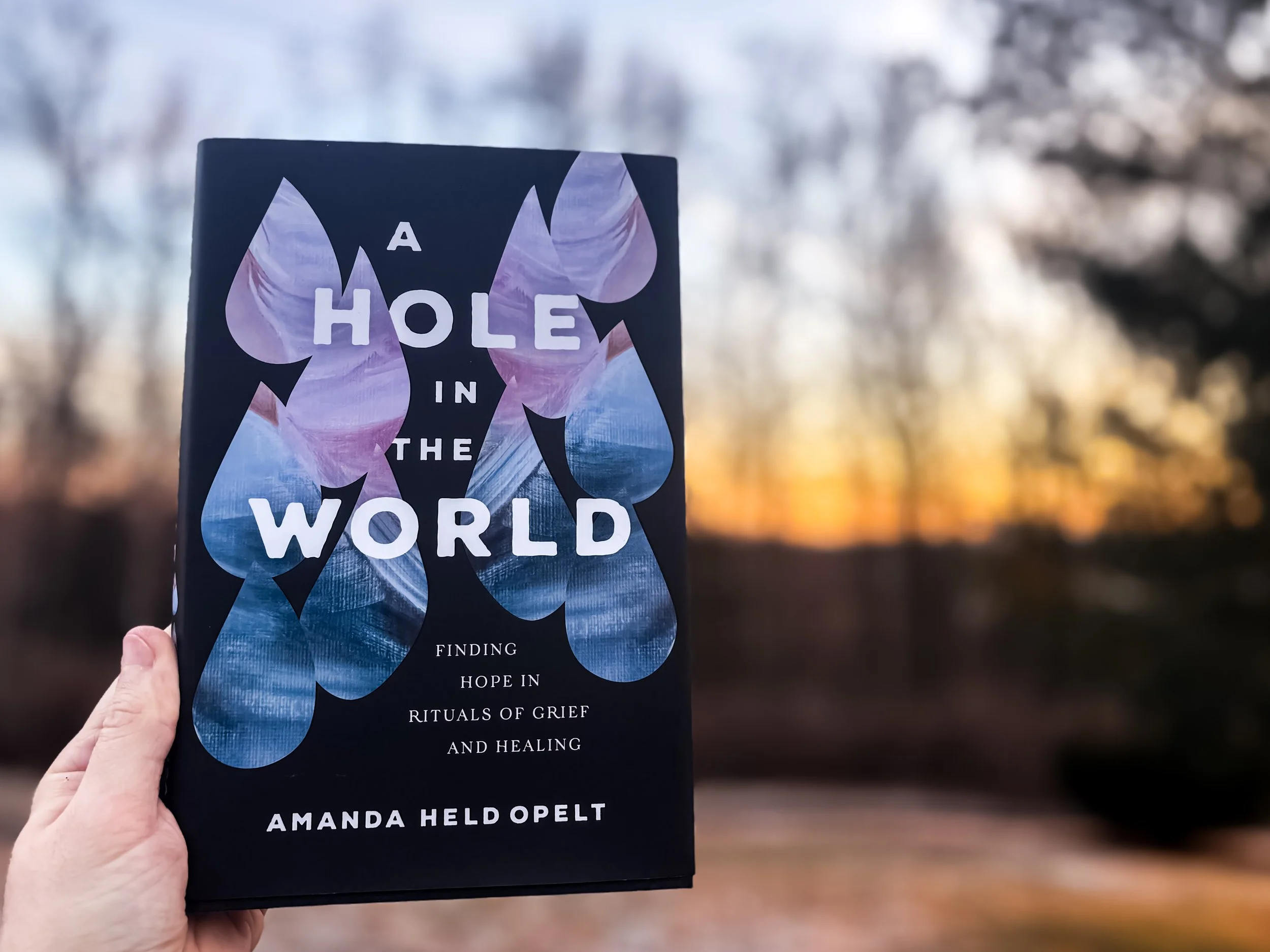
Published in 2022 by Worthy Publishing, Nashville, TN
240 pages
ISBN: 9781546001898
On a chilly February day in 2020, I pulled into the driveway of St. Luke’s Episcopal Church in Boone, NC. The white exterior walls and multi-colored stone foundation contrasted with the teal metal roof as gray clouds hung overhead, portending a soon-to-come snowstorm. This was my first time attending St. Luke's and my First Ash Wednesday service since moving back to the area at the end of 2019. In recent years, I had slowly fallen away from regularly attending church. Yet, while most nominal Christians may only participate in church on Christmas and Easter Sunday, my non-negotiable, must-attend service has become Ash Wednesday.
There’s something uniquely special about gathering together in a community to acknowledge the reality of our own mortality. “Remember you are but dust, and to the dust you shall return.” This mantra, spoken over the congregation as we receive ashes on our foreheads, was largely foreign to me in my evangelical upbringing. Religious rituals were more often eschewed in favor of large stage productions and worship bands, who, in Pentecostal fashion, would take up a large bulk of the service. During my time in college and graduate school, I came to appreciate the importance of quiet, somber reflection as an integral part of worship. The rituals of Ash Wednesday services, during this time of my life, became a key way for me to connect with not only my own finite being, but also with the mystery of the Divine.
As such, on this particular day, I remember running into my friend, Amanda, on the way into the service. She was on the leadership team at the church I attended in Boone, theHeart, often leading worship and occasionally providing sermons in the auditorium of Watauga High School on Sunday mornings. At first, I was surprised to see her here, but I also remembered that her sister, Rachel Held Evans, identified with the Episcopal tradition. Rachel, a prolific writer and speaker within the Christian deconstruction movement in the mid-2010s, had suddenly and unexpectedly passed away after being medically induced into a coma as a result of an allergic reaction to medication used to treat a case of influenza. At the time, I had been in conversation with many of Rachel’s contemporaries in the burgeoning progressive Christian movement that was beginning to blossom in the pre-Trump religious and political climate.
As opposed to her sister, who was often a bold and persistent voice who railed against the abuses of the Church and actively questioned accepted dogma, Amanda was always much more reserved and quiet in my interactions with her. She exudes a sense of stability and warmth, and while we never became incredibly close during my time in Boone, we regularly interacted and had many conversations at church. Thus, when I saw Amanda rushing into service on that midday service, I immediately felt a sense of comfort and familiarity, glad to have someone else here at the service that I knew.
Little did I know what was going on in Amanda’s world at the time. Still reeling from the loss of her sister, she was also struggling with pregnancy issues after suffering from a second miscarriage in December. Just a few weeks after this service, little did we know that the world would be plunged into a deadly and long-lasting pandemic, which would claim the lives of over seven million people (including one million Americans alone). Death and suffering were indeed at our doorstep.
During this time, Amanda was compiling research for a book she was writing about the rituals of grief. I heard little snippets from her and her research efforts during this time, and I was excited to read more about it. As such, in her 2022 book, A Hole in the World: Finding Hope in Rituals of Grief and Healing, author and songwriter Amanda Held Opelt offers a profoundly personal yet pastorally resonant reflection on the nature of grief and the spiritual role of ritual in processing it. Written in the wake of her sister’s death, Opelt explores a range of historic mourning customs and rediscover the healing potential of communal and embodied practices.
Overview:
Framed through the lens of her personal experiences, especially the death of her sister, the influential Christian writer, blogger, and speaker Rachel Held Evans, Opelt interweaves memoir with anthropological and liturgical insights to recover what she describes as “lost rituals” of grief. Each chapter is anchored in a specific grief practice, including Irish keening, Jewish sitting shivah, covering mirrors, postmortem photography, bringing casseroles to the bereaved, donning mourning clothes, and more. Each example serves as both a case study to examine cultural behaviors and an opportunity to reflect on their theological significance.
Raised in evangelical culture, Opelt saw her faith challenged by overwhelming loss. She came to value the ordered, communal forms of religious rituals over the privatized notion of a purely personal relationship with God. Through rituals such as putting on black clothing, opening sympathy cards, visiting and decorating graves, and eating casseroles prepared by friends, Opelt physically moved through grief, allowing her community to acknowledge and share in her sorrow. Grief comes in waves and reaches down into the deepest parts of us, as she writes, “Grief is like water. It follows gravity. It finds the lowest part of you and hollows it out even more. It exploits your weaknesses. Grief goes where it wants with or without an invitation. It seeps into the empty spaces” (41). But attending to grief with intention, guided by ritual, can also expand one’s capacity for love and healing.
Through this work, Opelt confronts deep queries into the nature of suffering, how faith succeeds and fails to prepare us for loss, and how rituals aid in the process of grieving. In doing so, Opelt counters the disembodied, hyper-individualistic modes of spirituality that dominate much of evangelical culture. Her work echoes the idea that theology emerges from concrete human suffering, not abstract doctrinal systems. Grief, for Opelt, is not a pathology to be treated or simply gotten rid of, but a rather a sacred space to be inhabited with the help of ritual, community, and tradition.
Deeper Dive:
The book is organized into twelve chapters, each pairing a grief ritual with an emotional theme. Opelt opens the book on an Ash Wednesday liturgy she attended at St. Luke’s Episcopal Church in Boone, NC, after the death of her sister, renowned writer and speaker Rachel Held Evans. This ritual of Ash Wednesday marked a peaceful entry point into structured mourning, one she’d largely avoided under the evangelical emphasis on personal faith over formal religious practice. She compares this expression of faith that her sister embraced before her death to her own faith tradition and reflects on how this Ash Wednesday service, which serves as a simultaneous expression of grief and an acceptance of death, was immediately followed by both a worldwide pandemic and her miscarriage.
In the First Chapter, Opelt introduces the Irish wailing tradition of keening. These professional mourners (most often women) would begin by singing or chanting in a low voice, gradually progressing louder until the crowd erupts in a powerful wail, allowing others to join in and give voice to their grief. She learns that fully embracing anguished sorrow is the first step toward healing. She contextualizes her own deep grief of multiple miscarriages, the loss of Rachel, and the suffering she witnessed in Iraq as a part of a humanitarian NGO within this communal ritual of letting grief voice itself.
In the Second Chapter, Opelt explores the custom of covering mirrors after death. Once thought to protect the living and the dead from evil spirits and from becoming trapped here on earth, covering reflective surfaces symbolizes transformation and helps the mourner reorient identity after loss. She reflects on her identity transformation after the loss of her sister, as she can never be the same person without her. Grief transforms those who are left behind, and to encounter this new, transformed self can be a space of incredible pain, but also of renewal and healing.
In Chapter Three, Opelt explores the lesser-known custom involving informing a hive of bees about a death in the family, presumed to prevent unrest in the hive. Opelt connects this ritual to the fear that grief brings, such as the fear of change, of forgetting, and of disconnection from others. She finds hope in remaining brave, not fighting the darkness around us, but by relinquishing control and being okay with not having clear-cut answers to the problem of suffering.
In Chapter Four, Opelt investigates the Jewish mourning tradition of sitting shivah, which is a week-long period of communal presence and visitation. She writes of how this ritual taught her that grief doesn't have to be faced alone in isolation. She discusses how these periods of suffering led her to seasons of doubt in her faith, but finds solace in remaining faithful even in the darkness of grief and pain. Instead of trying to suffer alone and put on a brave face for others to project a sense of composure, Opelt learns to accept the faithful presence of friends who offer their time to sit with her in grief. While faith often falters in the face of severe grief and loss, community and presence endure.
In Chapter Five, Opelt explores how food serves as a physical language of care. Using the example of Southern families delivering casseroles to the bereaved in the wake of a loved one’s death, Opelt highlights how grief is embodied and how shared meals with friends can be an initial source of healing. As such, caring gestures like meals affirm that sorrow impacts the body as much as the soul. Following the example of the Eucharist, consuming food together is an affirmation of life and joy amidst the sorrow and bitterness of death.
Chapter Six focuses on the Victorian-era custom of photographing the dead to permanently preserve their image. Opelt wrestles with how our memories often freeze the deceased in time while survivors evolve and change. She reflects on how memory reshapes relationships in the aftermath of loss. Our memories of the dead can too often occupy both extremes of the emotional spectrum, as we either remember only the good or the bad memories about them. There is also the danger of forgetting the dead as generations pass. As such, Opelt contends that memento mori such as these photographs help us to remember that life is fleeting and to embrace the present moment and our shared fragility as human beings.
In Chapter Seven, Opelt draws attention to how written condolences in the form of sympathy cards serve as tangible rituals of acknowledgment and lament. She shares her experience of opening pastel-colored cards regarding her sister’s death, reading every word, and allowing the language of grief to penetrate her heart rather than dismissing these sentiments as glossing over pain with contrite platitudes. She argues that, while we might be right to be somewhat skeptical or cynical regarding the sincerity of greeting cards, we also need to be more open to receiving words of sympathy and affirmation, even in the darkest moments when it seems like language fails to capture the depth of our grief.
Chapter Eight discusses the tradition of wearing a mourning dress as an outward sign that one is in a season of grief. She recalls her struggle to know what to wear in the aftermath of her sister’s death before providing a history of mourning dress (focusing largely on the Victorian era). She also compares the externalization of grief through garments to the wearing of sackcloth during the ritual of repentance in the Old Testament. For Opelt, wearing black clothes allows mourners to be seen and others to see their sorrow, opening space for honesty and compassion in a grief-averse culture.
In Chapter Nine, Opelt looks at the custom of tolling church bells at or before a death, believed to ward off evil spirits. It was also used as a method of determining who had died, as the frequency and tenor of the tolls delineated specific details such as sex (two strikes for women, three for men) and age (tenor bells for adults, treble for children, with the number of strikes indicating the age of the deceased). While these fell out of favor in the late 1700s due to significant outbreaks of smallpox and yellow fever, rapidly growing populations, and the widespread adoption of obituaries in newspapers, Opelt uses this metaphor to consider grief as a long, resonant process that requires emotional endurance and vigilance in faith and memory.
In Chapter Ten, Opelt focuses on the curious acts of frivolity after the death of a loved one. Surprisingly, some wakes included games like hide‑and‑seek or trick-playing to celebrate life amid sorrow. Connecting Greek funeral games found in the Iliad, the book of Ecclesiastes, Irish wakes, and Appalachian traditions, Opelt argues that honoring the dead calls for embracing joy and allowing life and laughter to cohabit with grief.
Chapter Eleven centers on the history of designating specific rooms prepared for dying individuals, emphasizing dignity, ritual presence, and the reality of mortality. Death now increasingly occurs outside of the home, in the presence of doctors and nurses at hospitals instead of in the private home. Opelt traces this outsourcing of death along with the rise of the funeral industry. By examining other traditions that invite death into the spaces of the living, such as Día de los Muertos and Halloween, Opelt reflects on embracing death as part of life’s narrative, not a taboo to avoid.
Finally, Chapter Twelve examines the 19th‑century tradition of cleaning, maintaining, and decorating gravesites, specifically the tradition of Decoration Day in Southern Appalachia. She reflects on her own participation in the decline and extinction of the holiday in recent years, as well as how it carries on in different forms across the country and world, such as in Arkansas, Texas, Ontario, Canada, and Libya. Opelt uses this ritual to consider how public acts of remembrance honor both the dead and the living’s capacity to carry their story forward with intention and honor.
In her Afterword, Opelt summarizes how these rituals provided her with a framework for processing grief: ritual as form, community, and embodied practice. She argues that the institutional church is in a unique position to lead society in reclaiming these rituals of grieving, as she believes it is one of the last communal institutions still intact in the Western world. She invites readers to reclaim some of these traditions so that we can name grief, stay present in the moment, and move forward in life with hope and authenticity.
Commendations:
There are many notable strengths to Opelt’s work. First and foremost, Opelt is a deeply talented and gifted writer. She is lyrical in her prose as she interweaves historical research with deeply personal moments, making each ritual resonate beyond its immediate cultural context. Her words exude the raw vulnerability of her grief and loss, and readers are invited to share in empathy and reflection by her intimate, conversational tone. This makes the work immediately accessible and relatable to the average reader, especially those who know the acute pains of loneliness and grief.
In addition to the comfort that Opelt offers through her reflections, her writing is theologically astute without being pedantic or condescending. Though not a formally trained theologian, her reflections are pastorally grounded and liturgically rich, modeling what Dorothee Soelle once termed a “people’s theology.” She speaks from the deepest vestiges of the lived experience of loss, offering much more than just doctrinal platitudes meant to quell questioning. This theology is forged in the midst of loss, carried not only in words but in the sacredness of silence, shared community, and intentional presence.
Additionally, one of the book’s principal strengths lies in its retrieval of embodied, communal practices of grief. Each chapter explores a historical or cultural ritual, ranging from Irish keening and Jewish sitting shivah to postmortem photography and the delivery of casseroles, utilizing each example as a locus for theological reflection. In doing so, Opelt challenges disembodied, hyper-individualistic paradigms of faith, particularly those prominent within American evangelical subcultures.
Opelt also allows readers to come to the book with questions, letting them sit with them while refusing to give easy answers. Grief, in her telling, is not a puzzle to solve but a physical reality to inhabit. The body mourns, so the community brings food and comfort. The mourner wears black to externalize their grief. This echoes longstanding affirmations in liberation theology that God is encountered not through abstract doctrine, but through suffering bodies and concrete acts of solidarity alongside others. As such, A Hole in the World may be read as a subtle deconstruction of low-church evangelicalism’s suspicion of ritual, with its implicit valorization of the autonomous self over the shared sacred gesture.
While she never says it outright, her entire book critiques the American evangelical fixation on hyper-individual salvation. The fact that her mourning required structured, communal, historic practices challenges the evangelical myth that all healing is internal or intellectual. In that way, this book unintentionally performs a kind of soft deconstruction of toxic evangelical spirituality, particularly its discomfort with lament, death, and vulnerability.
The book’s central pastoral contribution lies in its reclamation of ritual as a vital source of healing. Her attention to the material, embodied nature of grief marks a theological return to sacramentality in everyday life. Theologically speaking, casseroles become a form of affirming the Eucharist, and covering mirrors becomes a reflection of apophatic theology. Opelt gently but clearly critiques the ritual aversion of low-church Protestantism by modeling how meaningful grief work requires structure, slowness, and collective presence.
Finally, even for those who possess a more radical form of theology than Opelt professes, there is much to be gleaned from her reflections on the dialectics of grief and belief. In a Christian culture that often over-spiritualizes grief and bypasses lament, this book reminds readers that God meets us within the physical, not above or beyond it. Grief isn’t a distraction from the realities of faith but rather the crucible where faith is born or remade anew. Her reclamation of forgotten rituals is a quiet resistance against a capitalist, ableist culture that denies pain, speed-runs mourning, and demands productivity. Her emphasis on ritual as resistance to grief-erasing evangelical culture serves as both a pastoral intervention and an implicit political act. She shows how spiritual formation often happens through ritualized, communal presence, even in moments of great turmoil and grief.
Critique:
However, the book’s strengths as a spiritual memoir also illuminate its theological limitations. While Opelt foregrounds and is deeply attuned to personal grief, she largely elides the political and structural dimensions of grief. There is little engagement with forms of communal grief and mourning shaped by the forces of racialized violence, economic injustice, colonialist dispossession, or ecological collapse. There is no reflection, for instance, on the grief experienced by communities targeted by police violence, or by Indigenous peoples mourning land loss and cultural erasure. This limits the book’s liberative power, as the contours of grief remain personal, rather than collective or revolutionary. In failing to engage these dimensions, the work risks universalizing a culturally specific (white, middle-class, Western) experience of loss.
To this point, the political and theological implications of public mourning rituals such as vigils, protest chants, or memorial altars remain unexamined. For instance, the theological implications of grief in movements such as Black Lives Matter or the spiritual meaning of vigils for victims of violence are not considered. Neither is the grief of mothers who lose children to carceral systems or war. Such omissions render the book pastorally poignant but politically narrow.
In a global context of mass trauma that we’ve experienced in recent years, including pandemics, state-sanctioned violence, and ecological collapse, a robust theology of grief cannot afford to remain apolitical. This apolitical dimension is understandable given the wide audience and theological nuance that Opelt is aiming for, but it remains conspicuous, especially since the cry of the bereaved is often inseparable from the cry of the oppressed. Instead, we must ask ourselves some key questions that Opelt’s study elides: Who benefits from the rituals of grief being lost? Who is denied the space to grieve? Whose mourning is publicly validated, and whose is silenced or criminalized?
Additionally, Opelt only explores grief that arises as a result of the loss of a loved one through death. While this is certainly one of the most acute forms of grief that one can experience, it would also have been interesting to examine grief that arises due to other forms of loss, such as the end of a relationship, the dissolution of a friendship, or divorce. There’s a particularity to these kinds of grief in which the person who used to be the subject of your affection goes on living while you live in the aftermath of the broken relationship. As such, Opelt’s scope could have been widened and more deeply informed by including these other forms and expressions of grief that arise from different circumstances of loss.
Assuredly, there’s a loving, pastoral gentleness to Opelt’s writing that is often healing, but it occasionally borders on quietism. While this holds an inherent appeal to me as someone naturally inclined to this approach (as Amanda also admits as much, in opposition to the fiery, challenging nature of her sister Rachel), I must challenge myself and Amanda to more fully embody the fiery, justice-oriented prophetic tradition. Specifically, when it comes to critiquing her own religious tradition, she describes evangelicalism’s failures gently, but never fully critiques its anti-ritual ideology, death-denial, or individualist God-talk. She grieves in the deconstructed ruins of a theology that often elides material suffering and death, but she also doesn’t offer much theological rebuilding.
Finally, while Opelt does gesture toward diverse rituals and includes rituals from Jewish and Irish traditions, her scope is predominantly confined to Euro-American Christian practices. Readers steeped in interfaith, decolonial, or global liberationist theologies may find the lack of engagement with non-Western grief rituals a missed opportunity. For example, the grief traditions and practices of Indigenous, African, or Asian spiritualities are notably absent.
While she does acknowledge this limitation at the outset and admits that she is focused on Christian and Jewish traditions, Opelt also does not grapple with post-Christian forms of ritual-making. For readers whose grief unfolds outside institutional religion, they will likely not resonate with many of Opelt’s more Biblically-oriented observations on grief. A broader comparative or interreligious analysis could have significantly expanded the scope and depth of the book’s spiritual imagination, reaching out beyond a Christian framework.
Conclusion:
Overall, A Hole in the World is a deeply compassionate yet theologically provocative contribution to contemporary Christian discourse on mourning and grief. While its lack of structural critique and intercultural/theological breadth limits its utility for a wide audience, its theological humility, narrative honesty, and deep reverence for embodied ritual make it a valuable companion for those navigating loss, especially those emerging from traditions that have not taught them how to mourn. Through personal narrative and historical research, Opelt shows how ritual can bridge the gap between emotional chaos that one feels in the wake of loss and how healing can be found by embracing community. It’s a book for anyone wrestling with loss, faith, and the longing for meaning in grief.
Opelt’s work is particularly valuable for readers coming out of low-church or evangelical traditions who feel unmoored in their grief. The book gently reintroduces sacred rhythms to lives formed in a culture that fears silence and commodifies healing by offering quick fixes. It gently challenges American religious culture’s aversion to lament, reminding readers that mourning is not a failure of faith, but often its deepest expression. For those emerging from evangelicalism or other anti-ritual traditions, Opelt’s journey may serve as a guide toward healing through embodied, historic, and communal practices. It will also serve well in pastoral contexts, those seeking spiritual formation in the wake of loss, and as a rich and compassionate source for undergraduate theological education.
For those with a more radical theological bent (such as myself), A Hole in the World still offers a compelling case for the reclamation of grief rituals as acts of resistance. In a late capitalist society that commodifies healing and erases death, Opelt’s insistence on sitting in sorrow is itself countercultural. Theologically, her project aligns with the radical affirmation that mourning is not weakness. Grief names what is broken in a world that would rather look away. In a culture increasingly shaped by denial of death, Opelt offers a quiet but firm alternative: to mourn slowly, together, and with intention.
While the book may not satisfy those seeking systemic critique or radical transformation, it excels as a pastoral text for spiritual formation in grief. In this sense, it holds a needed space in the broader project of reclaiming Christian practices of lament as acts of both resistance and hope. As the church continues to reckon with its complicity in spiritual bypassing and its failures to hold space for lament, Opelt’s work gently but firmly calls the faithful back to the ancient wisdom of ritual: to keening, casseroles, and the memento mori of the tolling bell.