
Baltic: The Future of Europe - Oliver Moody
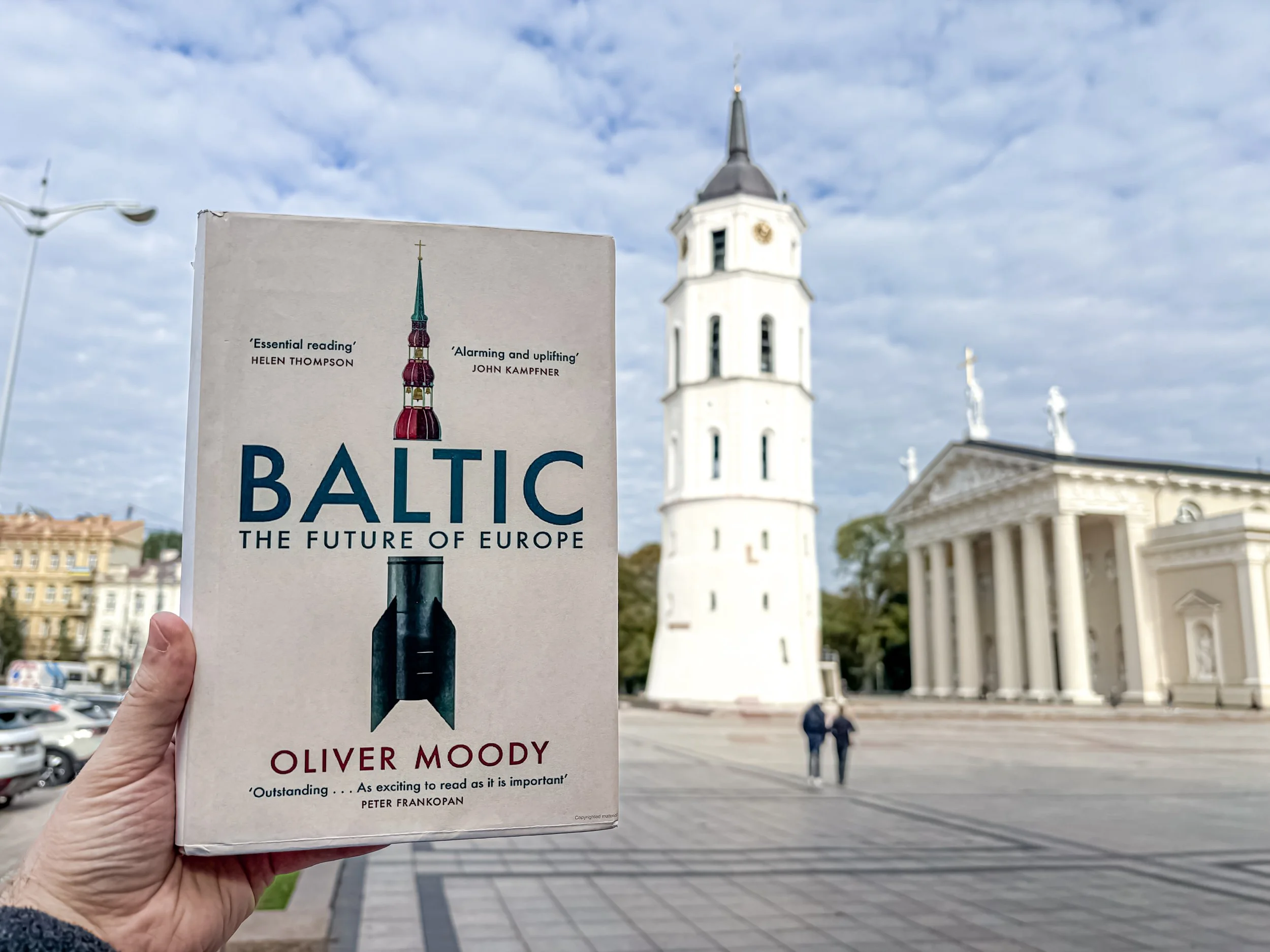
Published in 2025 by John Murray Publishing, London UK
384 pages
ISBN: 9781399814270
The underrepresentation of Estonia, Latvia, and Lithuania in Western media is deliberate rather than incidental. Although these countries are members of both the European Union and NATO, they are frequently positioned on the so-called periphery of Europe and have been historically marginalized, occupying a liminal space in the Western imagination. The Baltic States are often perceived as insufficiently "Western" to wield significant influence, unlike countries such as Germany or France, yet not "exotic" enough to attract scholarly interest in the manner of the Balkans or the Middle East. Consequently, the Baltic countries are routinely relegated to the margins of Western attention.
When Western media do pay attention to the region, it is only in response to the activities of their neighbor, Russia. Mainstream Western media, especially U.S. and U.K. outlets, focus coverage where there’s either strategic interest or commercial potential. The Baltics fall into neither category. News coverage of the region tends to spike only during moments of escalating tension with Russia, such as after the annexation of Crimea in 2014 or during NATO military exercises. Journalists flock to Riga or Vilnius when NATO troops arrive or Russian jets fly too close to the border, yet there is no sustained attention to Baltic society, culture, or politics unless there’s a direct threat. As such, Estonia, Latvia, and Lithuania too often become props in someone else’s geopolitical drama rather than subjects in their own right.
This marginalization, however, is a grave mistake. In his 2025 book, Baltic: The Future of Europe, journalist Oliver Moody presents a timely exploration of the Baltic Sea region’s emerging strategic significance within contemporary Europe. Arguing that this region is no longer peripheral but central to Europe’s political, ideological, and militarily secure future, Moody weaves together history, first-hand reports, and political analysis to illuminate how these nations are working to confront the geopolitical, technological, and environmental challenges of the 21st century. The future of Europe, he argues, lies around the Baltic Sea, in those small, restless democracies that have learned to thrive on insecurity.
Overview:
Moody’s work arrives at a moment when Europe is searching for both moral direction and strategic coherence. Russia’s war in Ukraine has shattered post-Cold War illusions of peace, while austerity, inequality, and populism have left the European project frayed. Moody, a Times correspondent long stationed in Berlin, offers a counter-intuitive answer to these looming crises: look north-east to the Baltic States.
The Baltic region has long felt that its place was on the margins of European attention. Moody claims that it is slowly changing, as its strategic importance is growing (especially because of Russia’s aggressive posture). Expanding our conception of the Baltic region to include not only Estonia, Latvia, and Lithuania, but also Finland, Sweden, Denmark, Germany, Poland, and bordering Russia, Moody argues that this region, long treated by many in Western Europe as peripheral, is now becoming central to the future of Europe. Because of its geography, history, recent political developments, and responses to external threats, Moody argues that this region has become a kind of frontline, offering lessons in security, governance, innovation, resilience, and identity that the rest of Europe can learn from.
Taking on the history of each country in turn, Moody highlights the Baltic States’ enduring legacy of 20th-century trauma, including war, occupation under various regimes, and Soviet rule, which has left them to become deeply skeptical toward authoritarianism and possess an acute sensitivity to Russian influence. Through more than a hundred interviews and finely observed reportage, Moody constructs a portrait of a region that has transformed vulnerability into strategy. Moody argues that this history has shaped the region’s culture, politics, and public attitudes in ways that make these countries more alert to threats, more willing to experiment, and often more capable of rapid adaptation.
Additionally, Moody emphasizes the region’s resilience and innovation. For example, he showcases Estonia’s pioneering digital governance, leveraging technology (despite its limited resources) to make a space for itself within broader European discussions. He highlights Poland’s evolution from fixating on its own past to becoming a central player in the Baltic region. Moody also broadly discusses the environmental initiatives within the region, such as nuclear-waste storage in Finland and the zero-waste community on Denmark’s island of Bornholm. He contends that these are examples of how Baltic states are not just reacting but proposing models for how to handle modern challenges. It’s not all success, though, as Moody also discusses internal divisions such as minority Russian‑speaking populations, political scandals, populism, demographic pressures, environmental risks, and energy dependence in the region. These challenges have also shaped how these countries craft international policy and have deeply influenced their relationships with their neighbors.
Moody situates these developments against the backdrop of renewed Russian aggression, particularly following the invasion of Ukraine, underscoring the Baltic States’ essential role within NATO and the European Union as frontline defenders of Western liberal values. As Moody interviews politicians, generals, diplomats, and scholars in the region, he advances the broader claim that Europe’s future may hinge on lessons drawn from these relatively small but strategically pivotal nations.
Moody’s key proposition is that the West cannot afford to treat the Baltic region as marginal. His broader claim is that much of Europe, particularly its more established powers that may feel “tired, divided, or complacent,” could learn from the Baltic region’s example. These states have both lived experience of dealing with Russian pressure and built models of resilience. In terms of security, democratic vitality, and innovation, Moody sees the West’s future as intimately intertwined with the region, as he calls for greater military spending as a form of deterrence against Russian incursions.
Commendations:
There are several notable strengths to Moody’s analysis. First of all, by integrating a mix of travel reportage, interviews with policymakers and citizens, and historical reflection, Moody creates a textured, multi-dimensional portrait of the region. He correctly reminds readers that small states are not mere pawns in great-power politics. The Baltic region, long cast as Europe’s periphery, becomes in his telling a workshop of modernity. Estonia’s leap into digital governance, Finland’s culture of preparedness and negotiation, and Denmark’s model of green capitalism all testify to what Moody calls “the agility of the small.” As such, Moody excels in granting the Baltic States agency and voice, moving beyond reductive portrayals of them as mere pawns in great power politics.
As someone wary of grand theories and Western parochialism, I found Moody’s focus on the margins to be refreshing. His work provincializes what we typically consider to be the imperial core of Western empire, showing how Europe’s supposed backwaters are innovating faster than its old metropoles. At his best, Moody writes with the pace of a foreign correspondent and the insight of a political anthropologist. As such, I appreciated Moody’s writing style that consistently remains vivid, humane, and unusually attentive to the unique position the Baltics hold.
His account also gives space to voices that rarely reach Anglophone media and discourses, highlighting the Baltic foreign ministers, farmers, politicians, analysts, and teachers who articulate what resilience means in daily life. As such, I deeply appreciated Moody’s challenges to the West’s habit of seeing Eastern and Northern Europe as zones of dependency or danger. Rather, he persuasively insists that they are sources of renewal and inspiration.
Additionally, Moody rightly situates Russian state aggression and disinformation as a real threat to democracy in the region. As a Leftist, I believe that we should oppose imperialism and authoritarianism wherever they arise. While I might be critical of NATO’s historic involvement in meddling with foreign affairs, Moody's firm stance helps challenge overly simplistic anti-Western or anti-NATO narratives. His analysis underscores the importance of defending liberal democratic values, the rule of law, and human rights in the face of hybrid authoritarian tactics.
Finally, by documenting Baltic initiatives in sustainability and environmental governance, Moody contributes to broader discussions on climate and ecological security, showing that smaller states can lead on pressing global issues, such as addressing climate change. Moody’s inclusion of Baltic countries’ leadership in environmental sustainability and innovation, such as green energy or nuclear waste management, provides a hopeful vision that smaller states can pioneer environmental governance in the face of immense global challenges.
Critique:
Yet, despite all of its merits, Moody’s work is constrained by several notable weaknesses. Beneath Moody’s brisk prose and cosmopolitan admiration lies a familiar ideological core that undergirds much of the book’s foundational assumptions. In short, I contend that Moody’s vision of the Baltic region in this work is not the future of Europe, but rather an attempt to re-enchant and breathe life into a decaying liberal order that refuses to confront its own contradictions.
An Economic Critique:
First of all, Moody’s economic argument is simply a repackaging of twenty-first-century liberalism. The small states of the Baltic, he insists, have escaped the sclerosis and overladen bureaucracy of Western Europe through openness, efficiency, and flexibility. In his estimation, Estonia’s digital government, Finland’s culture of preparedness, and Denmark’s green capitalism all become evidence of a new social contract between citizens and markets. The region’s transformation, he argues, stems from openness, deregulation, and digital innovation, which is ironically the very formula that Western elites have preached for three decades. Moody is ultimately making the argument that if only the rest of Europe could shed its bureaucratic complacency and emulate this agile form of capitalism, renewal throughout Europe would surely follow.
What Moody never pauses to consider is the social cost of this economic miracle, which is ultimately built on a foundation of austerity, out-migration, and the privatization of welfare. Estonia’s digital utopia sits atop a deeply divided labor market, and its highly-celebrated e-citizenship coexists with some of the highest inequality and housing costs in the EU. Latvia’s vaunted “fiscal discipline” (aka. austerity) hollowed out rural communities and produced mass emigration after the 2008 crisis, an issue that still haunts Latvia today as its population continues to decline. Finland’s “total defense” economy, once rooted in social democracy, now bends toward privatization and precarious tech labor. The region’s success, in other words, is success for the forces of capital, not necessarily for the working classes who sustain it. As such, Moody’s admiration for Baltic dynamism often slides into liberal economic optimism, the conviction that markets and technology can solve almost anything.
Historical Critique:
Furthermore, when it comes to his historical narration of the region's recent history, Moody once again defaults to a standard neoliberal narrative. His portrayal of the Baltic States’ economic transformation tends to overlook the profound social dislocations engendered by the post-Soviet neoliberal turn. The Baltic States’ integration into the EU and adoption of market liberalization have had mixed outcomes, both socially and economically. The Baltic States’ integration into the EU brought structural funds and investment but also imposed fiscal discipline, often requiring austerity and labor market flexibility. The rapid privatization of state assets, deregulation, and austerity measures deeply affected working-class populations, especially in Latvia, Lithuania, and Estonia. These policies led to rising income inequality and poverty rates, precarious labor markets, underemployment, and wage stagnation.
These factors have led to the outmigration of young people seeking better economic opportunities abroad, exacerbating demographic challenges. For example, in Estonia, while the digital economy boomed, rural areas and older generations faced neglect, widening social and regional divides. Latvia is rapidly losing its population to Western European nations, while most who stay within the country are consolidating within Riga. Moody does not fully interrogate how these economic reforms undermined social safety nets, which remain fragile, nor how they contributed to political disillusionment and the rise of nationalist or populist sentiments. While he does point out some of these ill-effects, Moody tends to present EU membership as a stabilizing and positive force without adequately discussing how EU-driven neoliberal frameworks limit states’ ability to implement expansive social policies.
In this sense, Moody’s vision reproduces what David Harvey calls the moral geography of neoliberalism, in which every crisis becomes a spur for innovation and every hardship an opportunity for resilience. The Baltic states’ capacity to survive austerity and adapt to market discipline is reinterpreted as moral virtue rather than material necessity. Moody’s admiration for their dynamism masks a basic truth: the flexibility he praises is the flexibility of semi-peripheral capitalism, where survival depends on remaining competitive within a global hierarchy dominated by Western capital and NATO patronage.
Technological Critique:
Furthermore, Moody’s techno-optimism echoes what Evgeny Morozov calls “cyber-utopianism” and “solutionism,” which is the conviction that every political problem can be solved by better design. What vanishes in this discourse are the conflicts that structure all societies, such as class struggle and ethnic division, two issues that are prominent in the Baltics. Instead of confronting these contradictions, Moody offers a narrative of perpetual optimization, particularly when it comes to Estonia.
For example, while Estonia’s digital state is praised as a model for the rest of the West to follow, Moody does not critically examine digital surveillance risks, data privacy, and inequalities in digital access. Technological innovation must be coupled with robust social protections and democratic oversight to avoid exacerbating existing power imbalances or creating new forms of exclusion.
Contrary to Moody, what is modeled in this example is not the politics of economic and social emancipation but of permanent precarity masked as “adaptation.” What appears as resilience is often the ability of small societies to absorb economic shocks that would devastate larger ones. What Moody presents amounts to little more than a high-tech austerity masked as rugged resilience. In Gramscian terms, Moody is performing hegemonic ideological work by sustaining consent for a social order in which continual efforts toward “innovation” (which are more often hype-bubbles, especially in the tech industry) substitute for economic redistribution and social progress.
Still, Moody’s portrayal does capture something real and true about the region. These are societies that have rebuilt themselves through determination and ingenuity over the past few decades, often facing enormous obstacles. Moody’s optimism is not cynical or fully misplaced, but merely selective in which case studies it highlights. What’s ultimately missing from his study is class analysis, recognizing that the same reforms that created the Baltic’s tech miracle also created its precarious underclass.
Security Critique:
If Moody’s economic argument is essentially neoliberal, his strategic security argument is unmistakably reminiscent of Cold War liberalism, often summarized by the stance of “peace through strength.” Europe, he argues, must harden itself militarily, technologically, and psychologically if it is to deter Russia and defend democracy. Having lived under Russian domination, these states, Moody argues, understand that deterrence, not dialogue, preserves freedom. According to this reading, the region’s military integration into NATO and its investment in cyber-defence and civil preparedness make it the frontline of Europe’s security. In this framing, the Baltic states, perched on NATO’s front line, become moral exemplars of defiance against Russia and proof that weakness invites aggression.
To be sure, there is no doubt that Russian imperialism is real and that the invasion of Ukraine has given these warnings fresh urgency. But Moody’s framing leaves no room for alternatives toward peace. He treats deterrence as common sense, not an ideological and material commitment to funding war. The result is a world permanently on alert, where the line between resilience and militarization dissolves.
Throughout the book, Moody vacillates between admiration and anxiety. He fears Europe’s decadence, pointing back to its tired welfare states, its fractious politics, and bureaucratic quagmires (particularly in Germany), and he instead finds salvation in the Baltic’s vitality. The narrative thus inadvertently reproduces an old European trope of finding redemption through the frontier. Just as the Balkans were imagined as Europe’s “other” in the 1990s, the Baltics is portrayed as a zone of danger and resistance that restores purpose to a weary civilization.
In doing so, he unwittingly rehearses a colonial logic of knowledge. Despite his well-researched examinations in the first two-thirds of the book, in the last section, the Baltic states are not treated as complex societies with their own epistemic traditions but as examples of where the West tests its models of governance and security. Their value is ultimately tied to their utility to Europe’s self-image. The result is what might be called epistemic extractivism, which is the appropriation of peripheral experiences to sustain ideology within the imperial core. Moody seems unaware of the historical irony here. A region that has for so long suffered under competing empires is recast as the West’s strategic periphery and a forward operating base in the great game of deterrence.
Essentialist Critique:
This is coupled with Moody’s Manichean vision of security, in which the West is cast as decadent and lazy, yet good, whereas Russia is disciplined and intelligent, yet bad. Aside from the expected swipes at Marxist-Leninist thought (describing it as “a boot stomping on a human face, forever” (45) or approvingly citing George Kennan’s assertion that “World communism is like a parasite which only feeds on diseased tissue” (284)), there are also a few downright essentialist and disparaging remarks about contemporary Russians, especially when comparing them against Western Europeans. For example, recounting Russia’s supposed advantages over the West, he writes,
The third [advantage] is the Russian disregard for life. The West is acutely sensitive to casualties, especially when civilians die…We should be proud that we care so much. But this care also results in a certain aversion to risk. Russia, on the other hand, has deliberately killed thousands of Ukrainian non-combatants and proven willing to expend tens of thousands of its own poorly trained and equipped troops on ‘meatgrinder’ offenses. (243)
In Moody’s view, Westerners mourn civilian casualties, while Russia has no regard for the loss of human life. While Russia is by no means a moral exemplar when it comes to the utilization of its military force, the whitewashing of Western war crimes and disregard for civilian deaths is blatantly gross.
For example, the United States seems not to have a problem when tens of thousands of Palestinian civilians are murdered by Israeli bombing and starvation campaigns. By utilizing the deaths in Ukraine as the prime example of the grief the West expresses when civilians are killed, Moody unintentionally illustrates how the Western liberal typically only mourns death when it occurs in the Global North. Proximity to whiteness is often the arbiter of whose death is deemed grievable, as seen in the immediate response of Western liberals to the invasion of Ukraine versus the occupation and genocide in Gaza. This double standard from Moody was shocking to read, offering little more than regurgitated talking points from Western military leaders rather than the journalistic rigor and relative balance that defined much of the earlier sections of the book.
Policy Critique:
Additionally, we run into one of the most problematic aspects of Moody’s work, which is his insistence on increased military spending as an act of deterrence. This Cold War stance of deterrence, he argues, “ deserves to be dusted off and updated for the twenty-first century” (276). In terms of policy, he ultimately advocates for increased funding for NATO military security, even at the expense of cutting social programs. He writes, “Some of these sacrifices are financial, such as higher taxes, cuts to other areas of public spending or the ‘security premium’ on the prices for many foods that come with attempts to reduce dependencies in our supply chains” (277).
In his view, the West needs to give up the psychological comfort that we are accustomed to and face a straightforward choice: “We can face up to these possible futures and calmly prepare ourselves to make the best of them. Or we can blank them out and then suffer the consequences” (278). This essentially amounts to a plea to fund more of the war industry, rather than investing in social spending, infrastructure, housing, and health care that are so desperately needed in the region.
The Baltic states, often operating with limited budgets, must weigh defense expenditures against education, healthcare, housing, and social welfare needs. Moody’s framing underplays this trade-off, prioritizing military strength without parallel investment in social infrastructure risks undermining the very social cohesion needed for durable peace. Not to mention that this would likely result in mass protests across Europe (for example, see the protests when Macron attempted to raise the retirement age in 2023).
Furthermore, Moody’s emphasis on NATO-backed military deterrence as the principal guarantor of peace presents a narrowly securitized conception of regional stability. The narrative strongly supports NATO as a security guarantor against Russian aggression, but does not critically interrogate the consequences of NATO expansion, militarization, or the potential escalation risks for regional security. Moody’s framing is far too aligned with hawkish security policies that can exacerbate tensions and neglect diplomatic or multilateral solutions to the region’s security dilemmas. While the threat posed by Russian aggression is real and serious, this militarized approach risks escalating tensions and solidifying adversarial blocs rather than diffusing them. Military build-ups often provoke reciprocal arms increases, heightening the risk of conflict by accident or miscalculation, especially in a geopolitically volatile space like the Baltics. Instead of fostering lasting peace, reliance on military deterrence may only work to entrench adversarial relations and create more intractable security dilemmas.
“There is no Alternative” Critique:
Finally, the book’s limited engagement with social democratic and leftist movements in the Baltics reduces the visibility of ongoing political debates about economic redistribution, social welfare, and alternatives to market orthodoxy. Moody’s sole focus on liberal democratic values and NATO integration overlooks the existence of vibrant left-wing political currents in the Baltic States, including socialist, green-left, and anti-militarist movements that critique both Russian imperialism and Western neoliberalism, alongside advocating for redistributive policies, stronger welfare provisions, and economic justice.
For example, parties like the Social Democratic Party in Estonia or Lithuania’s KArtu Left Alliance have argued that market reforms must be balanced with social protections. By framing the Baltic’s future primarily through a pro-Western liberal lens, Moody risks sidelining these critical voices that call for alternative models of social justice, economic equality, and peace. Without exploring these voices, Moody misses an important dimension of political contestation that could provide alternative, more inclusive visions for the Baltic States’ futures.
Conclusion:
Overall, Baltic is an insightful and well-researched contribution that rightly foregrounds the Baltic States’ strategic significance and innovative responses to contemporary challenges. Moody clearly articulates the historical legacy of authoritarianism in the region, spotlights innovation in the face of immense challenges, and recognizes the Baltic States’ strategic importance in the current European order. His vivid, accessible reporting style also expands current European geopolitical discourses by elevating the role of these smaller states that are all too often overlooked.
Nonetheless, Moody’s account would greatly benefit from a deeper integration of socioeconomic analysis and a more critical interrogation of the militarized security frameworks that he too often takes for granted. A comprehensive understanding of the Baltic’s future requires incorporating social justice, economic equity, and diplomatic engagement as essential complements to technological innovation and military preparedness. For scholars and policymakers seeking to grasp the full complexity of Baltic politics and security, Moody’s book is undoubtedly an essential entry point for understanding the Baltic States’ contemporary geopolitical role in the world. However, it requires complementary critical perspectives to fully grasp the social and political dynamics shaping the region’s future.
Despite its glaring blind spots, Baltic still performs an important service. It insists that the continent’s future will be shaped not only in Paris and Berlin but in Tallinn and Riga. As a guide to Europe’s renewal, however, Moody’s vision remains constrained by the very liberalism he uncritically celebrates. His Baltic future is still capitalist, militarized, and defined by the need to out-compete and out-arm rival nations. It offers no structural critique of the forces that have made the region vulnerable in the first place, including neoliberal austerity measures and narrowly-focused, militarized alliance politics.
At its core, Baltic is a book about liberalism trying to save itself. Its economic optimism and martial realism are two halves of the same project, which is to convince a disillusioned West that capitalism and militarism can still deliver order and security in a politically and economically fraught region. The Baltic region offers a comforting illusion that the system seems to work somewhere on the periphery, and so it might yet work again in the imperial core. But as with all ideological parables, the reality is less heroic. The Baltic miracle depends on EU subsidies, Nordic capital, NATO protection, and a compliant labor force. Its security rests on the permanent threat of war. Its prosperity is uneven, its politics are fractious, and its future ever more uncertain.
Moody’s account never grapples with these contradictions because to do so would expose the limits of the very order he celebrates. Moody’s Baltic is less about the region itself than about what the region reveals of Europe’s self-image. The continent looks to its frontier for renewal, as it once looked to America or Asia. Moody’s portrait of the region can be read as an optimistic projection in which a weary civilization sees a younger, braver version of itself. As such, when read critically, Baltic is not a manifesto for Europe’s renewal but a mirror of its unexamined contradictions. It is a book worth engaging, not because it is right, but because it reveals how deeply Europe’s future remains tied to the logics of capital and security that made its past so fraught.
The book’s lasting value, then, is puzzlingly paradoxical, as it both documents and dramatizes the limits of the liberal imagination. Moody shows us what resilience looks like under capitalism, but not how to move beyond it. It is an illustration of liberalism at war with itself. By contrast, a genuinely transformative vision for the region would begin elsewhere. It would ask how to democratize digital infrastructures rather than privatize them. It would seek to build peace through social justice and de-escalation rather than deterrence. It would strive to confront Russian imperialism without reproducing Western militarism and outdated Cold War strategies that only line the pockets of weapons manufacturers and arms industry stockholders. In short, such an account would abandon the fantasy of renewing Cold War liberalism and instead embrace the harder work of building international solidarity beyond capitalism. Until liberalism learns this lesson, its future will remain trapped in the past it stubbornly refuses to outgrow.