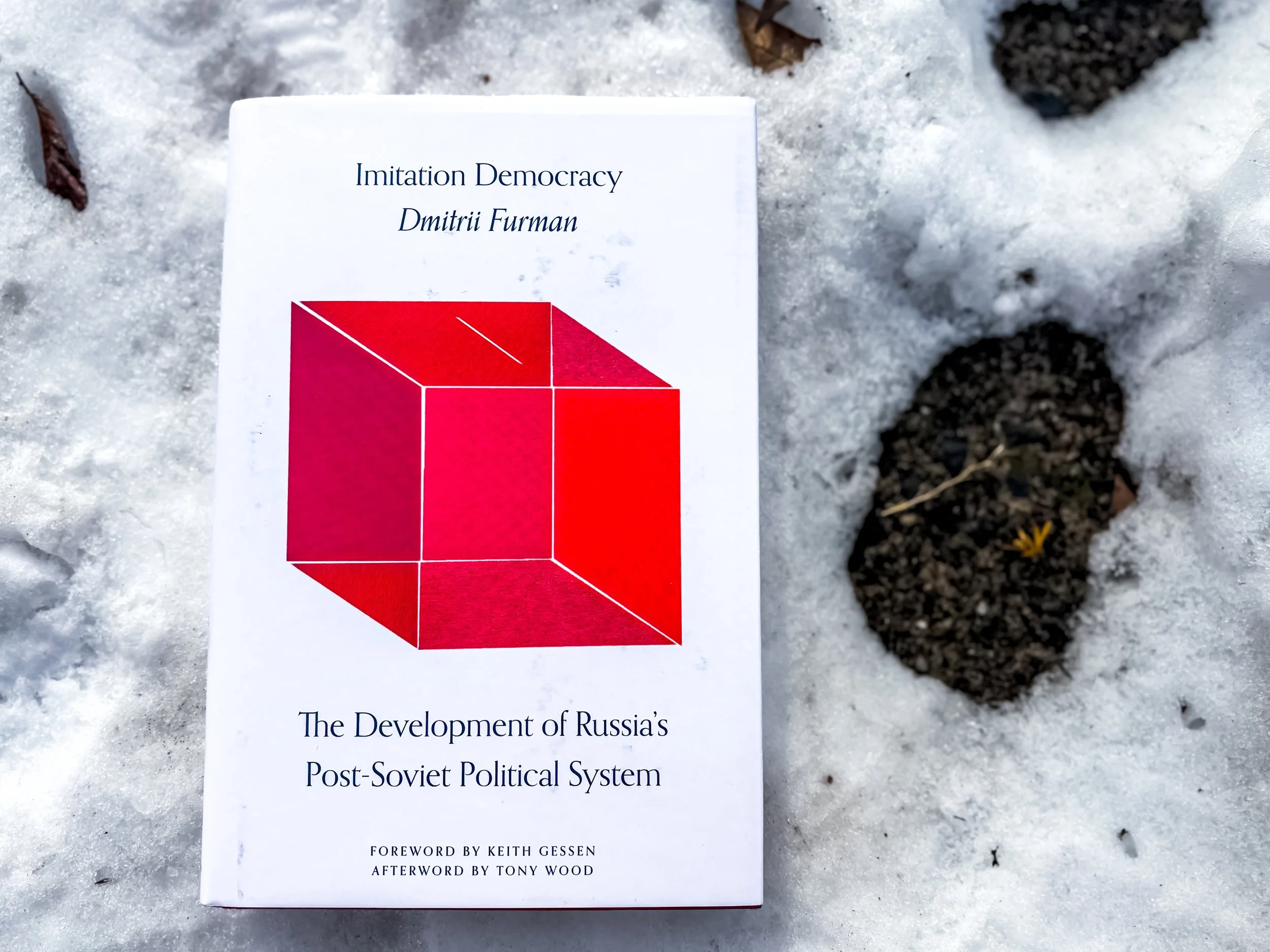
Imitation Democracy: The Development of Russia’s Post-Soviet Political System - Dmitrii Furman
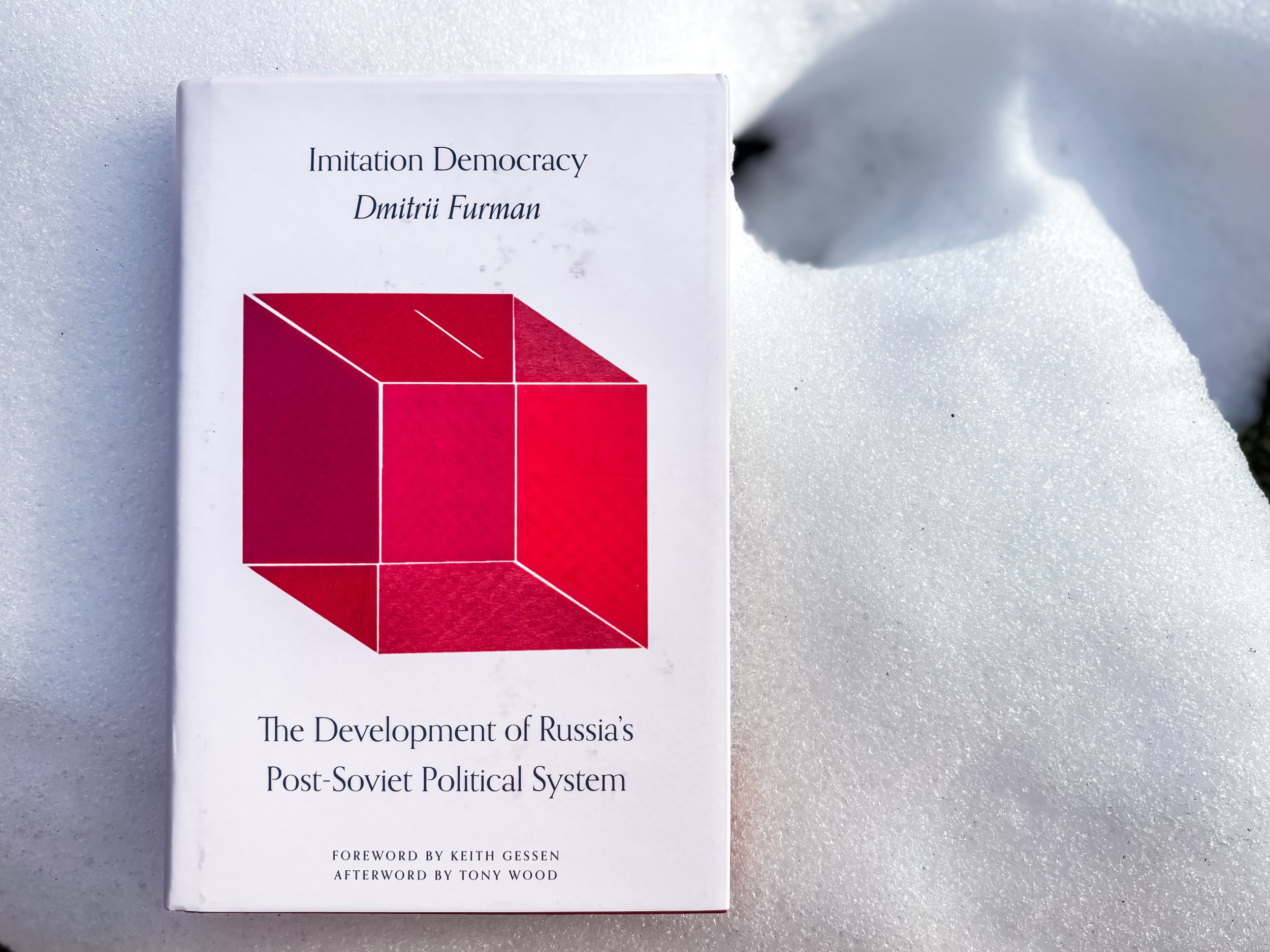
Translated by Ian Dreiblatt
Forward by Keith Gessen
Afterword by Tony Wood
Originally published in Russian in 2010 as Dvizhenie po spirali (Spiral Motion)
English language edition published in 2022 by Verso, London, UK and New York, NY
On the morning of October 4th, 1993, residents of Moscow gathered along the Moskva River to watch a peculiar sight. A line of heavily-armored tanks that had surrounded the White House, which is the seat of the Russian legislature, began to fire on the building. These tanks, however, did not belong to a foreign power. Rather, they were Russian forces firing on their own legislative building.
To understand how this occurred, we must first examine the relevant context. Two and a half years earlier, a referendum was held across the majority of the Soviet Union. Except for the Baltic States, Georgia, Armenia, and Moldova, the overwhelming majority of Soviet citizens (roughly 78%) supported the continuing existence and preservation of the Soviet Union. Yet, only nine months later, on December 8th, 1991, after several months of instability and succession by various states, the Soviet Union was suddenly dissolved overnight by the leaders of Russia, Ukraine, and Belarus during a secret meeting in the Białowieża Forest.
Soon afterward, Russian President Boris Yeltsin instituted his “shock therapy" economic reform program, which brought about rapid privatization, price liberalization, new taxes, and austerity measures that were designed alongside Western advisers and institutions. These policies were intended to usher Russia into the fold of Western economies, but they instead produced widespread impoverishment, a collapse in life expectancy, and the concentration of wealth in a tiny elite. Unemployment hit all-time highs, and government services were slashed while formerly-nationalized industries were rapidly privatized, splintered, and sold to the highest bidders, thus creating a new oligarchic class.
While discontent was growing rapidly among the greater Russian population, Yeltsin worked to consolidate his power. By 1992–93, the Congress of People’s Deputies and the Supreme Soviet (aka. Russia’s elected legislature) had become the main institutional sites of resistance to this neoliberal program. This led to a bitter standoff between Yeltsin and the Russian Parliament, which was highly critical of these economic reforms.
After a failed impeachment attempt and a national referendum in which confidence in Yeltsin was narrowly sustained and new legislative elections were called, Yeltsin used these victories as a mandate to tighten his grip on power. In September 1993, Yeltsin openly violated the existing constitution by issuing Decree No. 1400, dissolving parliament, and calling new elections in an attempt to pave the way for unrestrained market-based economic reforms. The Constitutional Court ruled his actions unconstitutional, and Parliament responded by impeaching Yeltsin and naming Vice President Aleksandr Rutskoi acting president.
While this made Yeltsin popular with Western powers who sought to eradicate the last traces of communist influence, it made him vastly unpopular with the general public, who saw it as a coup d’etat. What followed was a dual-power situation in Moscow, with both sides claiming legality. Crucially, Yeltsin retained the loyalty of the military, security services, and key media outlets.
The standoff ended violently in early October. After street protests and clashes involving workers, pensioners, and leftist activists, the army shelled the parliament building on Yeltsin’s orders. Hundreds were killed (although the true number remains disputed), and thousands were arrested. The charred building continued to burn as television cameras rolled, broadcasting the end of a constitutional crisis. In the aftermath. Yeltsin imposed a new constitution through a highly managed referendum in December 1993, creating a hyper-presidential system with weak parliamentary checks, which is an architecture that still shapes Russian authoritarianism today.
Western governments enthusiastically supported Yeltsin throughout, revealing their priority to institute neoliberal market reforms against the will of the people, despite their ill effects. The typical liberal narrative about post-Soviet Russia is one mostly based on fiction. In this telling, Russia began to take steps toward democracy in the Yeltsin years, messy as it may have been. Then, Vladimir Putin came along and crushed any sense of democratic normalcy, ruling Russia with an iron fist, sabotaging Russia’s trajectory toward democracy, and plunging the nation into authoritarianism.
As we’ve seen in this closer examination, however, this fantasy is easily dismantled. Far from a transition toward democracy, October 1993 marks the moment when post-Soviet Russia’s future was decisively bent toward oligarchy and executive authoritarianism, rather than any legitimate form of democratic or egalitarian reconstruction. The liberal fixation with Vladimir Putin’s personality eclipses a clear-eyed analysis of the historical development of post-Soviet Russia, as he is often contrasted against Yeltsin, who Westerners claim was a reformer and champion of democracy.
Instead of viewing Yeltsin and Putin as two opposing poles between democracy and autocracy, there exists a contingent of Russian thinkers and writers who argue that these two men are much more alike than different, representing different phases of a singular track of post-Soviet political development. Originally published in Russian in 2010 and translated into English in 2022, Russian sociologist and political scientist Dmitrii Furman’s Imitation Democracy: The Development of Russia’s Post-Soviet Political System traces the development of Russia’s political landscape in the two decades following the dissolution of the Soviet Union. What replaced the Soviet Union during the Yeltsin years, Furman argues, was not a democracy that later failed, but a political system designed from the start to appear democratic while preventing popular power from ever taking root. As such, Putin’s rule is not a dramatic rupture with the principles of Yeltsin, but rather the continuation and logical conclusion of a system that never placed power in the hands of the people in the first place.
Overview:
Written by a Russian scholar deeply embedded in the intellectual and political life of late Soviet and post-Soviet Russia, Furman’s book seeks to explain why the collapse of the USSR did not result in the consolidation of liberal democracy, but instead produced a durable hybrid regime combining surface-level democratic forms with authoritarian substance. In the nearly two decades between the dissolution of the Soviet Union and the publication of this book, several post-Soviet states had transitioned into democracy, in which various opposition parties had been elected to power in various election cycles. Russia, however, had not.
Furman, originally a scholar of comparative religion, analyzes the political trajectories of post-Soviet states to explain why some transitioned to democracies while others (including Russia) did not. Since these states emerged from the same Soviet background, their leaders faced similar political obstacles during their development. While internal differences such as religious, linguistic, and ethnic diversity contributed to differences in development, many of these states (including Belarus, Kazakhstan, and Russia) faced an internal contradiction as they espoused democratic ideals while wholly lacking the popular willpower to legitimize the neoliberal transformation of their economies. As such, Furman compares the development of imitation democracy to a kind of biological “species,” complete with its own stages of development and life cycles.
At the core of Furman’s analysis, then, is the claim that Russia did not experience a failed or incomplete democratic transition, but rather developed a distinct political system whose stability depends precisely on the imitation of democratic procedures. In this “imitation democracy,” elections, constitutions, parties, and representative institutions exist and function as they would in genuine democracies, yet they do so in ways that systematically exclude genuine political alternatives and popular accountability. Democracy, in this framework, becomes a legitimating ritual rather than a mechanism for the articulation and resolution of social conflict.
Furman rejects the widespread liberal narrative that juxtaposes a democratic 1990s with an authoritarian Putin era. Instead, he demonstrates that the institutional architecture of imitation democracy was largely constructed during the Yeltsin presidency, particularly through the 1993 constitutional settlement and the subordination of representative institutions to executive power. While Yeltsin’s administration was widely praised and supported by Western leaders as a model for democratic transition, in reality, it worked to consolidate control and ensure that a viable opposition could not challenge the power of the newly formed capitalist class. Putin’s role, in this account, is not one of radical shift from democracy to autocracy but of consolidation and stabilization of a previously established system. For example, Putin’s first act in office was to pardon Yeltsin from legal prosecution during his tenure as President. Far from a regression to an imagined Soviet past, Putin’s rule has been the logical consequence of this new post-Soviet system that Yeltsin established.
Methodologically, Furman combines institutional analysis, electoral data, and long-term public opinion research to buttress his argument. Furman’s approach blends historical narrative and empirical data (primarily in the form of public opinion polling data) to explain why Russia’s political system looks democratic but functions with authoritarian dynamics. Throughout his analysis, Furman treats public opinion as a socially conditioned variable shaped by depoliticization, elite manipulation, and apathy in the absence of meaningful alternatives. The result is a nuanced account of how consent, apathy, and resignation coexist within an ostensibly democratic system.
This led to what Furman saw as the inherent limitations of Russia’s imitation democracy that was beginning to show cracks during the book’s writing in the middle of Medvedev’s presidency. He argues that the current system will inevitably face a crisis, as the tensions and contradictions ultimately accumulate to a tipping point. Furman believes that there is an ever-widening gap between the outwardly stated form of democratic institutions and the authoritarian content of governance. This could lead to feedback loops that become increasingly weakened and detached from the will of the people and the needs of its society.
Thus, the signs that were previously seen as strengths that helped to consolidate the regime (aka. total control over politics and the elimination of challengers) invariably become liabilities, leading the system toward stagnation or crisis rather than renewal or liberalization. Continuing his biological framing, Furman suggests that once imitation democracy reaches maturity, it must inevitably enter a period of decline. As such, the political system will either be toppled by the weight of its own contradictions or must adapt to survive.
In the final chapter, Furman speculates on possible futures for Russia’s political system. The internal contradictions of the political system lead Furman to outline two possible scenarios: either a genuine transformation toward more democratic practices or a deeper entrenchment of authoritarian rule under the continuing guise of democracy. He does not predict a specific outcome for Russia, but rather frames the problem in terms of the various structural pressures and historical possibilities that provide precedents for such outcomes.
Commendations:
Furman’s concept of “imitation democracy” offers one of the most conceptually compelling analyses of Russia’s post-Soviet political system to date. He avoids the pitfalls of both liberal-democratic teleology and crude authoritarian labeling, offering a framework that explains the internal logic and durability of the Russian political system instead. Furman shows how elections, constitutions, parties, and parliaments function not as mechanisms of popular power, but as ritualized methods to maintain a facade of legitimacy. Furman correctly notes the differences in the democratic transitions of post-Soviet states and why Russia seemed to lag behind. By capturing this outcome with notable precision, Furman’s work holds significant explanatory value for scholars of post-communist transitions and comparative forms of authoritarian governance.
Additionally, one of the book’s most important contributions is its rejection of the idea that Putin represents a sharp authoritarian “break” from a democratic 1990s. Against the dominant Western narrative, which casts Boris Yeltsin’s presidency as a flawed but genuine democratic experiment that Vladimir Putin later derailed, Furman insists on continuity between the two, casting these administrations as two phases of a single process. Furman implicitly exposes the class violence of that decade by showing how democratic procedures were subordinated to elite power from the very beginning. This is important to note because the authoritarian system liberals now associate exclusively with Putin did not simply appear out of nowhere in the year 2000. It was built brick by brick during the 1990s under the watchful eyes and with the enthusiastic support of Western governments cheering on economic and political reform.
According to this framework, Putin inherited a system in which elections existed to ratify pre-determined elite decisions, and his decisions are primarily driven by the need to preserve the coherence of a political system designed to neutralize opposition. Putin emerges in this narrative less as a singular author of political repression than as an inheritor who recognized the system he had been given and learned to operate it efficiently. Furman is careful not to dramatize this transition or treat it as an exceptional case. What he offers instead is an explanation of how a political system can become normalized without ever becoming democratic in any meaningful sense.
By positing this idea, Furman went against the grain of his liberal-minded contemporaries, who mourned Russia’s “authoritarian turn” while ignoring the anti-democratic means used to impose market reforms in the first place. By showing that democratic institutions were subordinated to elite power from the outset, Furman undermines idealized portrayals of the 1990s and highlights the structural constraints that shaped post-Soviet politics.
Additionally, Furman’s use of longitudinal polling data counters mainstream liberal historical narratives and gives the book real empirical weight. Drawing on decades of polling data, Furman shows how political disengagement took root in Russian society in the early to late 1990s and early 2000s. Participation lost its meaning when it ceased to shape outcomes. Over time, apathy became less a symptom of repression than a form of adapting to institutions that asked little from their constituents and offered even less in return.
This phenomenon is not unique to Russia. In parts of Europe and the United States, elections and institutions survive even as the public grows skeptical of their capacity to effect meaningful change. Managed political spectacle, an overemphasized focus on voting as the primary political activity, and increasingly depoliticized electorates can be found from Washington to Warsaw, as political disengagement and the elimination of meaningful alternatives have led to the rise of the far-right across the United States and Europe. As such, these trends echo Furman’s key insight that democracy, like power, can persist in form long after it has faded in substance.
Furman is at his best when he explains why this system worked. Furman does not indulge in abstract moralism or echo Western triumphalist narratives of Russia’s post-Cold War democratization. Rather, he clearly explains why the system worked for the benefit of the few, how it stabilized in the aftermath of economic and political chaos, and how it generated consent (or at the very least acquiescence) among large sections of society. He shows that mass apathy was not the residue of Soviet authoritarianism, but the rational response of a population that quickly learned that participation changed nothing.
In the wake of the shock therapy economic reforms and the consolidation of power in the hands of the executive, citizens clearly saw that the system offered them little reason to believe that participation mattered. These types of “imitation democracies,” Furman contends, stabilize themselves by managing participation rather than outright eliminating it. Thus, in this reading, apathy becomes an intentional political outcome that ensures power is maintained in the hands of the few. As discontent grows, however, this framework becomes ever more fragile.
In a similar vein, Furman’s analysis of the system’s “golden age,” during which managed pluralism, elite coordination, and controlled electoral competition produced relative stability, is particularly valuable and prescient for our contemporary crises of capitalism. Furman perceptively identifies the system’s long-term contradictions that have gradually accumulated, especially the erosion of feedback mechanisms that ultimately render governance increasingly brittle and crisis-prone. He shows how imitation democracy destroys its own feedback mechanisms, leading to elite insulation, stagnation, and eventual crisis.
This reminded me of Nancy Fraser’s concept of “cannibal capitalism,” in which capitalist political economies inherently feed on and undermine their own structural supports (namely, social reproduction, ecological extraction/waste, expropriation of labor and resources, primarily from the Global South, and democratic norms). Essentially, both analyses draw from the Marxist understanding of political systems that suppress class conflict rather than work to resolve it. In these systems, stability is achieved through depoliticization, but at the cost of long-term fragility amid mounting contradictions.
Critique:
Despite its analytical strengths, Furman’s account is marked by several significant limitations. Most notably, the book largely brackets class relations and capitalist restructuring in its analysis of post-Soviet Russia. The social and economic upheavals of the 1990s, which included mass privatization, the collapse of welfare guarantees, and the erosion of labor security, remain largely in the background. While Furman acknowledges these transformations, he tends to treat them as context rather than as forces that actively shaped political possibilities.
This is significant because imitation democracy was not a political compromise that was stumbled upon, but rather a purposeful political solution to a social crisis. The dismantling of Soviet-era social protections, the collapse of industrial employment, and the mass impoverishment of millions demanded a state capable of enforcing market discipline while neutralizing popular resistance. Furman describes this resulting system with remarkable precision, but he stops short of fully theorizing it as a form of post-Soviet capitalism.
Instead of offering an economically-focused, materialist analysis, Furman instead relies heavily on polling data to support his argument. Yet, Furman then uses this data to suggest that much of the political apathy and cynicism felt by the Russian citizenry stems from Soviet-era disillusionment. As such, he too often relies heavily on cultural and psychological factors to explain what is largely geopolitical and economic. The reader is left to wonder how a more socially rooted democracy could have survived a transition that demanded so much sacrifice from so many, and whether the resulting apathy from the citizenry is a result of the shock-therapy economic reforms, rather than an embedded cultural condition.
In a similar vein, while Furman extensively utilizes polling data, this analysis disappointingly affords limited agency to actors from below. Popular forms of resistance, protests, and labor movements play a marginal role in the narrative. Society appears primarily as an object of governance and management rather than as a potential subject of political transformation, a framing that risks naturalizing depoliticization rather than explaining it as the historical outcome of defeat, repression, and ideological disorientation following the collapse of Soviet social institutions.
All of these points above illustrate how, while Furman was an acute comparative analyst of political form, he remained curiously reluctant to name the class forces that shaped those forms. The catastrophic privatization of the 1990s looms largely in the background and is rarely treated as a structuring force in its own right. This era of privatization still stands as one of the largest transfers of wealth in modern history, accomplished through the looting of public assets, as formerly nationalized industries were chopped up and sold to the highest bidders. These oligarchs appear as powerful political actors in Furman’s account, while the working class, shattered by unemployment, wage arrears, and the collapse of social protections, largely disappears as a historical subject. Furman acknowledges the chaos of these Yeltsin years, but he tends to frame it as institutional weakness and political confusion rather than as class war waged from above.
This lack of class analysis was a bit disappointing. Without a sustained analysis of how post-Soviet capitalism was constructed and stabilized, imitation democracy risks appearing as a political aberration rather than as a specific state form suited to enforcing neoliberal restructuring under the conditions of social trauma. Imitation democracy was not just a result of a failure to democratize, but rather serves as a necessary structure of class-based rule. The neoliberal transformation of Russia could not have survived genuine democratic accountability. Too many people lost too much, too quickly. What Furman describes as a political system was also a mechanism for enforcing class power in a society still haunted by expectations of social and economic rights. Ultimately, what results is a political analysis that remains somewhat detached from the structuring forces of political economy. The state appears as an autonomous actor rather than as a mediator of capitalist class interests forged in the shock-therapy era.
Finally, I found Furman’s definition of democracy to be insufficient in his account. There is a lingering sense throughout the book that democracy, for Furman, remains defined primarily by its liberal procedures, as Furman longs for the institution of a “real” democracy. Furman’s definition of what constitutes a democracy is fairly loose, as he argues that it is characterized by competitive election cycles in which opposition parties are successfully elected and take turns holding power. He compares imitation democracy to an idealized biological process, with its own periods of growth, maturity, and decline. Democracy is measured by its relative distance from competitive pluralism, rather than by its capacity to redistribute power or challenge economic domination.
Yet, this ignores how seemingly oppositional parties can serve the same underlying interests, namely, of capitalist hegemony in the case of American Democrats and Republicans. By elevating a particular ideal of what democracy “should be” (aka competitive pluralism) and evaluating imitation democracy primarily by how it fails to live up to this standard, he largely ignores the actual purpose of such a system and what it actively maintains, which is the assurance of capital accumulation, labor discipline, and geopolitical stability amidst an evermore chaotic economic restructuring.
What remains underexplored is the uncomfortable possibility that a genuinely democratic politics in post-Soviet Russia would have posed a direct threat to the neoliberal order itself. Such a thought makes me wonder whether a deeper, more socially grounded democracy was ever compatible or even possible in the wake of the Soviet Union’s dissolution. Furthermore, would such a pluralistic, competitive democracy have been compatible with the neoliberal economic order imposed in the 1990s at all? I would argue that it was not. The problem was never that Russia failed to democratize, but rather that democracy was inherently incompatible with the neoliberal transition it underwent.
Conclusion:
Overall, Imitation Democracy is an indispensable contribution to the study of post-Soviet Russian politics. Furman provides a compelling account of how democratic forms can be institutionalized without democratic substance, and how such systems can remain stable for extended periods. While its limited engagement with class analysis, overreliance on polling data, and scant attention to the devastation wrought by Russia’s post-Soviet, neoliberal transition to capitalism ultimately constrain its explanatory scope, the book remains an invaluable counternarrative to the simplistic Western triumphalist interpretation of post-Soviet democratization. Furman is far more honest than most liberal analysts about how power actually functions in Russia, and as such, his work remains essential reading for scholars seeking to understand not only Russia’s political system but the broader phenomenon of managed democracy in the post-Cold War world.
In the wake of Russia’s invasion of Ukraine in 2022, several of Furman’s insights are eerie;y prescient. Though Russia’s decision defied logic and took most commentators by surprise, Putin’s actions can be understood as a symptom of imitation democracy at the end stage of its life, when decision-making feedback loops have narrowed significantly to the point at which the top administrators of the state are detached from reality. While Furman might have hoped for a genuine transformation in Russian society, the decade and a half have illustrated Russia’s commitment to an imperialist project. But following the thought of Lenin, we can see that imperialism represents the highest stage of capitalism, signaling its inevitable decline.
Furman certainly could not have predicted Putin’s return to power, but his analysis of the spiral trajectory of Russia’s political system is still a powerful tool. Rather than finding a new leader, which would signify the system’s growth, Putin’s increasingly authoritarian measures are another signal of imitation democracy’s senescence, as elites kick the proverbial can down the road and turn to right-wing nostalgia and imperialism instead of working to resolve the system’s inherent contradictions. In our contemporary geopolitical moment, when managed elections, hollow institutions, and the insulation of the elite are increasingly common well beyond Russia’s borders and have spread across the capitalist world, imitation democracy no longer looks like a post-Soviet anomaly. As such, Furman’s diagnosis feels less like a regional, niche analysis and more like a warning for us all.