The Ballad of the Fugitive William Parker: A True Tale of Love, Murder, Treason, and Ordinary Folks who Saved America - Cristin O’Keefe Aptowicz
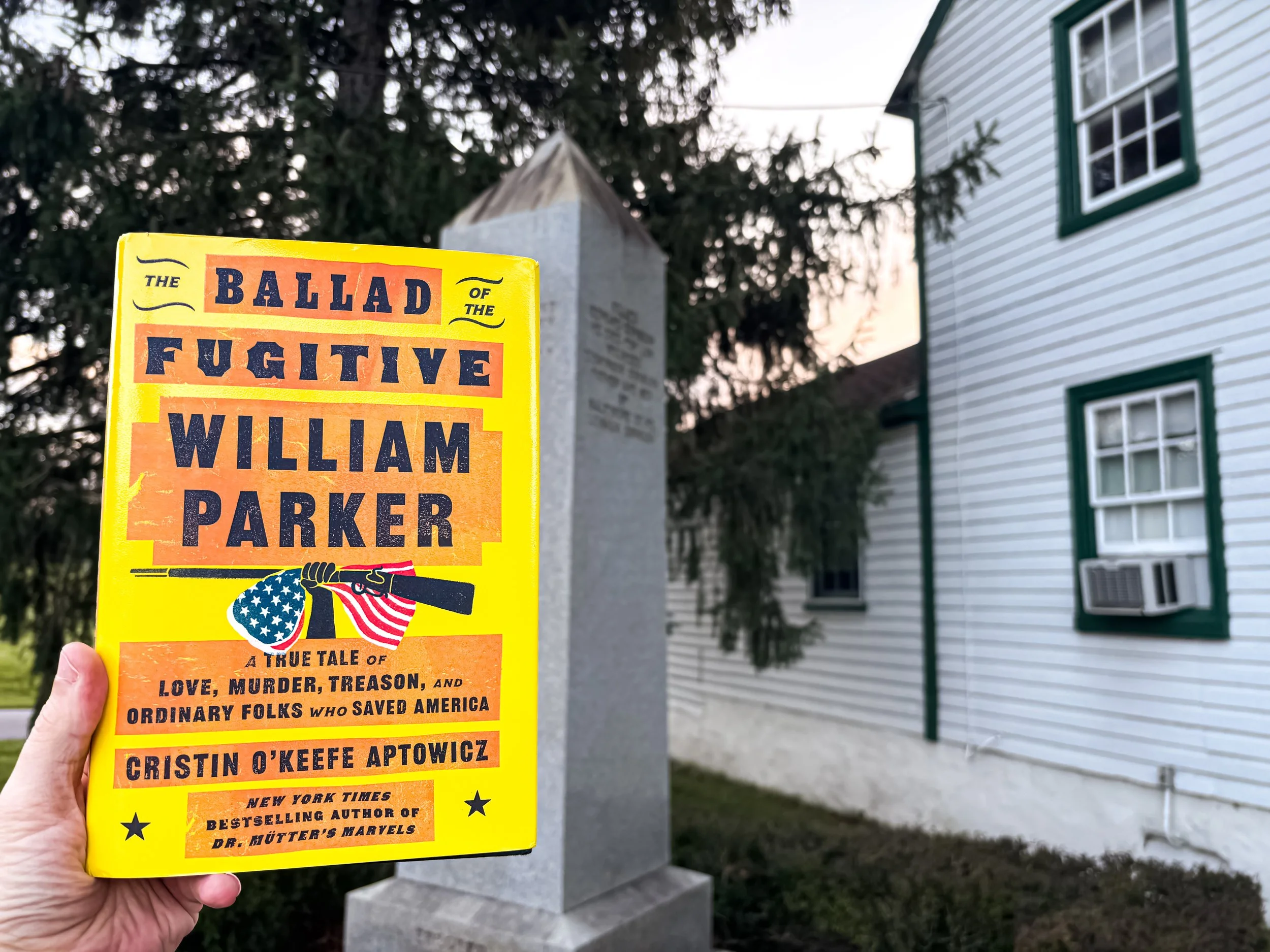
Published in 2026 by Simon & Schuster, New York, NY
448 pages
ISBN: 978-1-6680-3593-1
On the morning of September 11, 1851, just as the sun slowly began to peek over the rolling hills of Lancaster County, gunshots sharply rang out from a farmhouse in Christiana, Pennsylvania. Just moments before, an armed posse of white men descended on the unassuming farmhouse, looking for four black men who had escaped from a plantation in Maryland. The leader of this posse was Edward Gorsuch, a Maryland slaveholder who had enlisted the help of a federal marshal and crossed the Mason-Dixon line, staunchly determined to recover what he regarded as his property. At the farmhouse lived William Parker, himself a fugitive from slavery and by then one of the most formidable Black organizers of resistance in Lancaster County. Parker and his neighbors had spent years helping fugitives evade slave catchers, warning one another of approaching slavecatchers, and, when necessary, meeting violence with violence. Parker and his group had a reputation for punishing slave catchers, which struck terror into the hearts of those seeking to reclaim their “property,” especially under the newly passed Fugitive Slave Law.
When Gorsuch and his party demanded that Parker surrender the men, Parker and his neighbors refused. Gunfire rang through the air, and as a result of the ensuing violence of this fateful morning, Gorsuch would lie dead, his son would be gravely wounded, and the rest of the provocateurs would flee the scene. While Parker escaped through the Underground Railroad and eventually reached Canada, the federal government responded by arresting 41 people, most of them Black, and charging them with treason against the government of the United States. Deemed the Christiana Riot (or Christiana Resistance, depending on your political persuasion), this event would stretch the limits of the nation’s commitment to slavery and has often been referred to as the “first shot of the Civil War,” which would plunge the nation into one of the bloodiest chapters of its short history.
The ensuing prosecution became one of the most consequential cases of federal authority and antislavery resistance in the years before the Civil War, testing the limits of America’s commitment to slavery and the lengths that ordinary people would go to stand in solidarity with the oppressed. In her 2026 book, The Ballad of the Fugitive William Parker: A True Tale of Love, Murder, Treason, and Ordinary Folks Who Saved America, poet and writer Cristin O’Keefe Aptowicz renders this historical event into a thrilling narrative that illuminates the American tradition of protecting and defending one’s neighbor while fighting against the violent forces of an unjust state that threatens to tear us apart and divide us. Combining extensive archival research with the pacing and dramatic architecture of a novel, Aptowicz provides a gripping account of the Christiana Resistance and, more broadly, an examination of what happens when ordinary people decide that obedience to an unjust law has become incompatible with their obligations to one another.
Overview
Before diving into the details of the Christiana Riot and its aftermath, the first half of the book carefully sets the stage for the trial, as Aptowicz painstakingly details the course of Parker’s escape from the Maryland plantation to Lancaster, Pennsylvania. The chapters in this section largely alternate between a retelling of Parker’s story and the larger context of growing abolitionist movements during the 19th century, particularly in Philadelphia. Parker’s transformation from an enslaved teenager into a leader of organized resistance drives much of this first section of the book. Aptowicz depicts a world in which enslaved people could be forced into violence against one another and in which physical coercion structured nearly every aspect of daily life. Parker’s harrowing escape from the plantation was not the end of his relationship with slavery, as the Fugitive Slave Law of 1850 transformed the entire country into contested territory, permitting enslavers and their agents to pursue fugitives into free states and requiring federal authorities to assist in their capture. By alternating between Parker’s biography and the broader history of abolitionism, Aptowics allows the reader to see how the personal and political gradually converge (both narratively and, interestingly enough, geographically).
As such, Lancaster County was a complicated place of refuge. Situated just north of the Maryland border, it was close enough to slavery to be vulnerable to slave catchers, yet also close enough to Philadelphia to participate in the region's increasingly organized abolitionist movement. Black residents, Quakers, abolitionists, farmers, conductors on the Underground Railroad, and others developed informal systems for helping fugitives evade capture. While the sizable Quaker population provided important support to fugitives, it’s important to note that the narrative Aptowicz relates is not one of benevolent white abolitionists simply rescuing passive victims. Rather, she highlights that Black residents built resistance networks of their own.
In this story, Parker emerges as the lead organizer of one such mutual-defense network. Over the years, his collective self-defense network monitored the movements of slave catchers, circulated warnings throughout the community, assisted and housed fugitive slaves, and armed themselves in the event that they needed to drive off slavecatchers by force. He and his band of black resistance fighters became a formidable force that fended off these slavecatchers, striking fear into the hearts of those daring enough to defy them to reclaim their “property.”
Aptowicz sets Parker's increasingly militant position in Lancaster County within the larger disputes that fractured the abolitionist movement, especially in Philadelphia. The city of Philadelphia becomes an important second geographic location of the book, which allows her to introduce readers to the intellectual and political struggles surrounding abolition. Figures such as Robert Purvis, William Lloyd Garrison, and Frederick Douglass represented different approaches to antislavery politics, particularly around the pace and means of abolition. The disagreements raised fundamental questions about whether slavery could be dismantled through gradual reform or direct, violent resistance.
One of the consistent themes of this section is the tension between those who advocate for gradual, incrementalist reforms (Purvis) and those who call for the radical abolition of slavery by any means necessary (Garrison, and later Douglass). These also intersect with the tension between those who are strictly non-violent in their methods (such as the larger Quaker community) and those who, in the face of systemic violence, believe that violent resistance is sometimes necessary (Parker). For Parker, refusing to meet violence with violence could mean surrendering the people around him to kidnapping and re-enslavement.
These conflicts ultimately collide at William Parker’s farmhouse in Christina, where he is sheltering four runaway slaves. When Gorsuch arrives with his posse and a federal marshal, the standoff and confrontation is the final collision between two incompatible understandings of law. Gorsuch arrives believing that federal authority entitles him to reclaim human beings. Parker and his neighbors understand that the men taking shelter in the farmhouse are people whose freedom is worth defending, even by violent means.
Parker’s wife, Eliza, manages to sound a horn through a window in the farmhouse. Though she dodges a hailstorm of bullets to do so, the siren successfully calls the community to rally to Parker’s residence. After delaying the men with increasingly tense negotiations in hopes that reinforcements would arrive, Parker witnessed as over one hundred black and white men (many armed) surrounded Gorsuch and his posse. Gorsuch believed that the white men of the group (including shopkeeper Elijah Lewis and miller Castner Hanway) would obey federal marshal Henry Kline and apprehend the fugitive men.
Hanway and Lewis refused, urging the men to go back to Maryland. Growing increasingly incensed, Gorsuch stormed into the farmhouse, where he was clubbed in the head and shot to death. A massive firefight ensued, in which Gorsuch’s son, Dickinson, was also shot multiple times (though severely injured, he managed to survive). The rest of the men, including Kline, fled from the scene as they were also shot and seriously injured. In the immediate aftermath, Parker, the four fugitive slaves, and a few others fled north via the Underground Railroad (with Parker taking refuge with Frederick Douglass) before successfully crossing the border to the safety of Canada.
The violence at this small Christiana farmhouse was followed by a massive response from the federal government. With the blood of a white slave owner now shed, United States President Millard Fillmore directed federal authorities to search the area and arrest members of the surrounding community. Eventually, government officials arrested 36 black men and 5 white men and charged them with treason, asserting that resistance to the Fugitive Slave Law constituted an act of war against the United States. The prosecution of Castner Hanway and others, held in Philadelphia, became a test of whether resistance to the Fugitive Slave Act could itself be construed as an attack on the United States.
The trial, held in Philadelphia's Independence Hall, provides Aptowicz with the book's courtroom climax in the third and final section of the book. Under the assumption that trying and convicting a white man would set a precedent that would swiftly determine the outcome of the rest of the defendants, the prosecution decided to begin by targeting Caster Hanway. Thaddeus Stevens, already a prominent opponent of slavery and later one of Reconstruction's most consequential congressional figures, participated in the defense, often displaying theatrical orations and polemics against the prosecution. The courtroom thus became a stage on which the contradictions of a nation claiming liberty while enforcing human bondage became difficult to conceal, and indeed were even defended by the prosecution. In the end, Hanway would be acquitted of the charge of treason, and the rest of the men would likewise be released from custody. The federal government had ultimately failed to secure these convictions on behalf of southern slaveowners, further fueling national tensions that would come to a head a decade later in the outbreak of the Civil War.
Commendations:
There are several aspects to Aptowicz’s work which are well worth praising. First and foremost, just as in her previous work, Dr. Mutter’s Marvels, Aptowicz is exceptionally gifted in bringing historical events and figures to life. Aptowicz writes with the instincts of a poet and storyteller, building suspense around events whose outcome is already known. She allows her narrative to gradually gather momentum, providing just enough context to the reader to properly set the stage for the ultimate confrontation. By the time Gorsuch arrives at Parker's farmhouse, the reader fully understands why the confrontation could not easily be avoided, as well as what exactly was at stake in the encounter. She manages to retell this historical event with the gripping and page-turning prose of a political thriller, yet without sacrificing the underlying seriousness of the subject. I found this to be an absolutely riveting read, and the short chapters make it easy for the reader to quickly fly through the book.
More importantly, Aptowicz works diligently to restore agency to people who have too often appeared in American history merely as passive actors. Too often, histories of abolition have tended to place famous white reformers at the center of the story and treat Black fugitives as the beneficiaries of an antislavery movement organized on their behalf. Aptowicz reverses that perspective, placing William Parker at the center of the narrative around 19th-century abolitionism. He becomes an effective organizer who helps build the networks through which other people escape from slavery and a defender of his community who recognizes that freedom has to be protected collectively, and if necessary, by violence. Aptowicz further highlights the oft-forgotten contributions of women to these events, as she centers the experiences of Lucretia Mott, Harriet Purvis, and Eliza Parker’s resilience and bravery in fighting for equal rights, even in the face of angry mobs that burned their homes and threatened their lives. Rather than focusing on laws passed from above, Aptowicz emphasizes how freedom was fought for “from below” as these ordinary people took a courageous stand against injustice.
This emphasis also complicates familiar accounts of nonviolence, as Aptowicz places Black self-defense alongside the Quaker tradition of pacifist activism. On one hand, the Quaker abolitionists of Lancaster County are presented as courageous figures whose religious commitments led them to shelter fugitives and challenge slavery. By doing so, Aptowicz shows how religious conviction could become a practical source of solidarity and emancipatory politics, especially in a period when Christianity was also routinely invoked to defend slavery. By highlighting the Quaker community and their convictions, Aptowicz implicitly demonstrates the capacity of religious communities to become sources of solidarity and radical emancipation rather than merely instruments of social conformity.
Yet, the tension still exists between these nonviolent forms of resistance and the violent self-defense utilized by Parker. There has always been a divide between Leftists on political strategy. There are those who believe that they can utilize the mechanisms of the state to push for gradual, systemic change from the inside, passing progressive laws and securing rights for minority and disadvantaged groups. Then there are those who believe that the state itself is repressive and that any wins gained today can easily be rolled back tomorrow, as they advocate for revolutionary change that upends the entire system. Aptowicz illustrates how these debates are nothing new, as abolitionists in the 19th century sharply disagreed about how freedom and the abolition of slavery could be achieved. Aptowicz effectively highlights these tensions within the abolitionist movement, with some believing that slavery could gradually wither away through moral persuasion while others saw that the political and economic structures that undergirded slavery had to be directly confronted, even through violence (ie., John Brown).
These questions and the events at Christiana also hold political salience for today. While she’s never explicit about it, Aptowicz does not need to force a one-to-one equivalence between nineteenth-century fugitive slave laws and present-day immigration enforcement for readers to recognize the parallels. In providing this inspiring narrative about ordinary people standing in solidarity with their oppressed neighbors against an unjust system (especially salient for contemporary America), Aptowicz calls us to examine the obligations that we have to our neighbors, especially those whom the state has marked for removal. Just as in Parker’s refusal to give up the four fugitives taking asylum in his home, we are faced with the task of placing communal solidarity above legal obedience. Aptowicz shows us that this is a long tradition of American political history, as she highlights the recurring conflict between federal enforcement and communities that decide to protect neighbors, refugees, and migrants from state actions that they regard as unjust.
Finally, I also deeply appreciated Aptowicz’s attention to how these events have been memorialized in contemporary public history. Soon after the event, newspapers dubbed it the “Christiana Riot,” or the “tragedy” at Christiana, though it has been more recently remembered as the “Christiana Resistance.” This subtle shift of language reflects how we view and remember a particular event in history (for a more recent example, think of how the Black Lives Matter marches of 2020 have been memorialized in popular discourse, with some referring to them as protests, while others decry them as riots). Calling an event a “riot” emphasizes chaos and disorder, and is more often than not racialized. Labelling it as a tragedy attempts to take the middle ground, placing all parties on an equal moral plane. Calling it resistance (or protest) directs attention toward the unjust conditions against which people were resisting.
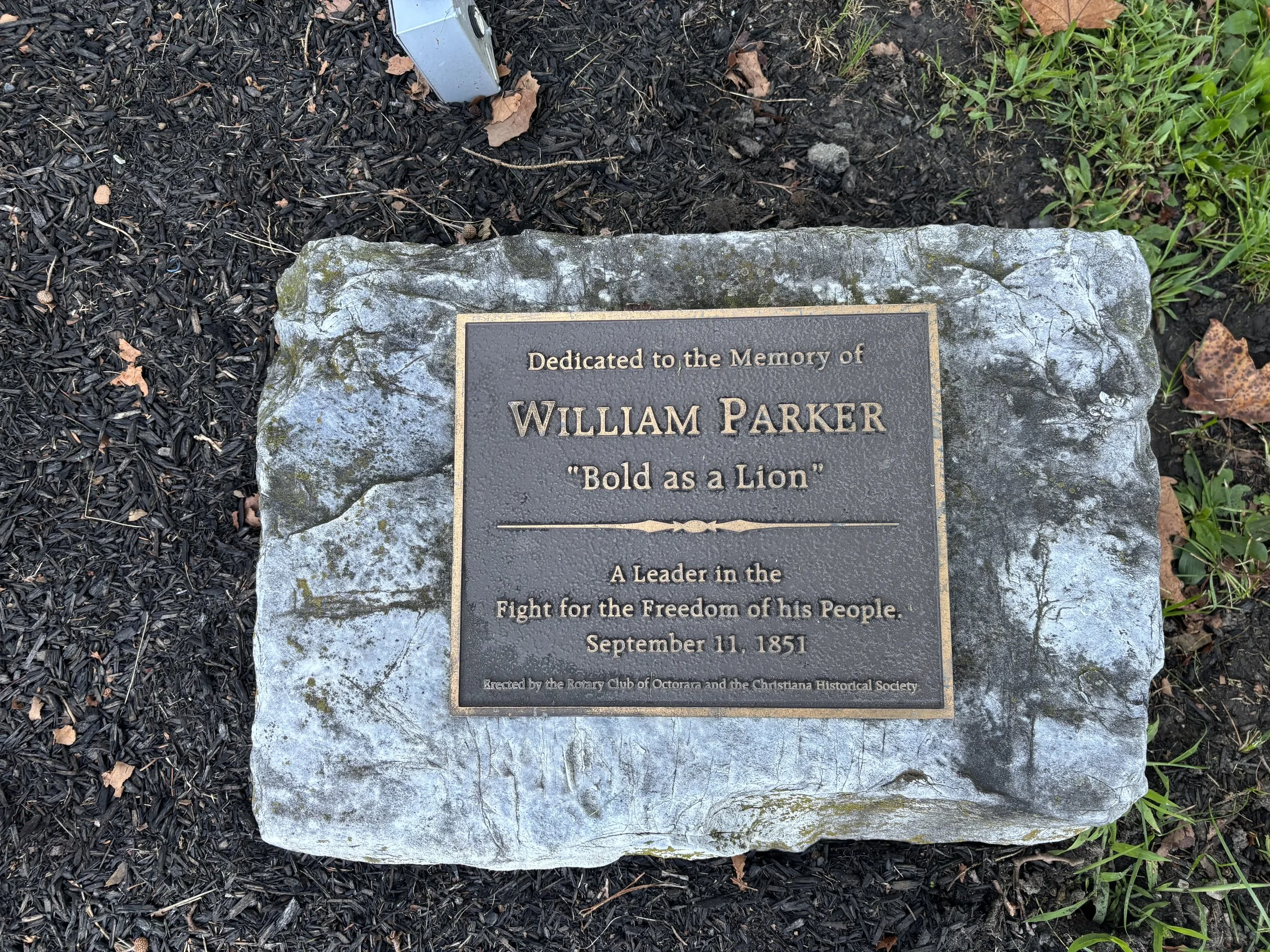
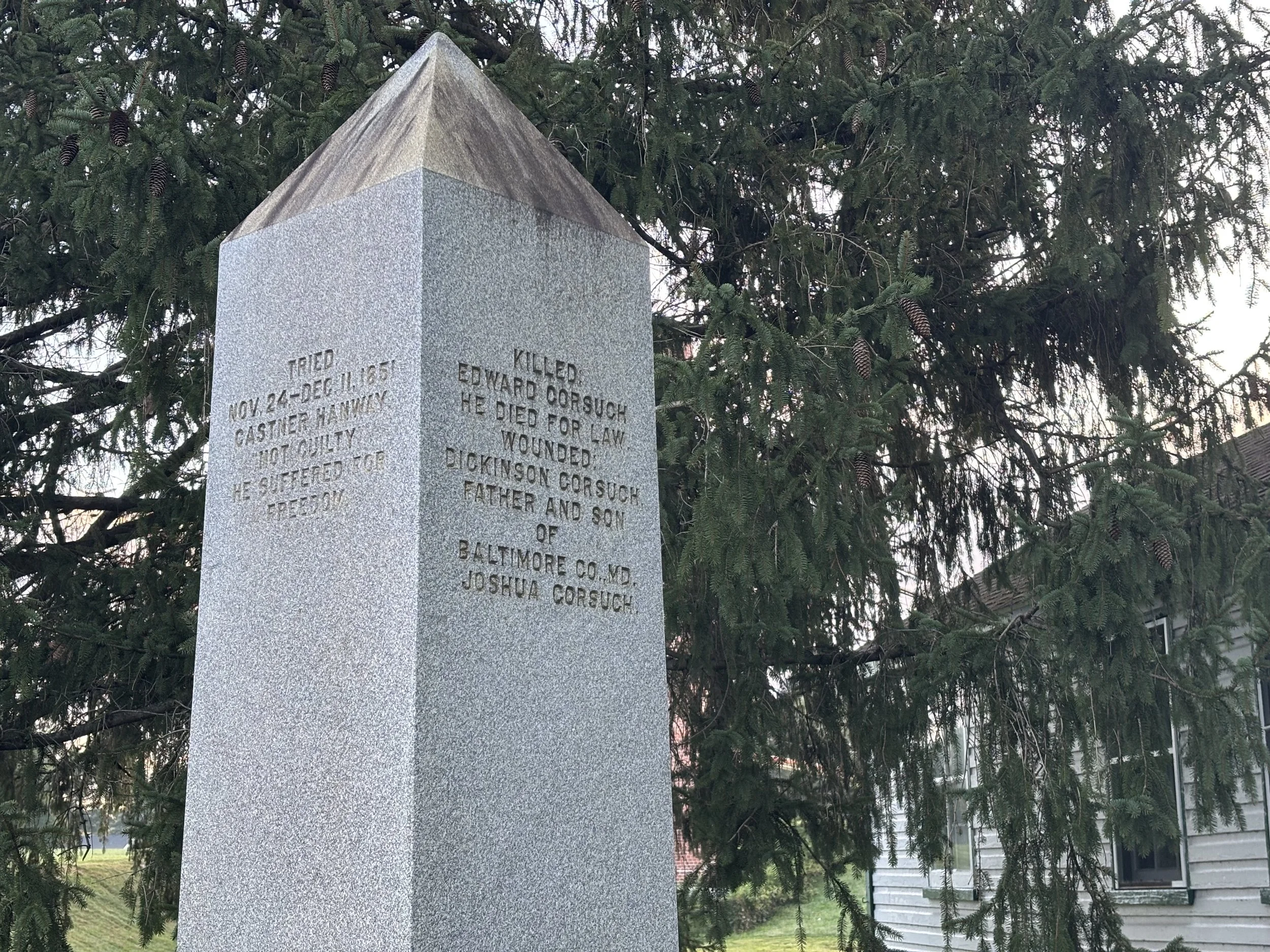
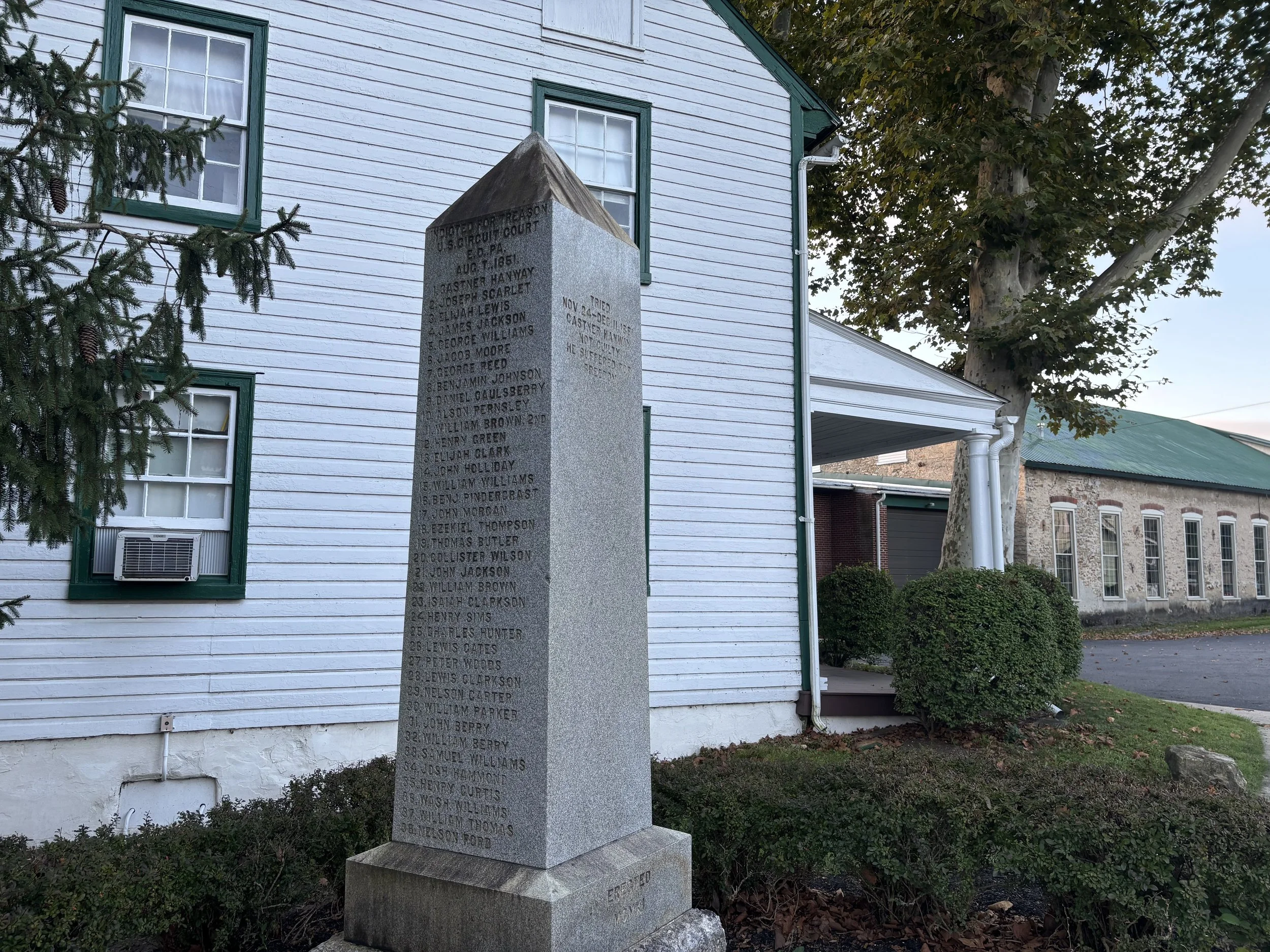
Communities frequently work to preserve the past in ways that make the present psychologically easier to live with. As such, for former slaveowners, the Christiana Resistance became less threatening when it was stripped of its context, Parker's organizing and militancy were forgotten, and when attention shifted toward the slaveholder who died rather than the people he came to reclaim. This is perfectly exemplified in the obelisk that was erected in Christiana commemorating the event in 1911. The South face of the monument reads, “Edward Gorsuch, he died for Law,” while the West face reads “Tried Nov. 24 – Dec. 11, 1851, Castner Hanway, 'Not Guilty.' He suffered for Freedom,” and the North face lists the 38 men indicted for treason (with William Parker occupying the 30th spot). Only in 2001 was a plaque dedicated to William Parker installed on a stone in front of the obelisk, reading: “Dedicated to the memory of William Parker, 'Bold as a Lion, ' A Leader in the Fight for the Freedom of his People. September 11, 1851.” The changing language and forms of commemoration surrounding the events in Christiana reveal the ways communities remember the past according to the needs and understandings of the present.
Critique:
On the other hand, there are a few minor criticisms that detract from the book’s overall quality. First and foremost, as in her previous work, Dr. Mutter’s Marvels, Aptowicz can occasionally blur the boundaries between historical fact and creative storytelling, as she often fills in the gaps of the available record with specific, unknowable details (such as what a historical actor is thinking or feeling in a given moment). While this undoubtedly aids in making the historical narrative come alive with rich detail, it also risks flattening or misrepresenting the motives of historical actors, especially when such information is sparse. This is an issue that occupies a central place in the academic discourse of historiography, especially when it comes to constructing clean, concise historical narratives.
Popular, narrative history almost inevitably carries an unavoidable tension. The historian wants to reconstruct the past with enough specificity that readers can inhabit it and relate to historical actors who may be spatially, temporally, and culturally distant from themselves. Such speculation is understandable within the conventions of narrative nonfiction. It gives otherwise dry historical events texture and emotional immediacy, and in many places it makes an otherwise distant historical episode remarkably vivid.
Yet, the available historical archive (especially predating the 20th century) rarely supplies the interior lives that a novel can provide. Narrativizing history necessitates editing out nuanced historical contradictions and accounts which complicate any clean, linear account of history. A narrative historian must inevitably impose chronological sequence and place specific emphases on fragmentary material. The more confidently an unknowable interior experience is rendered, the easier it becomes for readers to mistake interpretation for concrete evidence. Historical actors can easily begin to appear psychologically coherent and ideologically consistent in ways that real people rarely are. Parker's steadfast bravery and dedication to his convictions, Gorsuch's stubbornly evil intentions, and the fears of the people gathered around the farmhouse all become narratively legible in this account, even though the available historical record necessarily leaves parts of their inner lives obscure (notwithstanding that much of Aptowicz’s source for this book is Parker’s own account, which he gradually published in the Atlantic in 1866).
Much to her credit, Aptowicz openly acknowledges such complexity, and she provides plenty of sources for scholars who want to dig deeper into the historical record. Her extensive documentation in the appendix gives readers the opportunity to distinguish the archival record from her interpretive work built upon it, and scholars or historically curious readers will find substantial avenues for pursuing the story beyond the narrative itself. I honestly found Aptowicz’s openness and transparency to be particularly refreshing, as she actively encourages readers to challenge her interpretation and chart new paths with the available evidence. This kind of open-handedness and honesty can be rare to find among historians, and it furthers her credibility as a reliable source.
Additionally, two small quibbles regarding the book’s framework should be noted. First, while the book’s emphasis on Parker as an exceptional leader is persuasive and narratively tidy, it can also risk reproducing the very individualism and “great man” theories of history that historical narratives of liberation sometimes struggle to escape. Parker was unquestionably central to the Christiana resistance, yet the story is ultimately about networks of ordinary people, such as the Black, women, and Quaker communities of Lancaster County, in addition to the abolitionist organizers, lawyers, and people who made the practical decision to hide, feed, transport, or defend fugitives in Philadelphia/ The power of the events in Christiana lay not simply in Parker's individual courage (as admirable as that may be), but in the collective infrastructure and networks of solidarity that made his resistance possible. Fortunately, Aptowicz largely recognizes this, and while most of the narrative focuses on Parker, she also is careful to set his actions in the larger context of 19th-century abolitionist movements. Political transformation most often occurs through the accumulated decisions of people who rarely appear in textbooks, and while Parker might be a central figure in this narrative, he is also a gateway case study into a much larger social history of resistance during this period.
Finally, there is a broader interpretive risk in framing the events in Christiana as a story of “ordinary folks who saved America.” The phrase is rhetorically powerful, and Apowicz utilizes it to inspire hope in the reader that resistance to an unjust government can and should be done by everyday citizens. However, this emphasis can pull the story toward a reassuring national narrative. The people of Christiana were certainly acting within the broader arc of American history, and their resistance exposed the distance between the nation's supposedly democratic ideals and the institution of slavery. Yet, slavery was not something externally imposed upon the United States, but rather was embedded in its economy, law, constitutional order, and political institutions from its founding.
Thus, the radical implication of Parker's story is therefore somewhat more unsettling than the language of national salvation suggests. He and his neighbors in Lancaster County were not merely helping America live up to its ideals and saving the country from an external institution that had corrupted an otherwise ideal society. Instead, they were resisting a legal (if unjust) state that had made itself an instrument of slaveholders' power, which had been established and perpetuated (with various degrees of contestation) since the nation’s founding.
Their actions at that Christiana farmhouse on that fateful morning thus force us to consider the possibility that fidelity to a nation's professed ideals can sometimes require opposition to the institutions through which that nation governs. We see this in the Haitian Revolution, as Toussaint Louverture and his fellow slaves took the French Revolution’s commitment to “Liberté, égalité, fraternité,” extending these principles to their logical conclusion, even against the material interests and legal codes of their colonial occupiers and leading the only successful slave revolt in history.
In the context of the United States, when faced with an unjust state depriving its citizens of life, liberty, and the pursuit of happiness, as per the Declaration of Independence, “ it is the Right of the People to alter or to abolish it, and to institute new Government, laying its foundation on such principles and organizing its powers in such form, as to them shall seem most likely to effect their Safety and Happiness.” Furthermore, “when a long train of abuses and usurpations, pursuing invariably the same Object evinces a design to reduce them under absolute Despotism, it is their right, it is their duty, to throw off such Government, and to provide new Guards for their future security.” The origin of the United States is one of rebellion, borne out of righteous anger toward an unjust and despotic government. Even if the Founding Fathers and subsequent generations betrayed this universal appeal in favor of private protections for bourgeois interests, Aptowicz rightly reminds us that protest and resistance is a treasured and inalienable American tradition.
Conclusion:
Overall, The Ballad of the Fugitive William Parker is a remarkably accessible and deeply researched narrative history of an oft-forgotten event in American history. While its novelistic approach occasionally asks the reader to accept imaginative reconstruction to fill in the gaps of the historical record, Aptowicz's willingness to acknowledge those limitations, together with the breadth of her research, makes the book an especially accessible entry point into a history that deserves much wider attention. Aptowicz is an exceptionally gifted storyteller and a committed historian, and the result of this winning combination is an absorbing and deeply researched addition to the literature of abolitionism and American resistance. Through this engrossing work, she allows the voice of William Parker and his allies to resonate and speak to the much larger contemporary American discourses over freedom, resistance, and the obligations of solidarity in the face of an unjust government.
To be sure, the resistance and bravery that Parker and others showed in Christiana did not immediately end slavery or transform federal policies. In fact, in the immediate aftermath, one could not be blamed for thinking that all hope had been lost. Parker fled northward to Canada, his friends and neighbors faced prosecution and the possibility of the death penalty from the federal government, and the nation at large continued to divide ever deeper, pushing itself toward a war whose origins lay in generations of racial domination and political compromise.
Yet the people of Christiana demonstrated something that the history of American abolition cannot afford to forget, which is that oppressive systems depend not only on laws and institutions but also on ordinary people's willingness to enforce them. As such, resistance can begin with ordinary people's refusal to participate in the status quo. It is easier to celebrate this period of American liberty when the story begins with a Declaration of Independence and ends with the Emancipation Proclamation. It is harder to remember the struggle that ordinary people engaged in the middle of it all, as the federal government once treated the defense of freedom as treasonous. At Christiana, ordinary citizens had to choose between obeying the unjust edicts of the United States and protecting their neighbors. In an era of ICE raids, mass deportations, and an increasingly fascist, authoritarian, and deeply corrupt government, we must learn from past examples of solidarity, mutual aid, religious conviction, spontaneous organizing, and self-defense if we hope to build a dignified future for all peoples.