
The Spoils of War: Power, Profit, and the American War Machine - Andrew Cockburn
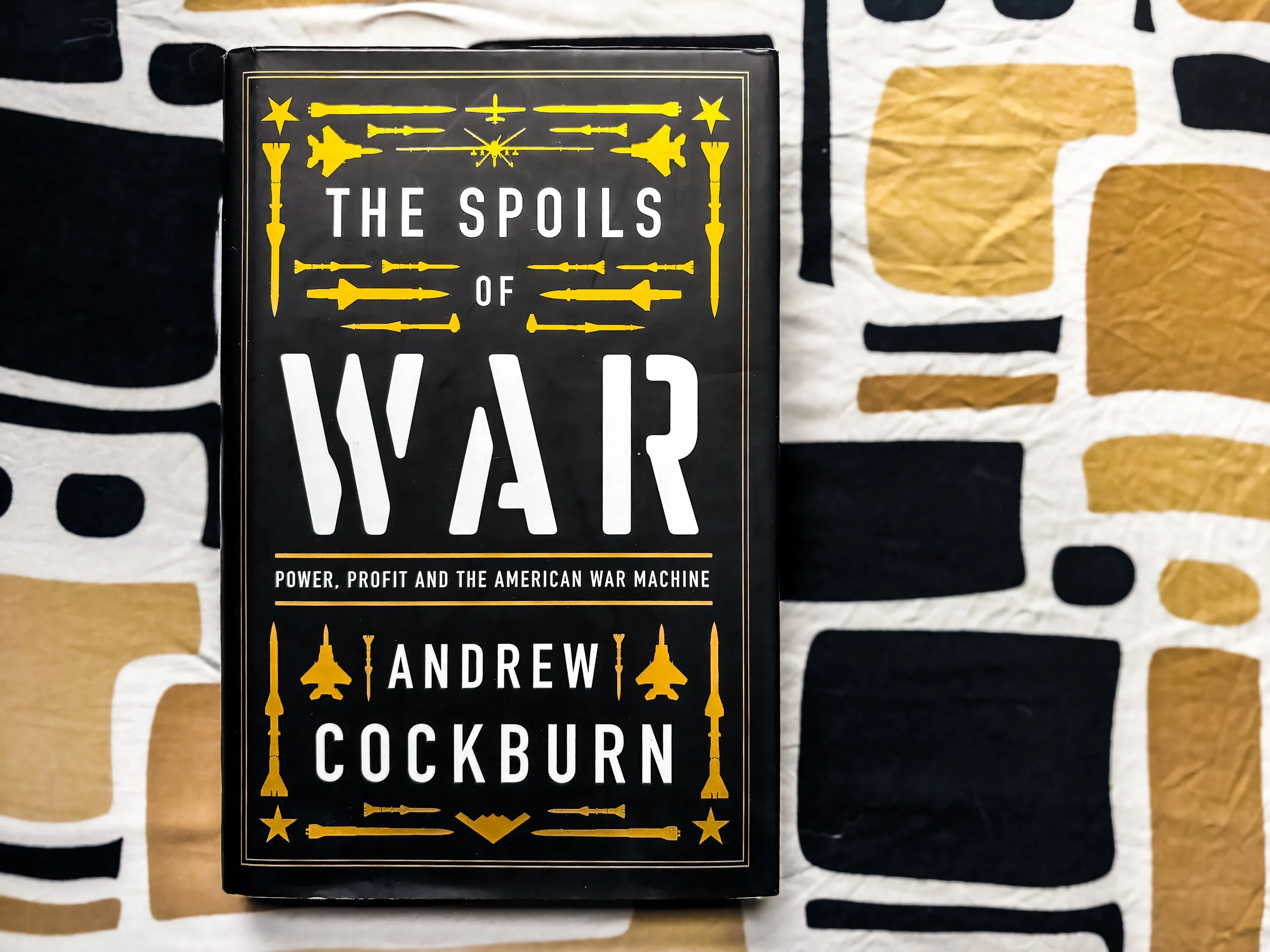
Published in 2021 by Verso, London, UK, and New York, NY
288 pages
ISBN: 9781839763656
As Washington once again ramps up defense spending to record-breaking levels ($858.5 billion in 2026, with Trump aiming for $ 1.5 trillion in 2027), one must ask: Who actually benefits from this exorbitant spending? Pundits and politicians in Washington often invoke the language of “great power competition” to justify increased spending and permanent militarization, often posing Russia, China, and Iran as boogeymen against the maintenance of American hegemony. Despite all evidence to the contrary, Donald Trump ran in 2024 as the “President of Peace,” promising in his victory speech, “I’m not going to start wars, I’m going to stop wars.”
Yet beneath all the political posturing from Republicans and Democrats alike, the familiar rhythms of the American war drum are resounding once again. From Vietnam, Iraq, and Afghanistan, to the various proxy wars, arms transfers, invasions of foreign countries, and ever-expanding global footprint in the form of military bases, the United States has perfected a model of warfare that ensures its own survival regardless of victory, defeat, or public disapproval (with less than 10% of Americans approving of the increased military spending). As the United States has more outwardly embraced interventionism and outright regime change in countries such as Venezuela and Iran, many of us on the Left are left screaming into the void as we remember the failed interventions in Libya, Afghanistan, and Iraq.
Amid all this destruction and devastation, one would be right to ask: Who benefits from it? Liberal pundits and conservatives alike tout the necessity of these weapons and interventions for the sake of “national security.” Yet, in its 250 years as a nation, the United States has been involved in conflicts and wars for over 93% of its existence. Decades after the end of the Cold War, the United States remains entrenched in an endless cycle of war, with no clear enemy and no apparent exit strategy. War, it seems, is less of a necessary evil than a deliberate choice to enrich the pockets of the few.
In his 2021 book, The Spoils of War: Power, Profit, and the American War Machine, journalist Andrew Cockburn offers a forceful and meticulously documented critique of the contemporary U.S. war-making apparatus. Drawing on decades of investigative journalism, Cockburn interrogates the economic incentives that underpin America’s commitment to militarism, arguing that U.S. foreign policy and defense practices are driven less by strategic necessity than by entrenched profit-driven systems and institutional self-interest. In doing so, Cockburn dismantles the myth that American militarism is driven by security, humanitarian concern, or democratic ideals, arguing that the system works remarkably well, but only for those within its inner circle.
Overview:
Composed of 17 interconnected essays, many of which were first published in Harper’s Magazine, Cockburn’s work argues that the United States sustains war because powerful institutions profit from it. This has accelerated to a fever pitch since 2001, as private defense contractors, intelligence agencies, military bureaucracies, and their allies in Congress have formed a self-reinforcing ecosystem in which failure is rewarded, budgets continue to grow exponentially, and accountability is permanently out of reach. Cockburn repeats Eisenhower’s warning about the military-industrial complex, arguing that it has not only materialized but further metastasized into an autonomous force shaping policy rather than responding to it, or what he calls a “malignant virus” that is deeply embedded in American politics.
Central to Cockburn’s case is the claim that militarism has become economically and politically indispensable to key sectors of the U.S. state. NATO expansion, permanent overseas basing, and the normalization of drone warfare are presented not primarily as strategic responses to external threats, but as mechanisms for sustaining arms markets, legitimizing budgetary growth, and lowering the political costs of perpetual war. Through all of these examples, Cockburn shows how military policy reproduces itself regardless of outcomes on the ground. The war in Afghanistan, in particular, stands as a paradigmatic case. Even as officials privately acknowledged the war was unwinnable, contractors continued to rake in billions, intelligence agencies expanded their reach through increased surveillance, and Congress kept the money flowing for all of these projects.
Cockburn also points out that narratives of strategic military dominance have led to a lavishly wasteful and unnecessary use of resources. For example, in the early chapters, Cockburn focuses on the Air Force’s claim that air dominance can be used to survey and eliminate threats autonomously, without putting human lives at risk. When we look at 20th-century American history, however, almost all major wars have been won or decided by ground forces.
Yet, the promise of autonomous air domination has continued to proliferate, justifying immense expenditures toward aircraft such as the B-1 and F-16 that are ultimately slow, inefficient, and possess several technical deficiencies (such as not being able to see what is actually happening on the ground), rather than relying on older and more reliable aircraft, such as the nimble A-10. Not only has this led to a large amount of financial waste, but the commitment to these cumbersome machines that are built by private contractors such as Lockheed Martin has led to multiple mistakes and caused unnecessary death and destruction, particularly in Afghanistan, Syria, and Iraq.
Cockburn also pays close attention to the expansion of NATO, which he argues was driven more by the material interests of arms manufacturers than by any genuine concern about security in the post-Cold War era. After the dissolution of the Soviet Union, it became necessary to conjure new enemies in the form of Russia, Iran, and China to justify more defense spending. Cockburn points out that this relationship with Russia became another impetus to spend resources on countering Russian missile technology, such as the Avangard, even though these Russian claims were wholly untested and there was no evidence that these hypersonic missiles even worked.
Toward the end of the book, Cockburn shifts his focus to the financial sector, detailing the various bailout and fraud schemes that have proliferated over the past few decades. Whether discussing the operational issues of CitiGroup, the attempts by the banking industry to weaken the Volcker Rule (which restricts banks from making certain kinds of risky, speculative investments), or the Malaysian 1MDB scandal (which is one of the world’s largest financial scandals in history), Cockburn reveals how these interest groups have seized the levers of power to further their own interests at the expense of the vast majority of people.
Commendations:
Several dimensions of Cockburn’s work are particularly notable. First of all, Cockburn excels at translating abstract concepts into concrete, empirically grounded narratives. Drawing on his decades of experience as an investigative journalist, Cockburn provides vivid, concrete examples of how the military-industrial complex has grown into a behemoth in modern American politics. His detailed accounts of weapons systems, contractor behavior, and intelligence failures provide a level of specificity that is too often lacking in more theoretical critiques of militarism.
Specifically, Cockburn is at his best when exposing the grotesque logic of how we procure and develop weapons, often against common sense. He shows how products such as the F-35 Joint Strike Fighter are often produced over budget, consistently underperform, and remain largely untested, yet remain politically untouchable due to private contracts. As such, these have become ideal products in a system designed to spread manufacturing across congressional districts and insulate contractors from risk.
One thing that I appreciated most about this work is that one of Cockburn's most important contributions is its refusal to individualize blame. Unlike liberal reformist critiques that tend to place our commitment to militarism solely on bad actors, poor decision-making, ideological zeal, or a consequence of good-faith mistakes, Cockburn documents a structure in which rational actors behave destructively because the system actively rewards them for doing so. In this system, generals retire into lucrative board positions, intelligence agencies exaggerate existential threats to protect their budgets, and lawmakers (even those who posture as skeptics or peaceful doves, *cough Bernie Sanders, cough*) decry wasteful spending while quietly safeguarding defense jobs back home. As such, oversight exists largely as political theater, as both sides of the political aisle are united in their commitment to funding conflict.
In this sense, The Spoils of War is a much-needed correction to liberal critiques that treat militarism as a problem of poor management or insufficient expertise. Cockburn makes clear that no amount of technocratic reform can fix a system whose primary function is accumulation and institutional survival. Eisenhower’s warning about the military-industrial complex looms over every page, but Cockburn shows that what Eisenhower feared has evolved into something far more entrenched: a permanent war economy with its own logic and momentum. In doing so, he challenges common narratives that portray recent wars as exceptional or aberrational, instead presenting them as logical outcomes of an entrenched system.
Critique:
On the other hand, Cockburn’s book also suffers from a few key shortcomings. First of all, since the book is a collection of previously published essays from 2014 to 2020, those who have followed Cockburn’s writings (especially in Harper's) will find little new content in this work. Since the essays span from 2014 to 2020, many of them are already dated as well. On an organizational level, I found myself wanting these essays to be tied together in a more cogent fashion, as the entire final section of the book on financial crimes seemed wholly out of place amid the rest of the essays.
Additionally, Cockburn occasionally risks being too reliant on a crude form of economic reductionism. While his focus on profit and material incentives is undoubtedly persuasive and central to our current commitment to militarism, Cockburn’s analysis underplays the role of ideology, culture, and geopolitical competition in sustaining militarism. American exceptionalism, elite identity formation, and the cultural prestige of military power receive comparatively little attention, even though they plausibly interact with economic interests in shaping policy outcomes. War is indeed profitable, but it is also deeply woven into our sense of national identity in ways that exceed balance sheets, often justified and glamorized in film, television, and video games (such as the Call of Duty franchise, which is essentially propaganda that promotes American exceptionalism and interventionism). As such, Cockburn’s materialist analysis would benefit from incorporating the mechanisms by which militarism is propagated through popular culture.
Furthermore, while I largely agree with his arguments, Cockburn can also be a bit selective in his evidence, focusing overwhelmingly on cases that reinforce his central thesis. Instances of internal dissent among military personnel, program cancellations, or genuine strategic debates within the military and intelligence communities are largely absent from these essays. This does not necessarily invalidate Cockburn’s larger argument, but it limits its explanatory scope and weakens its engagement with countervailing evidence. The reader is shown what happens, but not always why this system persists despite repeated failure, resistance, and public skepticism. As such, I think Cockburn’s central argument would be stronger if he acknowledged and explained exceptions to the full commitment to militarism, rather than implying total systemic capture.
Relatedly, Cockburn’s analysis is narrowly focused on the American context of rampant militarism and its foundation in the profit motive. Yet, America, especially as a hegemonic global power (however much on the decline), does not operate within a vacuum. As such, I was surprised that there is relatively little sustained engagement with the international context, such as how allies like Israel, Saudi Arabia, and NATO shape U.S. militarism, how adversaries’ actions constrain or provoke policy, or the global political economy of the weapons manufacturing industry beyond U.S. firms. This makes the analysis feel U.S.-centric, when militarism is in fact co-produced through strategic alliances, client states, and global markets. As we have seen in the latest war against Iran, European countries will meekly capitulate to America’s brash decisions and provide material support, even if it is against their own interests or the will of their populations. As such, I would have liked for Cockburn to explore more of this international dimension to war-profiteering.
Finally, while Cockburn deftly provides ample evidence of what is wrong with our current system, his essays offer little in the way of normative or strategic alternatives. While the critique he provides is devastating, readers are left with little sense of how militarism might be meaningfully constrained or dismantled, or whether this deeply embedded problem lies primarily in capitalism, empire, or the structure of the American state itself. This is not so much a flaw as a reflection of the political moment. Today, militarism is largely bipartisan, normalized, and insulated from popular democratic pressure, so it should come as no surprise that imagining alternatives is difficult. Yet, if we are to have a livable and dignified future for all people, we must take up this task.
Conclusion:
Overall, The Spoils of War is a compelling and politically urgent collection that simultaneously deconstructs many of the common justifications for U.S. foreign interventions and reveals the financial and political machinery that perpetuates them. While loosely organized, short on solutions or alternatives, and largely focused on American militarism over international contexts, Cockburn’s essays still stand as substantial contributions to our understanding of how American war-making functions to fill the pockets of the few. The book is best read not as a standalone all-encompassing theory of American foreign policy, but as an indispensable empirical resource for critical scholars seeking to understand how war has become normalized, profitable, and self-sustaining within the contemporary U.S. political order.
Seen against the long arc of American history from the permanent mobilization inaugurated by World War II, through the Cold War’s institutionalization of military Keynesianism, to the post-9/11 normalization of perpetual conflict, The Spoils of War makes clear that today’s crises are not ruptures with the status quo but continuations. The same system that sustained counterinsurgency in Southeast Asia, covert wars in Latin America, and catastrophic interventions in the Middle East now underwrites new confrontations with China, Russia, and Iran, justified by fresh rhetoric but animated by familiar incentives. Cockburn deftly shows that the problem is not a failure to learn from history, but a political economy that has learned all the wrong lessons.
Although Cockburn’s overall outlook might be bleak, it is also clarifying. The problem is not that America keeps getting war wrong. The problem is that, for those who make these life-and-death decisions, the system is working exactly as intended. As long as war remains profitable, politically safe, and institutionally self-reinforcing, the United States will continue to find reasons to fight, regardless of the cost to those on the receiving end. In that sense, Cockburn provides not merely a critique of American militarism but a warning about its future amidst the declining hegemony of American power.