
Baltic Facades: Estonia, Latvia, and Lithuania since 1945 - Aldis Purs
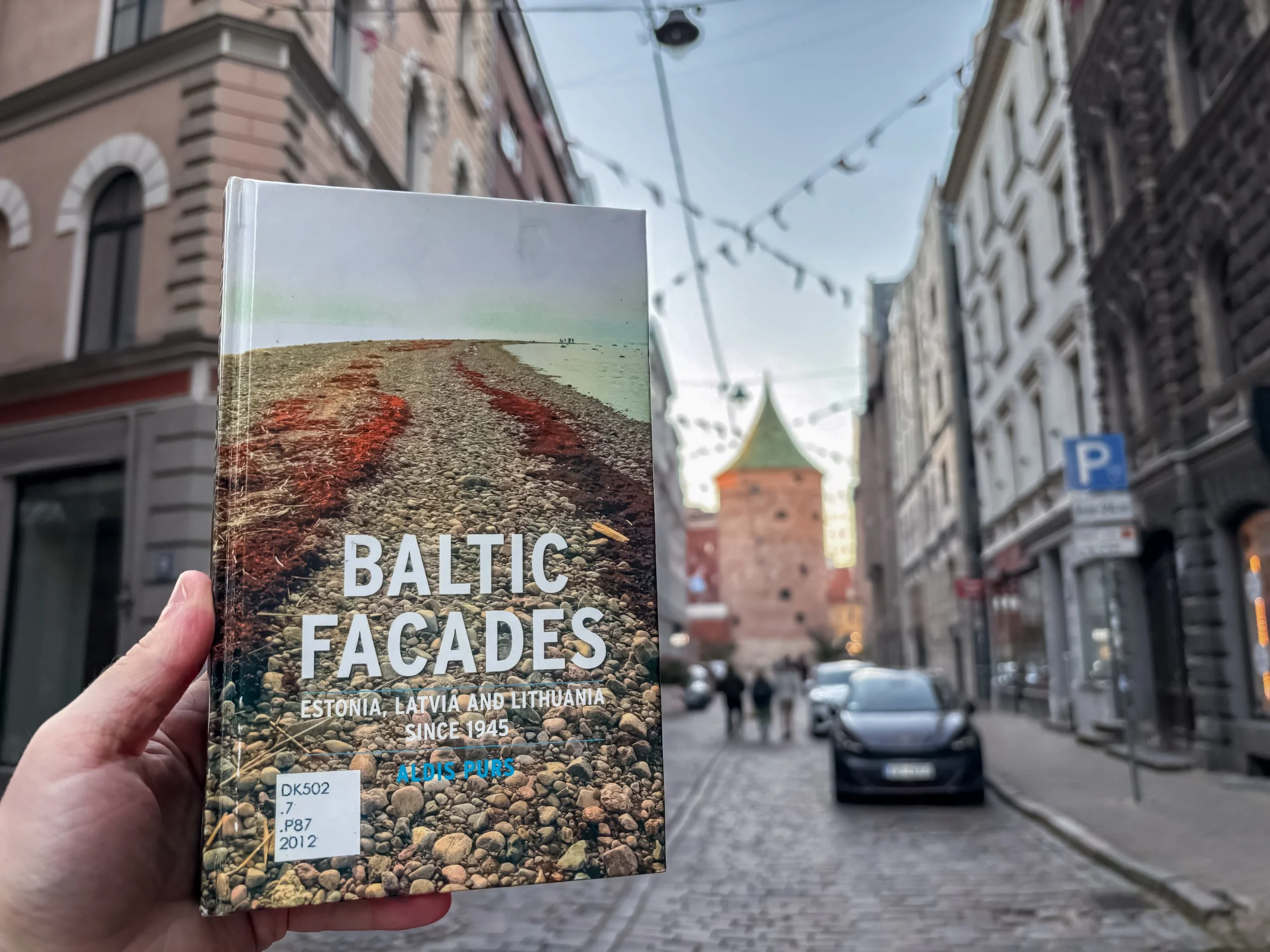
Published in 2012 by Reaktion Books, London, UK
203 pages
ISBN: 9781861898968
When it comes to the study of European history, perhaps no region receives less attention in contemporary discourse and scholarship than the Baltic states. Receiving independence in the wake of the dissolution of the Soviet Union in the early 1990s, Estonia, Lithuania, and Latvia have struggled to define themselves apart from their Soviet past, often reaching into their pre-occupation pasts to fuel nationalist sentiments. With their ascension into the EU and NATO in 2004, the Baltic states have worked diligently to separate themselves from their Soviet past.
Yet, Western narratives of World War II and the Cold War often either erase the Baltics entirely or simply fold them into broader Soviet/Russian history. The Baltics experienced both Nazi and Soviet occupation, yet their struggle for independence is rarely framed within anti-colonial discourse. The region’s own contentious memory politics, especially around Soviet legacies and collaboration with Nazis, make it hard to craft a "clean" Western narrative of the region. So instead, it’s just largely avoided.
Likewise, within the academic world, the Baltic states can struggle for international recognition. On one hand, there’s a population bias in historiography. Countries with fewer than 3 million people each often get overshadowed, even when their histories are deeply instructive for larger global events (such as histories of forced deportation, resistance to occupation, and navigating the rights of populations who possess hybrid identities). Additionally, Estonian, Latvian, and Lithuanian are not widely spoken outside their native countries, making in-depth research difficult for non-locals. Scholars who speak these languages are often ignored in favor of generalists.
Furthermore, Western academia (especially U.S. and U.K.-based institutions) privileges areas where there are already established fields of study, funding pipelines, or perceived strategic interest. More resources are poured into Russian, Ukrainian, or Central European studies because they’re seen as "bigger players" in the geopolitical strategic interests of the region. Baltic studies programs are rare, underfunded, and often subsumed under broader “Eastern European” or “Nordic” umbrellas. Much of the Western work that does exist focuses on state-building, market reforms, or digital innovation, while critical, bottom-up perspectives are rare or marginalized.
In short, the Baltics are largely ignored because they don’t fit neatly into the dominant narratives of power, profit, or identity that shape Western media and academia. Their stories are ideologically complicated, narratively inconvenient, and often difficult to understand by outsiders. But that’s exactly why we should be paying more attention to this region.
As such, in our efforts to better understand the region, scholars have debated a key question over the past few decades: how useful is the term “Baltic?” Is there a shared common “Baltic” identity that these three countries share, or is it simply a shorthand for a region that is largely relegated to the margins of history? In his 2012 book, Baltic Facades: Estonia, Latvia and Lithuania Since 1945, Latvian historian Aldis Purs offers a concise and accessible thematic history of the Baltic states during and after Soviet occupation. Combining historical narrative, political analysis, and contemporary cultural critique, Purs seeks to challenge the façade of Baltic cultural unity, instead arguing that much of what people assume about their commonality is a surface-level façade that masks distinct national trajectories, identities, and anxieties. He aims to dispel myths of Baltic homogeneity and to show how each country’s history, politics, culture, and identity evolved differently under Soviet rule and since independence, while also considering what unites them and how they are seen (both by themselves and others).
Overview:
Purs presents a thematically organized, accessible historical narrative of Estonia, Latvia, and Lithuania’s development from Soviet occupation to EU accession. He is particularly concerned with challenging the perception of the Baltics as a cohesive bloc, writing, “If the Baltic idea is contested in the twentieth and twenty‑first centuries, a long history of the Baltic states built around such a Baltic concept is, to paraphrase Benedict Anderson, an ‘imagined history’” (22). Purs identifies the category of “Baltic” as a regional identity often constructed externally and projected internally through state narratives and policy. Rather than treating Estonia, Latvia, and Lithuania as a monolithic bloc, Purs underscores their divergent historical trajectories, particularly as they relate to identity formation, economic transformation, and political sovereignty.
Despite attempts to find a singular narrative thread stretching back into antiquity, all three of these states are instead modern creations that are less than a century old. Each has had distinct historical, linguistic, and religious trajectories, and aside from a history of “shared unhappy experiences imposed upon us from outside” (10), there is little that unites these three countries, making it difficult and problematic to fit them all together under the label of “Baltic.” As such, the metaphor of the "façade" is used to expose both the artificial unity imposed from outside and the curated self-presentations these states perform in global contexts.
Throughout the rest of the book, Purs explores this concept of contested identities as he takes the reader through a historical tour of Estonia, Latvia, and Lithuania. The book, he writes, “is about Latvians’, Estonians’, and Lithuanians’ obsessions with their identities, about how they see themselves and about how others see them” (20). Despite the weakness of a unifying Baltic identity, Russian aggression in the region has led these states to once again find common cause in their shared past. Ultimately, Purs argues that if these individual states succeed in integrating into the EU, then the need for a Baltic identity will cease to exist. The problems they face are also wider systemic challenges that the rest of Europe faces. Yet, these states are canaries in the coalmine, as “their successes and failures, and the consequences of each, should inform a much larger debate” (183).
Deeper Dive:
In the introduction, Purs establishes the framework and purpose of the book, which is to challenge the assumption that Estonia, Latvia, and Lithuania form a single “Baltic” identity or experience. Purs begins with former Estonian President Toomas Hendrik Ilves’s provocative question, "Who the f— are Balts to us?", as he questions the fundamentally flawed concept of a unifying Baltic identity (9). He argues that many of the supposed similarities between them are superficial (thus, “facades”) and beneath them lie important differences.
Purs also sets up the temporal scope of his analysis, which is from Soviet rule post‑1945, through independence, up to EU accession, and to the present day. He explicitly states that this work is intended for intellectually curious readers rather than specialists. As such, he emphasizes that this book should be read primarily as an introduction to the history of the Baltic states, rather than a rigorous deep dive into any one particular aspect of this region.
Chapter One is primarily focused on the historical background of the region. Purs goes back before 1945, tracing very long‑term developments in the Baltic region to show how the "Baltic states" are modern creations with diverse historical roots. As such, he covers prehistoric settlements (Finno‑Ugric, proto‑Baltic), linguistic groups, early migrations, and the medieval era, including the influence of German, Polish, and Russian merchants and the gradual Christianization of the region on state formation (particularly in Lithuania).
Through his historical analysis, Purs emphasizes that the histories of Estonia, Latvia, and Lithuania diverged significantly long before the Soviet period. For example, Lithuania had a medieval state and a powerful Grand Duchy, while Estonia and Latvia were more heavily influenced by German and Danish control. Thus, in terms of religion, these differences led to the prevalence of Catholicism in Lithuania, while Protestantism is more widely practiced in Latvia and Estonia. Purs also covers how national memory and the development of historiography in the 19th and early 20th centuries shaped modern self‑understanding, particularly how myths of oppression and statehood were constructed.
In Chapter Two, Purs covers the period of Soviet occupation leading up to the Second World War, the Nazi occupation of the region, and the subsequent Soviet reoccupation after the war. Referring to how the Soviet‑controlled Baltic republics were façades, Purs uses the metaphor of “Potemkin Republic" to describe how these states were Soviet republics with formal structures on the surface, but underneath, real power and identity were constrained. As such, Purs examines policies such as collectivization, deportations, Russification, repression of culture and language, as well as resistance to the Soviet regime through partisan warfare (most notably the Forest Brothers in Lithuania) and the emergence of competing parties (such as the National Communists in Latvia). Accordingly, Purs points out both similarities in Soviet policy across all three republics, but also differences in implementation, effects, and local responses. While the three states followed distinct historical and national trajectories until the First World War, the struggle for independence and their multiple occupations during the Second World War drew these countries closer together, thus sparking the potential for a shared “Baltic” identity.
In Chapter Three, Purs focuses on the transition of these states from Soviet Republics to fully independent states. With the destruction of resistance forces in Lithuania and the eradication of the National Communists in Latvia, political movements in the region had stagnated under the Soviet Union. This began to change in the 1980s, especially during Gorbachev's glasnost and perestroika programs, which gradually opened up freedom of the press and introduced massive restructuring of the economy, respectively. Purs tracks this transition, starting in the late Soviet period as calls for reform and growing nationalist movements began to spring up across the region. With independence, a proliferation of political parties emerged, each with different visions of how to forge a path forward. Many of the issues that arose during this period, particularly who should be counted as a citizen in the wake of independence, still linger over the politics of the Baltic region (especially Latvia).
In Chapter Four, Purs shifts from tracking the political shifts that came with independence to the economic overhaul that occurred. With independence, the Baltics looked increasingly Westward for assistance, and Purs covers the process of financial liberalization, addresses the challenges of state-building, and describes the eventual accession of these states into the EU in 2004. Purs examines Estonia, Latvia, and Lithuania’s economic trajectories since the Soviet collapse, including the process of privatization, instituting austerity measures, and reforms made within the market. As such, he examines differences in growth rates, foreign direct investment, sectors that succeeded or lagged, investments in infrastructure, and the shift in trade ties (with Russia, the EU, etc.). He also addresses economic challenges that these countries faced, such as inequality, labor migration, demographic decline, dependency on external capital or investment, as well as how these differ among Estonia, Latvia, and Lithuania.
As one of the core chapters of the book, Chapter Five focuses on identity politics and the formation of national identity in each of these countries. A central theme of this chapter is how much concern there is in each country about how they are perceived by neighboring powers, by Western Europe, by elites, and by minorities. The region desperately wants to be recognized as more than simply a “former Soviet state,” yet there is also concern regarding how to preserve a distinct national identity while vying to integrate into wider Europe. This anxiety about how those perceptions feed back into their internal self‑image has dramatically shaped policy (especially the institution of language requirements), as well as culture and politics. Accordingly, Purs recounts the various debates that have arisen over what events should be remembered and what is deserving of commemoration. Primarily focusing on the development of the arts in the region (specifically folk music, painting, film, and sports), he also questions whether there is anything inherently “Baltic” about these works of art, or whether they merely imitate Soviet/Western trends.
In the final chapter, Purs offers an analysis of the current political situation of the Baltic states, including their many challenges such as demographic decline, emigration, maintaining identity, economic competitiveness, and geopolitical pressures (especially from Russia). He considers how being part of the EU and the broader European norms affect these countries, and what opportunities and constraints this inclusion provides. He also reflects on what lies ahead for the region, specifically whether the idea of a Baltic bloc is sustainable. He contends that a unifying Baltic identity helps the region when it is negotiating for joint security against Russia, but it more often masks internal diversities and becomes irrelevant with increasing integration into Europe.
Commendations:
Several dimensions of Purs’s study are well worth commending. First of all, by focusing his writing toward a general audience, Purs has produced an accessible introduction to the region for the average reader. His writing is clear and free from unnecessary jargon, yet still analytically rich and nuanced enough to capture many of the key issues and debates that define the Baltic region. Purs makes complex transformations understandable to a broad audience, which is important if historical revisionism and democratic pluralism are to be popularized rather than confined to academic silos.
In terms of content, Purs’s primary contribution lies in his deconstruction of what might be called “epistemic regionalism,” which is the tendency in Western academic and policy discourse to flatten distinct national experiences into a convenient geographical shorthand. All too often, Western scholarship tends to flatten Estonia, Latvia, and Lithuania into a monolithic post-Soviet or “Baltic” category. Purs rightfully critiques the assumption of shared Baltic identity by drawing attention to long-standing linguistic, cultural, and religious differences, as well as to the disparate colonial legacies that preceded and shaped Soviet domination. By unsettling this oft-imposed regional identity, Purs opens space for each state's distinct experiences with empire, resistance, and modernity to emerge.
Additionally, I particularly enjoyed Purs’s exploration of the complicated process of identity-formation, especially in the context of state-building. By exploring how Baltic elites have constructed post-Soviet national narratives through cultural policy, historical memory, and linguistic regulation, Purs beautifully illustrates how identity is not inherent but produced, especially in moments of rupture and fragmentation. In the case of the Baltic states, these identity projects often rely on exclusive ethnolinguistic frameworks, especially in Latvia and Estonia, where citizenship policies have politically marginalized Russian-speaking minorities.
This becomes quite a quandary for progressive thinkers who are concerned with decolonial praxis: on the one hand, we believe that people have a right to self-determination (and the nation state has historically been one of the most viable expressions of this right), while on the other, this national identity is policed and maintained often through exclusionary, ethno-nationalist frameworks. Thus, the Baltics become a fascinating case study in how various state practices constitute technologies of boundary-making in the aftermath of occupation. These practices (such as mandatory language tests for citizenship) delineate not only who belongs to the nation, but who is positioned as a perpetual “other” within it. While Purs does not explore such questions in depth, his work serves as a fascinating entry point into contemplating these thorny issues.
I also appreciated Purs’s nuanced and relatively balanced perspective on the politics of the region. He rightly critiques simplistic narratives that view the Baltics merely in terms of a binary between Soviet suppression vs Western freedom, or as simply buffer states. Rather than simply demonizing Soviet occupation, Purs attempts a more nuanced exploration by acknowledging the repressive nature of the regime while also showing how some Soviet-era institutions, infrastructure, and educational systems were foundational to post-1991 development. Rather than reproducing Cold War binaries of freedom versus occupation, Purs allows space for a more nuanced understanding of how Soviet structures simultaneously constrained and enabled different forms of modernity. This brilliantly avoids the binary of total victimhood versus rose-colored nostalgia, and creates a much-needed space for a more honest reckoning with this dimension of the region’s past.
Critique:
On the other hand, while I appreciated his attempt to disaggregate power, expose mythologies of statehood, and highlight the contested identities that define the Baltic region, Purs’s work is also shaped by certain liberal assumptions and analytic gaps that limit its transformative potential. Purs tends to treat EU and NATO accession as unproblematic benchmarks of progress, with little critical attention paid to the neoliberal restructuring that accompanied Western integration. The chapter on economic developments, for example, adopts a largely technocratic lens, focusing on indicators like GDP growth and foreign direct investment. It glosses over the socio-economic costs of “shock therapy,” privatization, and austerity policies that have disproportionately affected working-class and rural populations over the past three decades.
In my opinion, this omission is significant. The Baltic states have been at the forefront of neoliberal experimentation in post-socialist Europe, with rapid deregulation, labor market flexibilization, and widespread outmigration reshaping their socio-economic conditions. Purs mentions these trends but does not critically interrogate the political ideologies or external institutional pressures that enabled them, particularly from the IMF and European Commission.
Additionally, while Purs frequently references occupation, repression, and identity, he does not frame the Soviet Union as a colonial formation in the deeper sense, nor does he extend a decolonial analysis to the Western institutions that replaced it. EU and NATO accession are treated largely as normative goods or inevitable destinations as these countries become more integrated into the fold of Western liberalism. As a decolonial scholar, I believe that we must interrogate all forms of empire: not just Soviet domination, but also Western-led globalization, market fundamentalism, and epistemic colonization via the push from political leaders to have a closer proximity to “Europeanness.” Purs often skirts these critiques, implicitly affirming liberal teleologies of progress.
Since the book is largely an introduction to the region aimed toward the average reader, those looking for a more in-depth analysis of the social issues that define the region will most likely be disappointed. For example, when it comes to forging a national identity, the book does not explore how such projects have been gendered largely in favor of heteropatriarchy, nor how transitions to market capitalism have restructured reproductive labor, caregiving economies, or social safety nets.
Similarly, the idea of racialization within these nation-building projects is also largely absent. While Purs discusses attitudes toward Russian minorities and the institution of language laws and citizenship policies, he does so through a decolonial lens that might view these policies as technologies of state control. Nor does he delve into how racialization operates in the Baltics, particularly toward Roma, Jews, or migrant workers in the post-EU era. It would have been enlightening to see a rigorous examination of how the state produces “insiders” and “outsiders” in the wake of political emancipation, and how this dichotomy has often been produced along ethno-linguistic lines as part of a settler-colonial logic of national purity.
Finally, from a philosophical perspective, I believe that interrogating the metaphor of a Baltic “façade” could be a productive endeavor. More specifically, while the “façade” metaphor is productive in revealing the disjuncture between the performance of identity and the substance of material conditions in informing both domestic and foreign policy, it carries certain epistemological risks. By implying that beneath the surface lies a “true” national essence, the metaphor may inadvertently reinforce essentialist logics, reinforcing a false binary between surface and essence.
A more productive framing might have been one of contested subjectivities or layered sovereignties, allowing for a more fluid understanding of nationhood in a postcolonial and globalized context. Such a framework would emphasize multiplicity and contradiction as inherent to the constitution of identity, rather than a method of concealing it. As such, instead of façades hiding “real” nations underneath, we should view these contested identities and constructed concepts as integral parts of the state’s process of identity formation, rather than deviations or distractions from an “authentic,” immutable core.
Conclusion:
Overall, Baltic Facades is a valuable and engaging introduction to the modern histories of Estonia, Latvia, and Lithuania. While it may be limited by an economically neoliberal framework, a largely uncritical embrace of Europeanization, and a lack of in-depth discussions on social issues, the book challenges readers to reconsider our presuppositions of the Baltics. By destabilizing normative assumptions about Baltic unity and each country’s process of identity formation, Purs offers a more nuanced picture of Baltic countries as distinct nations with their own internal debates, struggles, and identities, especially in the post-Soviet context.
As such, this book is most useful for the average reader who wants to gain a basic understanding of the Baltic region. Furthermore, since Purs explores how these small states in Europe negotiate identity, sovereignty, and belonging after periods of foreign domination, it also provides fertile ground for discussion for scholars of European politics, post‑colonial studies, cultural history, and anyone interested in how nations come to terms with their past while charting future paths.
Despite being historically relegated to the margins, Baltic scholars, artists, and activists are pushing back. Independent Baltic media (like Satori in Latvia or Levila in Estonia) are filling in the gaps with longform journalism, essays, and podcasts about actual life, not just politics. Feminist, queer, and environmental collectives are creating alternative narratives that resist both the Western gaze and nationalist conservatism, especially in Vilnius and Riga. As such, future scholarship on the region would do well to build on Purs’s foundational work by more explicitly foregrounding empire, capital, and resistance in their multiple and overlapping forms. In the meantime, it remains to be seen whether Russia’s ongoing war against Ukraine will reunite the Baltic states against the potential threat of invasion or if it will simply accelerate their differentiation from one another as they more deeply integrate into the fold of NATO.