
Welcoming the Stranger: Justice, Compassion, and Truth in the Immigration Debate - Matthew Soerens and Jenny Yang
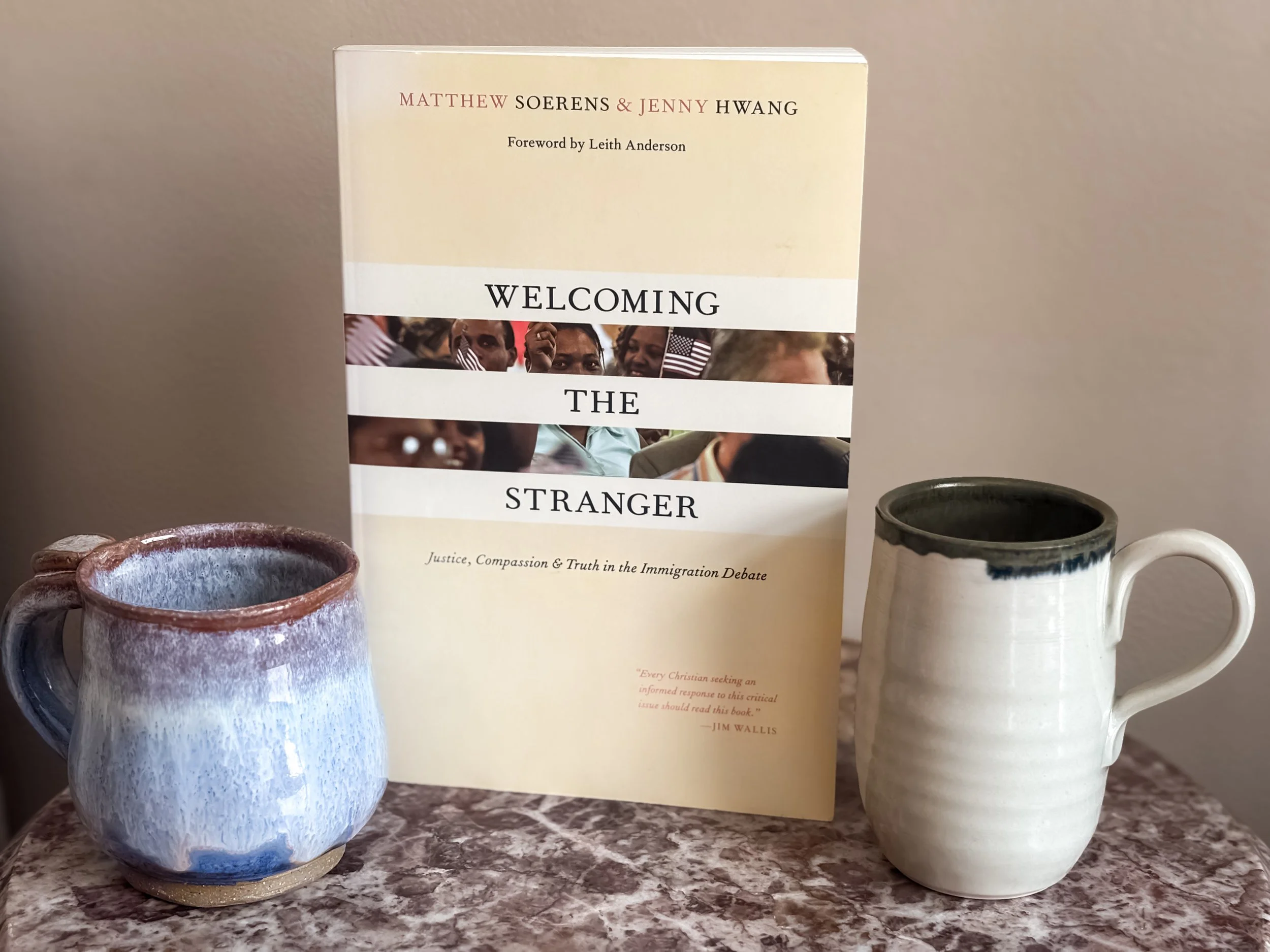
Forward by Leith Anderson
Published in 2009 by InterVarsity Press, Downer’s Grove, IL
240 pages
ISBN: 978-0-8308-3359-7
LCCN: BV639.I4.S554 2009
The United States is now living through a profound and largely unacknowledged reversal in its immigration history. After decades of growth, the foreign-born population peaked in 2025 and has begun to decline, with net migration turning negative for the first time in over half a century. This shift is not the result of diminished global displacement (on the contrary, asylum applications reached roughly 1.7 million in 2024) but of deliberate policy choices designed to choke off access to protection and bar the door to the foreigner and stranger. Border encounters have fallen to historic lows not simply because migration pressures have somehow relaxed in recent years, but because the U.S. has systematically dismantled legal pathways to asylum, expanded violent summary removals, and externalized enforcement to keep migrants from ever reaching ports of entry. Even as the country continues to admit around 1.4 million permanent or long-term immigrants annually, the overall trajectory is one of violent exclusion and deterrence.
The increasingly militarized border and policing regimes that define the United States’s border policies have predictably produced a wide range of deadly consequences. Interior deportations have surged, increasingly targeting people already deeply embedded in U.S. communities and violently tearing people from their families, churches, and workplaces. Our immigration detention system, which was already notorious for medical neglect and abuse, has become even more lethal, with inhumane conditions and physical abuse becoming the norm at deportation centers. Thirty-two people died in ICE custody in 2025, the highest number in over two decades, with additional deaths already reported in the first month of this year (not to mention the filmed murders of Renee Good and Alex Pretti by ICE and CBP officers in Minneapolis). At the same time, the federal government has revoked more than 100,000 visas, suspended immigrant visa processing for dozens of countries, and terminated Temporary Protected Status for groups fleeing violence and instability, including Somali migrants. These measures are often justified in technocratic language about “ensuring border security,” but their real function is to further racialized exclusion in the United States, narrowing who is allowed to belong and under what conditions.
The cruelty of the system is compounded by a long history of bureaucratic paralysis that has too often masqueraded as due process. More than one million asylum cases languish in immigration court backlogs, forcing people to wait years in legal limbo, often detained or barred from stable employment. This is not merely an administrative failure but rather a structural design, as delays, deterrence, and disposability have become core features of U.S. immigration laws. As such, the use of detention centers and violent deportation tactics is not the sign of a broken institution that must be reformed, but rather they are tools of social control that produce suffering by design. As migration continues to be driven by global inequality, climate crisis, and and increasingly interventionist U.S. foreign policy, the question is no longer whether the system is unjust, but why a one of the wealthiest countries in the world, which feigns to care about democratic values, continues to defend a regime that normalizes death, exile, and exclusion as acceptable political outcomes.
For Christians who claim to follow the way of Jesus, these policies and actions stand in direct contradiction to the Gospel’s injunction to welcome the stranger and care for “the least of these.” Sin is not merely individualistic and personal but also deeply structural, embedded in systems that deny life and dignity to the poor. The U.S. immigration regime today is one such structure, built to deter, delay, and disappear those seeking refuge, even as it continues to rely on immigrant labor to sustain its economy. As Desmond Tutu once wrote, neutrality in the face of suffering is itself a form of violence, and as we’ve seen with our own eyes, the U.S. state has chosen not neutrality, but active harm against the migrant community.
Again and again throughout Scripture, God’s people are reminded who they are and how they should treat the immigrant. In the book of Leviticus, the Lord commands, “When a foreigner resides among you in your land, do not mistreat them. The foreigner residing among you must be treated as your native-born. Love them as yourself, for you were foreigners in Egypt. I am the Lord your God” (Leviticus 19:33-34, NIV). In the contemporary political climate where migrants are continually scapegoated and violently arrested and detained, Christians must be called back to this foundational truth.
In their 2009 book, Welcoming the Stranger: Justice, Compassion, and Truth in the Immigration Debate, Christian immigration experts Matthew Soerens and Jenny Yang provide an overview of our broken immigration policies, debunk many of the common myths and hyper-partisan rhetoric around immigrants, and propose a compassionate, sensible, and just Christian response to the immigration debate. Drawing on their work with World Relief, Matthew Soerens and Jenny Yang invite the church to see immigrants not as problems to be solved or enemies to be deported, but as neighbors bearing the image of God.
Overview:
Aimed primarily at an evangelical audience, Soerens and Yang utilize their knowledge and experience from working in immigrant advocacy through World Relief to provide a theologically-informed response to the ongoing discourse around immigration in the United States. The book unfolds in three broad sections. First, Soerens and Yang work to humanize immigrants (especially undocumented migrants) through personal narratives and demographic context, challenging common stereotypes about immigrants and clarifying legal terms. Second, they offer a set of historical and policy-oriented chapters that explain U.S. immigration law, its development, and its contemporary dysfunctions, arguing that our current system often makes lawful migration practically inaccessible. Third, the authors provide a biblical and theological framework for Christian engagement with the issue of immigration.
They emphasize scriptural commands to care for the foreigner and propose concrete practices for churches and individuals, including hospitality, service, and advocacy for comprehensive immigration reform. Throughout, the authors aim to hold together a delicate balance of respecting the rule of law and expressing concern for human dignity, as they outright reject both xenophobic restrictionism and “open borders” rhetoric. The concluding chapters move from analysis to action, calling churches to relational engagement with immigrants and constructive participation in public policy debates.
Deeper Dive:
In the First Chapter, Soerens and Yang outline the book’s overall purpose, which is to move beyond polarized rhetoric and help readers understand immigration with both compassion and truth, particularly from a Christian perspective. They succinctly explain why immigration is such a complex and charged issue, often filled with a wide range of myths and strong emotions that often defy simplistic slogans. They also provide their personal backgrounds of working with World Relief and relay their experiences with immigrant families in their own communities, stressing that stories build empathy and reveal the complexity behind statistics and divisive rhetoric. By doing so, they emphasize that immigration is first and foremost about people, not abstract policy.
In Chapter Two, Soerens and Yang break down the daily realities of undocumented immigrants, showing where they come from and the wide variety of reasons why they come to the United States. Rather than the standard stereotype of hordes of migrants flooding over the southern border, most undocumented people entered legally and have simply overstayed their visa. Most come to the United States for economic or geopolitical reasons, often seeking greater opportunities or asylum from violence. By highlighting the stories of real immigrants throughout the chapter, the authors complicate many of the simplistic narratives about “illegal” immigrants, showing that undocumented migrants often enter legally and face difficult choices, rather than being uniformly “lawbreakers.” Undocumented immigrants are diverse people with complex stories, not a monolithic “other,” and these stories illustrate how misunderstandings about the immigration system can harm real families.
In the Third Chapter, the authors turn their attention to the history of immigration in the United States, highlighting how attitudes toward migrants and immigration policies have changed over the past two and a half centuries. The United States has always been deeply shaped by immigrants, and the debates we are currently having about immigration are not new, but rather part of a longstanding tradition. America’s character has always been shaped by newcomers, and while settlers and immigrants hold a central place in the national mythology of our founding, attitudes toward more recent migrants have always been less open and friendly. Anti-immigrant and pro-immigrant sentiments have ebbed and flowed over time, with the first significant restriction on immigration being passed after the Civil War. Aside from the fact that many migrants did not come to America of their own free will (primarily the experience of enslaved Africans being forced into chattel slavery), historical policies often reflected various forms of exclusionary or discriminatory thinking, whether they be against Chinese, German, Italian, or Irish immigrants in the 19th century.
While many might point to their ancestors coming to Ellis Island as coming into the country “the right way,” the authors point out that immigration policy during that time was much more lax, as migrants did not have to provide a pre-approved visa to the government before showing up at our shores. Thus, “for those of us whose ancestors came prior to the 1920s, without the requirement of a visa, to proudly note that our ancestors came legally to the United States is quite like a basketball coach bragging that his team scored 100 points in a game while a baseball coach’s team only scored six--the boast is illogical, because the rules are completely different” (58, emphasis original). The 1965 Immigration and Nationality Act (also known as the Hart-Celler Act) completely reformed our immigration system, and is what our current immigration policies are modeled after. While it opened up new avenues for immigration from Asia, Africa, and other parts of the world beyond Europe and placed a cap on immigration from European countries, it also introduced a litany of new issues, such as new barriers of entry for Latin Americans and “lower-skilled” workers.
Drawing on Soerens’s extensive background as an immigration counselor, Chapter Four primarily details how the U.S. immigration system works (and how it doesn’t work), including the distinctions between legal categories, visa limitations, and the massive amount of backlog and bureaucratic red tape that currently exists. In short, the U.S. legal immigration system is complicated, restrictive, and often inaccessible to many who want to enter legally, and there are limited pathways to citizenship, such as family reunification, employment visas, diversity lotteries, and attaining asylum/refugee status, each carrying significant barriers and risks. As such, the immigration system’s complexity contributes to the undocumented status of migrants as a practical outcome of policy, not just a personal choice of immigrants to evade the law. As Soerens writes, “That immigrants should wait their turn and immigrate the legal way sounds entirely reasonable, but the realities of our present immigration system complicate this truism” (81). Most of us agree that the system is broken, but how to fix it becomes the subject of the next few chapters.
In Chapter Five, the authors consider what Scripture says about immigrants and outsiders, drawing on biblical commandments to love and care for the stranger. The authors recognize that some people might see potential tension between obeying human law and living out Christian compassion, but Scripture consistently urges love, justice, and mercy. They pull several examples from the Biblical narrative, as Abraham, Joseph, Moses, Ruth, and Jesus all occupy the role of a refugee and immigrant throughout their lives, showing that migration and care for the stranger/outsider are central to the story of the Gospel. As such, they earnestly wrestle with the tension between compassion and obedience to law, ultimately urging evangelicals toward a faith-informed perspective that honors both justice and mercy.
In Chapter Six, Soerens and Yang address several common concerns that are often raised about immigration, including economic impact, jobs, national security, and cultural shifts. Rather than dismissing these fears outright, the authors take them seriously but also offer evidence and ethical reflection to reframe the conversation. For example, while some people might be worried that resources spent caring for refugees could be better spent on the poor among our own citizens. Here, the authors insist that we must indeed do more to help the poor among us, and they even come close to a systemic critique by pointing out that much of the poverty that faces the Global South can be traced back to the exploitation of these regions by the Global North (though they restrict their critique to trade agreements such as NAFTA).
Additionally, they dismantle the common argument that immigrants dilute an otherwise homogeneous culture, the authors correctly point out that these arguments based on racial or cultural superiority have no basis in Scripture, and are often fueled by fear and a hardness of heart. They correctly show that stricter immigration policy does very little to deter immigration, but rather simply makes it much more deadly to do so. The authors attempt to strike a balance, however, as they write,
Stronger border security measures…are not inconsistent with a more generous immigration policy; they in fact reinforce one another. By having responsive legal avenues through which immigrants can enter our country, we will relieve pressure off the border and allow our law enforcement officials to focus on those who intend to harm our country, rather than on those who are entering to work or reunite with family. It takes a great deal of creative inference and conjecture to find anything in the biblical text that mandates that we restrict immigration. (110-111, emphasis original)
As such, they encourage Christians to evaluate these concerns through the spirit of welcoming, compassion, and truth, not fear or misinformation.
Following the debunking of several myths, Chapter Seven highlights how immigrants are not a burden to their host nation, but rather contribute to the economy and society, including through their labor, entrepreneurship, cultural enrichment, and demographic vitality. Rather than taking jobs away from American citizens, the authors argue that immigrant labor complements the demographic needs of a rapidly aging workforce. As such, the stories and data that Soerens and Yang present challenge common narratives that immigrants are a net burden to society, instead showing they often enhance societal wellbeing. Yet, they are also careful to note that our decision to welcome immigrants should not be based on their impact on the market, which is difficult to square with Scripture. Rather, “the human person should not serve the economy, but the economy should serve the human person” (137).
Drawing on Yang’s experiences representing World Relief in the halls of Washington, Chapter Eight surveys the contemporary political landscape of immigration, including ongoing debates in Congress, various policy proposals, increasingly partisan rhetoric, and the roles of advocates and lobbyists from both sides of the political aisle. The authors paint a picture of the current policy stalemate and suggest that the debate needs to move beyond simplistic “either/or” frames toward more balanced solutions. As such, Yang proposes four principles that she believes should have been adopted by the new (at the time) Obama administration: 1) Border protection policies consistent with human values, 2) Reforms in family-based immigration to reduce backlogs, 3) Creation of legal avenues for workers and their families, and 4) Earned legalization of undocumented immigrants. She also recounts various attempts at immigration reform throughout 2006 and 2007, showing how these attempts fell short of providing meaningful change for immigrants. Overall, she advocates for Democrats and Republicans to work together to find compromise and be able to move past divisive rhetoric to a more comprehensive and compassionate approach (which, as we’ve seen from the book’s publication, did not come to pass).
In Chapter Nine, the authors turn their attention to how Christian churches are engaging with immigrants. They argue that the church has a unique role in responding to immigration, distinct from government or political parties. While many churches already serve immigrants through legal advice, ESL classes, community support, and inclusive fellowship, the authors call for deeper relational transformation, where former strangers become part of the church family. They also consider how shifting demographics and the growth of immigrant church communities are changing American Christianity and what it means for the Church’s mission and witness.
In Chapter Ten, Soerens and Yang finish the book by offering practical suggestions for Christians on how to respond to the immigration debate. First, they call on Christians to pray for both the immigrants among us as well as for policymakers to be guided by the principles of grace and welcome. They also call on Christians to get to know and serve alongside their neighbors who are immigrants. Additionally, they recommend volunteering and donating to local ministries that serve our immigrant neighbors, including offering ESL classes and other educational resources. Finally, they also entreat their fellow Christians to advocate for a more just and compassionate immigration policy, calling on us to call our elected officials and take actionable steps toward realizing a more loving and just immigration system that offers dignity to all people, regardless of national origin. Finally, as an addendum, the authors include discussion questions, resources for further learning, advice and tools for political advocacy, a list of ministries and organizations working toward immigration reform, and the World Relief Statement in Support of Comprehensive Immigration Reform.
Commendations:
There are several notable strengths to this work. First and foremost, one of the book’s most notable strengths is how it humanizes migrants. Soerens and Yang consistently insist that immigration is not merely a policy problem, but a moral and spiritual one. By foregrounding the stories of undocumented immigrants and refugee families, Soerens and Yang effectively counter the litany of dehumanizing discourses that reduce migrants to threats against the state. Their lives are shaped by systems far more complex than popular talking points suggest, and the authors correctly insist that immigration is primarily about people, rather than mere abstractions or caricatures that so often pervade the media and political discourse. This narrative strategy of foregrounding the personal narratives of immigrants is an effective counter to the constant efforts of the political Right to broadly dehumanize and criminalize immigrants, and it forces readers to confront the issue and move them toward solidarity.
Soerens and Yang also effectively point out that the testimonies of these immigrants also echo the biblical witness itself, where God’s saving work is again and again revealed through the lives of migrants. Abraham crosses borders in faithful obedience to God, Ruth accompanies Naomi into a foreign land, the Israelites wander the desert without a land, and Jesus himself flees to Egypt as a child refugee. By centering these stories, Welcoming the Stranger helps readers recover the human faces that too often disappear behind policy arguments. Ethical reflection on this issue must begin from the lived experience of the marginalized, and this could be particularly effective in communities where immigrants are otherwise known only through media caricatures.
As such, Soeren and Yang have created an important theological work within the tradition of evangelical Christianity, particularly by challenging the tendency within evangelical politics to sacralize law and order. They question the assumption that immigration laws are inherently just, carefully distinguishing civil violations from criminality and arguing that laws themselves must be evaluated according to higher moral principles. This is significant because it interrupts a deeply entrenched type of white Christian nationalism that treats border enforcement as divinely sanctioned. The authors rightly insist that law itself must be judged morally and uprooted if they go against our values, not merely obeyed without critical reflection. .
In a context where Christian nationalism is on the rise and has a direct hand in developing federal border policies, this is a meaningful and necessary intervention. While the authors could go much further in their critique, at minimum, they effectively weaken theological and political arguments that legitimize detention, deportation, and family separation as moral necessities. In a political landscape where migration is framed through fear, punishment, and nationalist anxiety, Soerens and Yang’s work represents a notable attempt to shift the influential constituency of American evangelicals away from outright hostility toward immigrants.
For readers who might be skeptical of religion’s emancipatory potential, the book is best understood as a reformist intervention within a conservative moral ecosystem, not as a radical critique of the global forces that produce migration. Its primary achievement lies not in advancing a materialist, structural analysis that seeks to abolish borders and provide mass amnesty (as I might prefer). Rather, its principal strength is in loosening the grip of punitive nationalism within contemporary American Christian communities that have often functioned as reliable bases of support for conservative politics and carceral border regimes.
Soerens and Yang also offer a needed word of correction to forms of Christian faith that have confused obedience to God with allegiance to the nation. They challenge the assumption that immigration laws are morally self-justifying, reminding readers that Scripture never treats law as an end in itself. The prophets, after all, were relentless in exposing laws that protected the powerful while crushing the vulnerable. In this sense, the book is an example of Christians pushing back against an emerging Christian nationalist theology years before Trump descended the golden escalator and declared his intention to run for the presidency.
Finally, the text is immediately accessible to a wide audience, especially those within the Christian tradition. Its clear prose, explanatory chapters on immigration policy, guided discussion questions, and practical recommendations make it well-suited for congregational study and small groups who want to start the conversation in their community about immigration. Soerens and Yang explain the history of immigration and policy in a clear and widely accessible way, staying away from technical jargon that can plague much more radically-oriented works. As such, from a pedagogical perspective, the book has the potential to play a significant role in shifting evangelical attitudes toward greater empathy and engagement.
From a movement-building perspective, this accessibility is much-needed, especially among the evangelical community. As a Leftist myself, I would argue that collective liberation does not occur only through reading radical texts that align with every contour of Marxist theory. It also requires mass moral formation, as works such as these gradually shift people toward more radical action and organizing. On this level, the book largely succeeds.
Critique:
And yet, for all its strengths, Welcoming the Stranger stops short of the deeper prophetic critique our moment demands. Scripture teaches us that hospitality, while essential, is not enough. The Bible does not merely call God’s people to be kind within unjust systems. Rather, it calls them to tear down systems that deny life and dignity to our fellow human beings who are also created in the image of God. Here, Soeren and Yang’s treatise reaches its theoretical and practical limits.
First of all, their analysis, while radical when compared to the contemporary far-right evangelical embrace of xenophobic and anti-immigrant sentiments, remains tightly bound to a liberal reform framework. Migration is treated primarily as a policy problem requiring balance, compassion, and better governance, rather than as a predictable outcome of empire, racial capitalism, and environmental extraction. The authors largely avoid naming the forces that drive migration in the first place, such as the histories of conquest and colonization, ongoing U.S. military interventions in Latin America, the Caribbean, and the Middle East, exploitative trade agreements and economic policies that enrich the few while dispossessing the many, climate disruption that uproots entire communities, and an economic system that extracts wealth from the Global South while closing its borders to the people it has displaced.
As a result, migrants are often portrayed as people in need of welcome rather than as subjects displaced by systems of capitalist extraction and power. Without an account of how borders function to protect accumulated wealth and manage surplus labor, the book risks presenting immigration enforcement as deeply flawed but ultimately legitimate. Detention and deportation are softened in their account, rather than being named as forms of state violence. The possibility that borders themselves might be unjust or that they function as extensions of the prison-industrial complex remains largely unexplored. Without this broader analysis, migration risks appear as an unfortunate problem to be managed rather than a consequence of global injustice in which the United States is deeply implicated.
As such, the book’s policy orientation reflects a liberal reformism that prioritizes consensus and incremental change over direct action. While this is understandable given its intended audience (more moderate, evangelical Christians), this posture limits the text’s capacity to imagine abolitionist alternatives to detention, deportation, and border enforcement. The result is a theology of compassion that attempts to mitigate the symptoms of suffering without fully confronting the systems that produce it in the first place.
Similarly, the book accepts the nation-state and its borders as fixed realities, asking how they might be administered more humanely rather than questioning their moral legitimacy. For Christians shaped by the witness of Scripture, this is a missed opportunity. The Bible consistently portrays God’s people as migrants, exiles, and sojourners. Scripture consistently warns against turning land, power, or identity into idols. The God who “defends the cause of the fatherless and the widow, and loves the foreigner residing among you, giving them food and clothing.” (Deut. 10:18, NIV) does not sanctify walls that divide life from death, and Scripture consistently warns against turning land, borders, or national identity into idols. As such, a more radical, prophetic reading would ask whether today’s border regimes function less as instruments of law and order and more as systems of exclusion and death which enforce scarcity and fear in a world that God intends for abundance.
From a theological perspective, Welcoming the Stranger leans toward moral exhortation and encouragement rather than prophetic confrontation. The authors strategically and correctly draw on the biblical language of hospitality and the love of one’s neighbor, but they avoid more confrontational strands of Christian tradition, such as liberation theology, which names the state as a site of violence and imagines faith as demonstrated in acts of love and resistance rather than intellectually consenting to an ideology or moral persuasion.
This is evident in their entreaties to the evangelical community, which they believe could have been a powerful force for social change. As they write, “Only when evangelical Christians as a whole…agree on a unified, scriptural position on the immigration issue, one that welcomes the stranger and embraces both God’s justice and his compassion, will our voice have a substantial impact on public policy” (174). Read in the year 2026, this viewpoint cannot help but come across as a naive piece of wishful thinking. As it turns out, the evangelical community has been a powerful voice in the immigration debate over the past few decades, but just in the opposite direction that Soerens and Yang hoped for. If nothing else, their idealistic prose is a testament to how far the American Evangelical community has largely bent the knee to the throne of power and full-throatedly accepted an anti-Christ-like ideology, actively espousing hatred toward their immigrant neighbors.
In their account, Jesus appears primarily as a teacher of compassion, rather than someone who was arrested, tried, and executed by the state for disrupting imperial power. The Church is imagined here as a charitable partner in reform and advocacy, rather than a counter-political body willing to engage in civil disobedience or risk confrontation with the state, like the apostles in Acts who say, “We must obey God rather than human beings” (Acts 5:29). By contrast, the Church should be a radical community called to costly resistance, especially when unjust laws take the lives and dignity of our neighbors. In our contemporary administration that is defined by mass detention, family separation, and violent deportation, this distinction greatly matters.
Discussion:
Still, it would be a mistake to dismiss the book for what it does not do. To do so would be to miss its strategic significance in communicating basic truths about the Gospel, especially to our more politically-entrenched conservative, evangelical neighbors. Political change rarely emerges only from the most radical spaces. It also depends on fractures within dominant blocs. In other words, the Gospel reminds us that growth often begins with small acts of faithfulness. By encouraging millions of Christians to question border cruelty, to see migrants as neighbors, and to support legalization rather than mass expulsion, the book helps destabilize one pillar of support for the punitive immigration regimes that define our current political administration, whether Republican or Democrat.
As such, Welcoming the Stranger has the potential to move many Christians away from indifference or even outright hostility and toward a posture of care and concern. In that sense, it represents real progress. But the God of both the Exodus and the Resurrection does not stop at calling us to compassion alone. Compassion, as the Gospel reminds us, is only the beginning. God delivers slaves from bondage, topples empires and their oppressive regimes, and raises the dead back to life.
The question before the church today is not simply how to welcome immigrants into our communities more kindly, but whether we are willing to confront and dismantle the systems that make people “illegal” in the first place. Read generously, Welcoming the Stranger can open our hearts to that much-needed and urgent calling. It is a salient reminder of how much further our faithfulness to the Gospel still calls us to go in caring for and protecting the weak and marginalized among us.
Conclusion:
Overall, Welcoming the Stranger is an eminently accessible, effectively argued, and strategic intervention into the immigration debate in the United States from the perspective of a pair of moderate Christian evangelicals. While constrained by their commitment to a reformist approach, a moderate theological stance, and limited analysis of racial capitalism and colonial history, the work still succeeds admirably at humanizing immigrants for a largely white, evangelical, middle-class Christian readership, often challenging the punitive, fear-driven narratives that so often dominate discussions of immigration in America. As such, the book is best understood as a transitional text, effectively moving evangelical Christians from a posture of fear and resentment toward compassion and understanding.
As such, Welcoming the Stranger should be read not as a comprehensive critique of immigration policy from a Christian point of view, but rather as an entry point into the debate. It serves as a bridge between conservative Christian ideology and more humanitarian (and dare I say, fully Christ-like) approaches to migration. It calls readers to welcome the stranger, but it stops short of asking why strangers are produced in the first place or what it would mean for those who adhere to the Christian faith to demand the dismantling, rather than the reform, of the systems that criminalize human movement. As such, it is a work that requires further radicalization if it is to meet the demands of justice in a world shaped by empire, economic and ecological displacement, and exploitation and underdevelopment of the Global South that drives much migration to the Global North.
For churches seeking to start the conversation around immigration in their communities, Welcoming the Stranger is an especially helpful resource. Its explanations of immigration policy are clear and patient, and its practical suggestions offer concrete ways to practice hospitality, including learning the stories of immigrant neighbors, opening church doors wider to the migrant community, and advocating for immigration reform. For many Christian communities, this book can function as a first step toward repentance, opening eyes and awakening hearts long shaped by the dominant narratives of fear rather than the Christlike spirit of love.
The deeper work, however, remains unfinished. We must recognize that migration is a consequence of global inequality, confront borders as instruments of racialized control, and imagine the fight for the freedom of movement is a matter of collective dignity and justice rather than an act of individual charity. Whether the Christians in America can meaningfully contribute to that work remains an open question. Welcoming the Stranger suggests that, at the very least, it can be a terrain of continued struggle rather than a settled issue.